(model Jan, 2022)
The Sundancer etalon was measured using four different approaches :
(1) Sol'Ex spectrometer in collimated beam (f/115 beam):
- The etalon is exposed at normal incidence to the Sun light (no optics between the Sun and the etalon),
- Temperature regulation is ON (Sundancer BF and telecentric lens are removed).
- Measurement is done over a 10 micron x 4.5 mm surface, accordingly CWL and FWHM non uniformities are not captured.
(2) Sol'Ex spectrometer with f/24 telecentric beam:
- Sun is the light source,
- The Sundancer with its 3x telecentric and BF (temperature regulation is ON) is placed at the focus of a 55 mm f/8 refractor.
- Measurement is done over a 10 micron x 4.5 mm surface, accordingly CWL and FWHM non uniformities are not captured.
(3) Interferometry using an hydrogen lamp:
- Temperature regulation is ON (Sundancer BF and telecentric lens are removed).
- The full aperture of the etalon is sampled.
(4) Ha collimated beam:
- The Sundancer (without its BF and telecentric lens) is exposed to Ha collimated beam.
- The full aperture of the etalon is sampled.
Futhermore, the BF was tested with Sol'Ex spectrograph (5).
(1) Sol'Ex spectrometer in collimated beam (f/115 beam):
- The etalon is exposed at normal incidence to the Sun light (no optics between the Sun and the etalon),
- Temperature regulation is ON (Sundancer BF and telecentric lens are removed).
- Measurement is done over a 10 micron x 4.5 mm surface, accordingly CWL and FWHM non uniformities are not captured.
(2) Sol'Ex spectrometer with f/24 telecentric beam:
- Sun is the light source,
- The Sundancer with its 3x telecentric and BF (temperature regulation is ON) is placed at the focus of a 55 mm f/8 refractor.
- Measurement is done over a 10 micron x 4.5 mm surface, accordingly CWL and FWHM non uniformities are not captured.
(3) Interferometry using an hydrogen lamp:
- Temperature regulation is ON (Sundancer BF and telecentric lens are removed).
- The full aperture of the etalon is sampled.
(4) Ha collimated beam:
- The Sundancer (without its BF and telecentric lens) is exposed to Ha collimated beam.
- The full aperture of the etalon is sampled.
Futhermore, the BF was tested with Sol'Ex spectrograph (5).
Main results
| Test method | f-ratio | Surface sampled | FSR | FWHM | Delta CWL | Note | |
| Baader Sundancer II |
Interferometry with hydrogen lamp |
collimated |
Full aperture |
1.1 to 1.2 A |
|||
| Sol'Ex spectro | f-115 |
10 micron x 4.5 mm | 18.1 A | 0.90 A | |||
| Sol'Ex spectro | f-24 | 10 micron x 4.5 mm | 1.1 A | consistent with FWHM = 0.9 A in collimated beam | |||
| Blocking Filter | Sol'Ex spectro | f-8 (non telecentric) |
10 micron x 4.5 mm | 10.9 A |
- 2.0 A | 3-cavity filter |
(1) Test of the etalon with Sol'Ex spectrometer: measurement in collimated beam (f/115)
Optical set-up : Sun => Sundancer II (without its BF and telecentric lens) => Sol'Ex spectrograph
Sol'Ex spectrograph : 10 microns x 4.5 mm slit, 80 mm collimating lens, 125 mm imaging lens, ASI290 camera, 12-bit acquisition.
Measured dispersion = 0.0753 A/pixel
1 January 2022
Three successive images are presented:
- (1) solar spectrum arround the Ha line,
- (2) solar spectrum transmitted by the Sundancer etalon with temperature ON in a f/155 telecentric beam, the etalon is normal to the incident light.
- (3) X profile of the spectrum transmitted by the Sundancer.
- (1) solar spectrum arround the Ha line,
- (2) solar spectrum transmitted by the Sundancer etalon with temperature ON in a f/155 telecentric beam, the etalon is normal to the incident light.
- (3) X profile of the spectrum transmitted by the Sundancer.
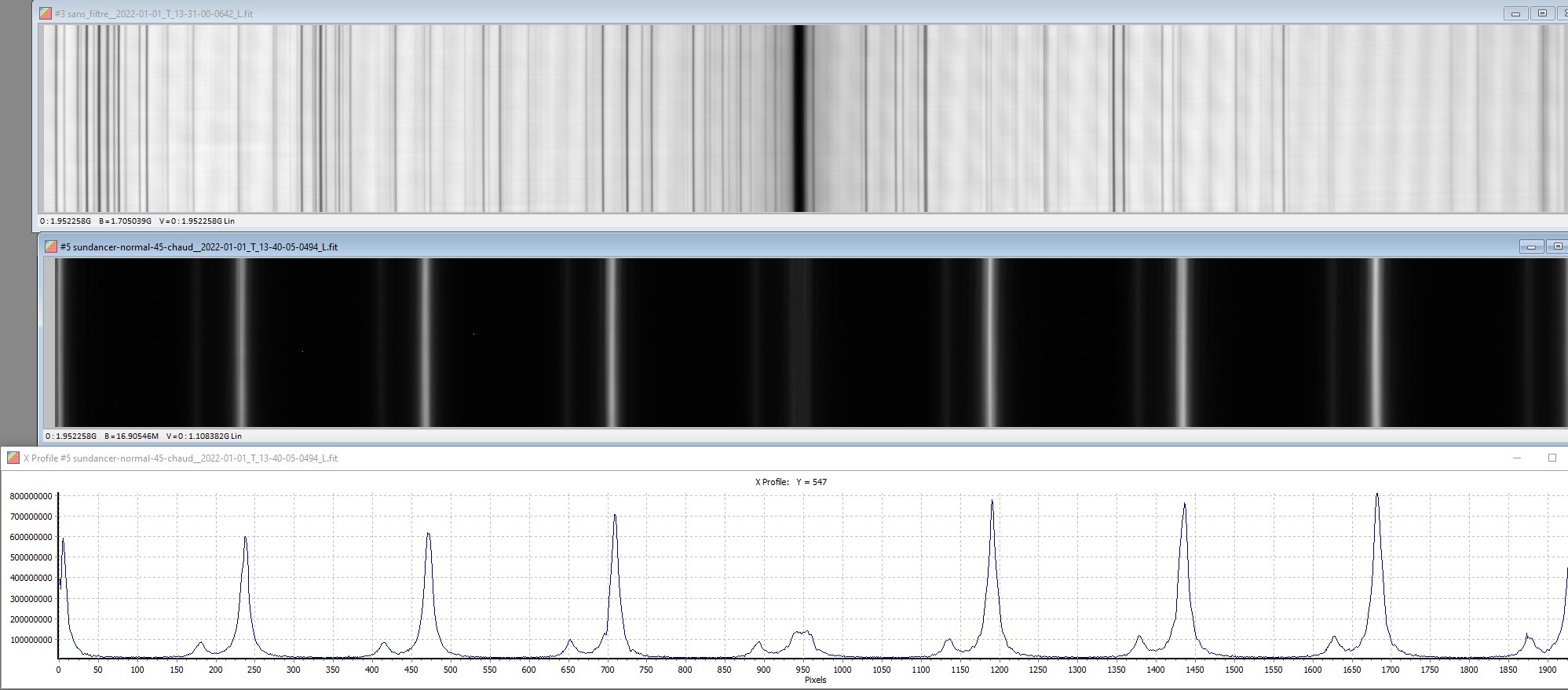
We note the presence of a faint secondary fringe system, possibly due to some leakage in the polarizing filter (the mica being bi-refringent a polarizing filter is used in the etalon stack to cut "extraordinary" rays).
The profile of each fringe is fitted with a Lorenztian function (with Fityk) in order to measure its position and its FWHM. The measure is done directly on image (2), using a profile along the X axis (only one pixel width). There is no need to divide this by the solar spectrum because of the lack of strong solar lines near each fringe. The measured FWHM is similar to one fringe to the other ± 0.05A.
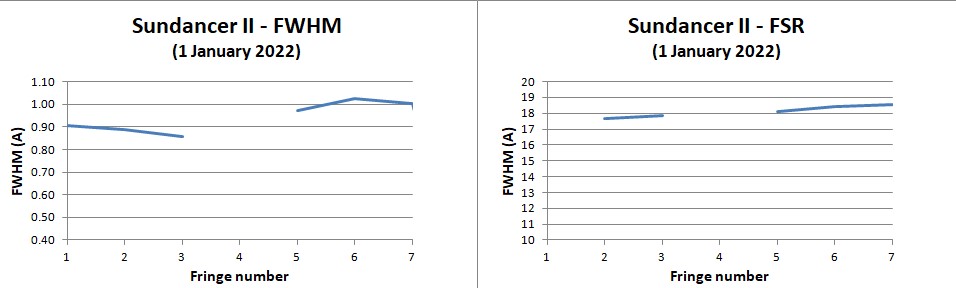
The two fringes left of Ha line are considered more relevant for the estimation of the FWHM.
Results:FWHM : 0.90 ± 0.05A
FSR = 18.1 A
(2) Test of the etalon with Sol'Ex spectrometer: measurement in telecentric beam (f/24)
Optical set-up : Sun => 55 mm f/8 Fluorite refractor => Sundancer II without its BF and telecentric lens => Sol'Ex spectrograph
Sol'Ex spectrograph : 10 microns x 4.5 mm slit, 80 mm collimating lens, 125 mm imaging lens, ASI290 camera, 12-bit acquisition.
Measured dispersion = 0.0753 A/pixel
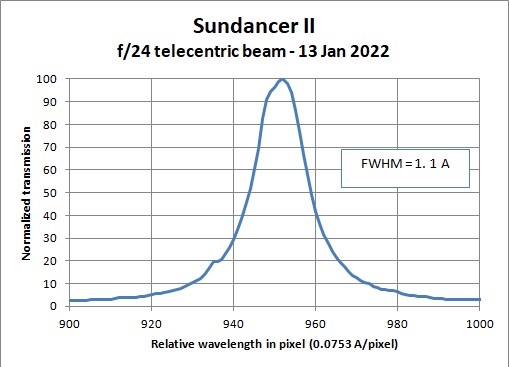
The measured FWHM of 1.1 A is consitent with a FWHM of 0.9 A in collimated beam.
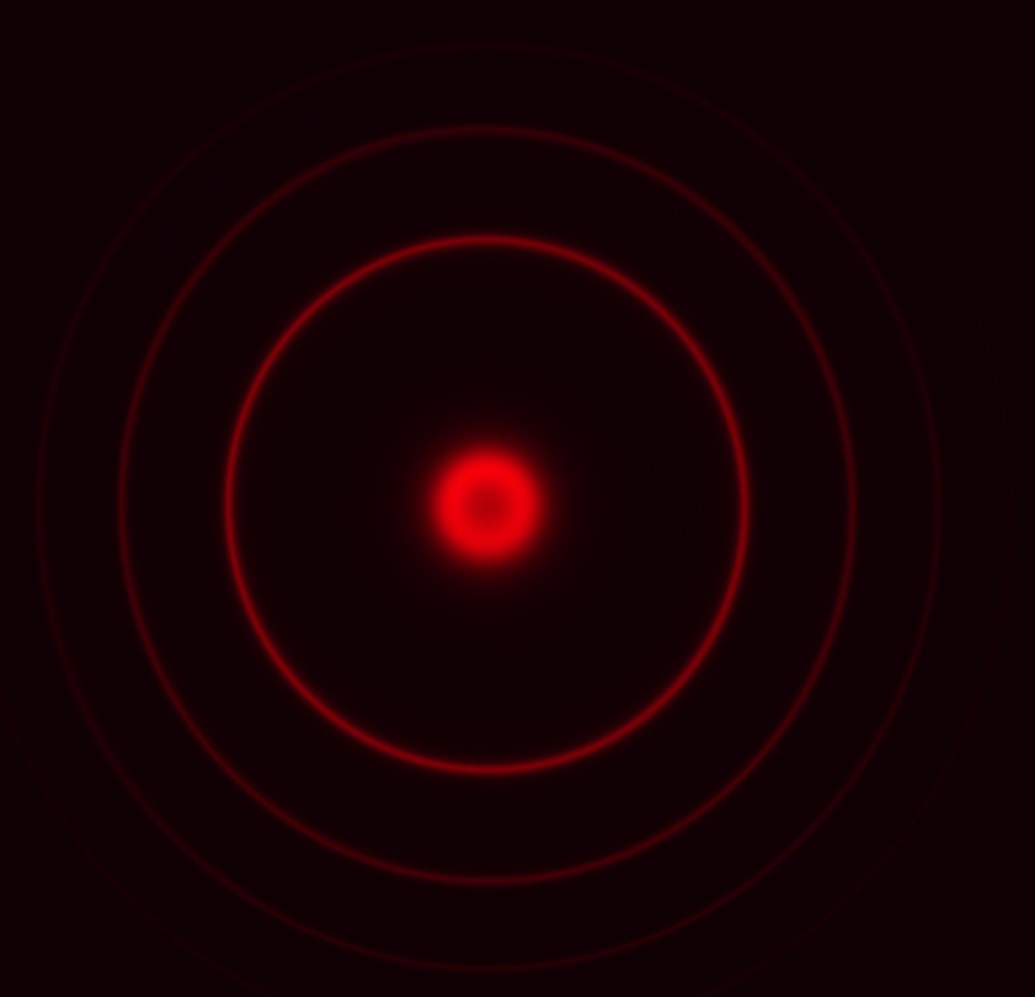
Sundancer II - Nikon Z6 - 50 mm f/1.8 at f/2 - 400 ISO - 2 s exposure - 12 bit acquisition
The CWL is not perfectly centered on Ha. No effort was taken to tune the etalon on the Ha line with the thermoelectrical unit, since there is no impact on the measurement of FWHM.
As with the spectrograph Sol'Ex, we note the presence of a faint secondary fringe system, possibly due to a lack of blockage of the polarizing filter (the mica being bi-refringent a polarizing filter is used in the stack to cut "extraordinary" rays):

Visual inspection shows that the CWL is not uniform over the aperture of the etalon. Furthermore, the width of the fringes is not uniform.
The two inner finges are curve-fitted with a Lorentzian function in order to calculate the peak position of each fringe and the FWHM of the etalon.
For the calculation of the FWHM of the etalon, we need the value of the FSR. This value was taken equal to 18.1 A from the direct measurements with Sol'Ex spectrograph. This is consistent with an index of 1.56 for the mica spacer.
The measurements were made over the full aperture of the etalon, 13 mm aperture and 9 mm aperture, as well as the etalon heated or cold. Results remain unchanged to about ±0.1 A.
Results :

(4) Test in collimated beam and Ha lamp
Optical setup: Ha lamp => Fluorite 55 f/8 (collimated beam, 5 mm aperture stop) => Nikkor Z 85 mm f/1.8 S focussed on etalon surface
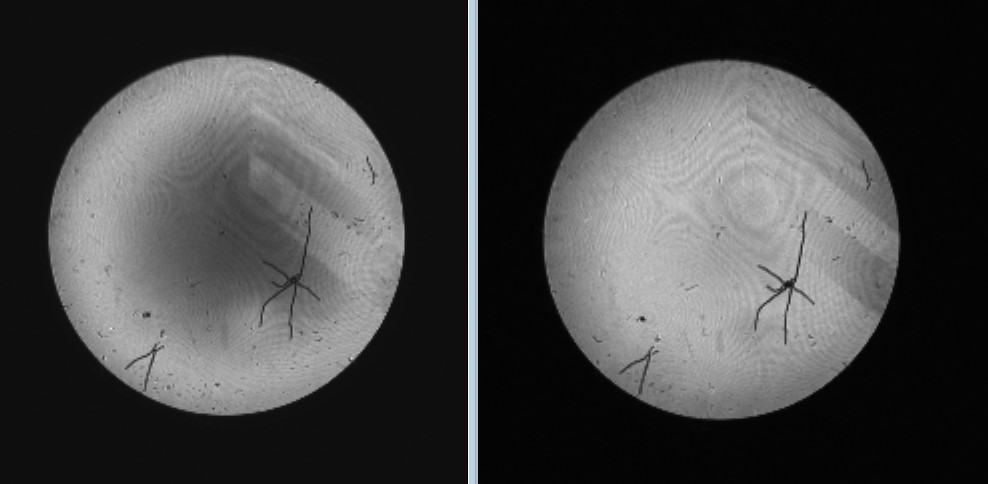
18 Jan 2022
Left: etalon close to temperature balance. The outer rim is warmer than the central part of the etalon.
Right : etalon at target temperature.
Some interference fringes are visible as well as low amplitude cleavage defaults. All of this has no impact on the observation.
Visual appearence of the default developing in the etalon (manufacturing issue).
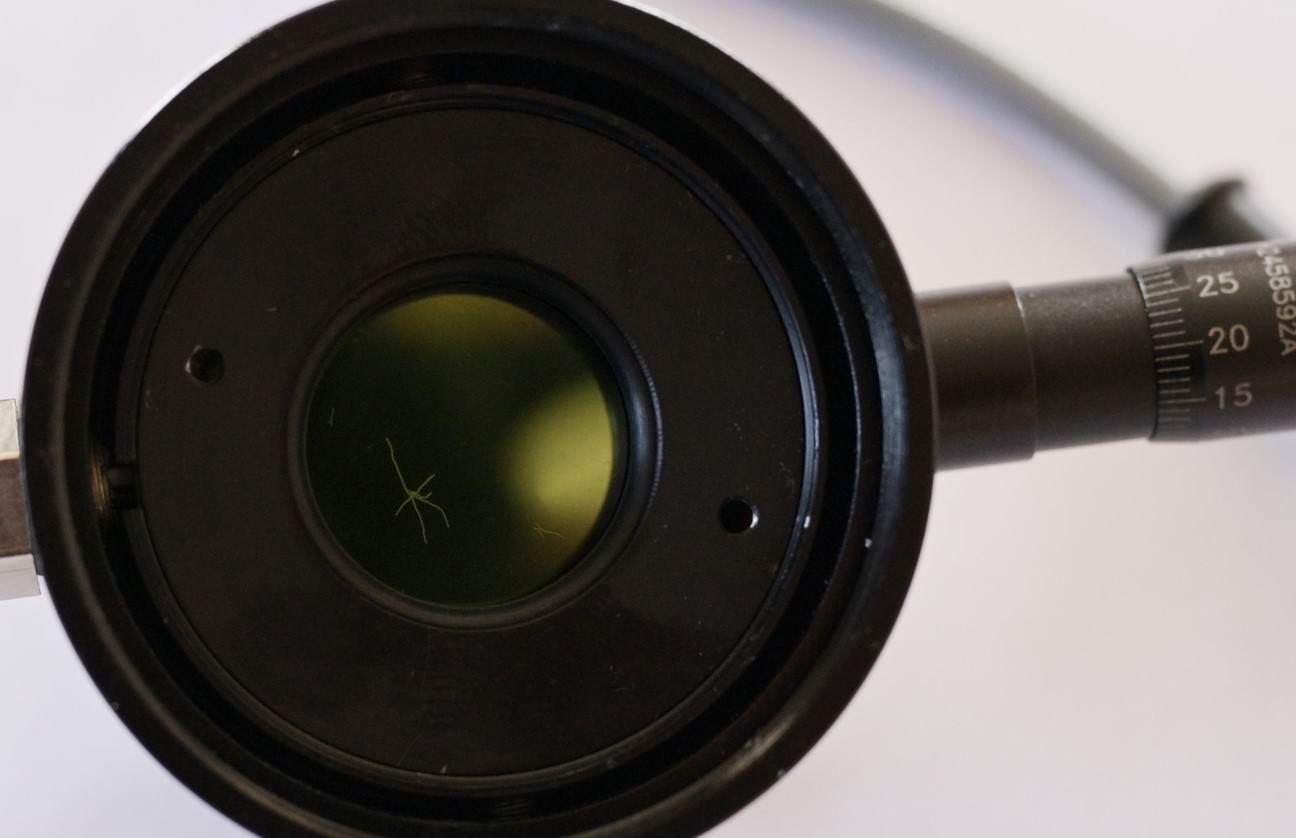
(5) Measurement of the BF profile with Sol'Ex spectrometer
Optical set-up : Sun => Fluorite 55 mm f/8 - Sundancer II BF and telecentric (without the etalon) => Sol'Ex spectrograph
Sol'Ex spectrograph : 10 microns x 4.5 mm slit, 80 mm collimating lens, 125 mm imaging lens, ASI290 camera, 12-bit acquisition, dispersion = 0.0753 A/pixel
13 January 2021
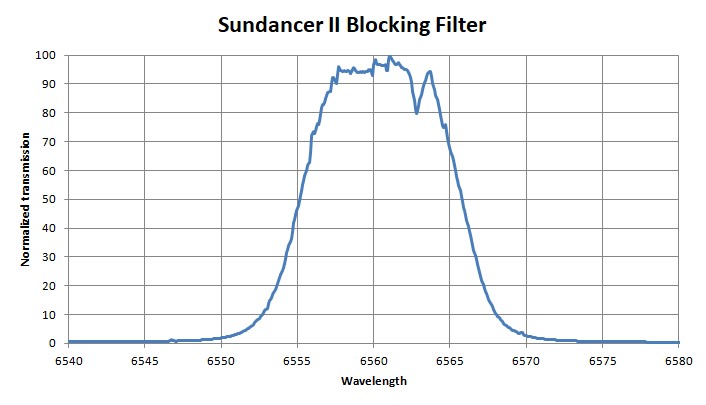
Result:
FWHM = 10.9 A
Bandwidth at 10% peak transmission = 15.4 A
3-cavity filter
Delta CWL = -2.0 A
(4) Test in collimated beam and Ha lamp
Optical setup: Ha lamp => Fluorite 55 f/8 (collimated beam, 5 mm aperture stop) => Nikkor Z 85 mm f/1.8 S focussed on etalon surface
18 Jan 2022
Left: etalon close to temperature balance. The outer rim is warmer than the central part of the etalon.
Right : etalon at target temperature.
Some interference fringes are visible as well as low amplitude cleavage defaults. All of this has no impact on the observation.
Visual appearence of the default developing in the etalon (manufacturing issue).
(5) Measurement of the BF profile with Sol'Ex spectrometer
Optical set-up : Sun => Fluorite 55 mm f/8 - Sundancer II BF and telecentric (without the etalon) => Sol'Ex spectrograph
Sol'Ex spectrograph : 10 microns x 4.5 mm slit, 80 mm collimating lens, 125 mm imaging lens, ASI290 camera, 12-bit acquisition, dispersion = 0.0753 A/pixel
13 January 2021
Result:
FWHM = 10.9 A
Bandwidth at 10% peak transmission = 15.4 A
3-cavity filter
Delta CWL = -2.0 A
Back to narrowband filter testing