12 August 2026
Pedrosa del Principe - Carrasquillo wind farm - Turbine 4 - Spain
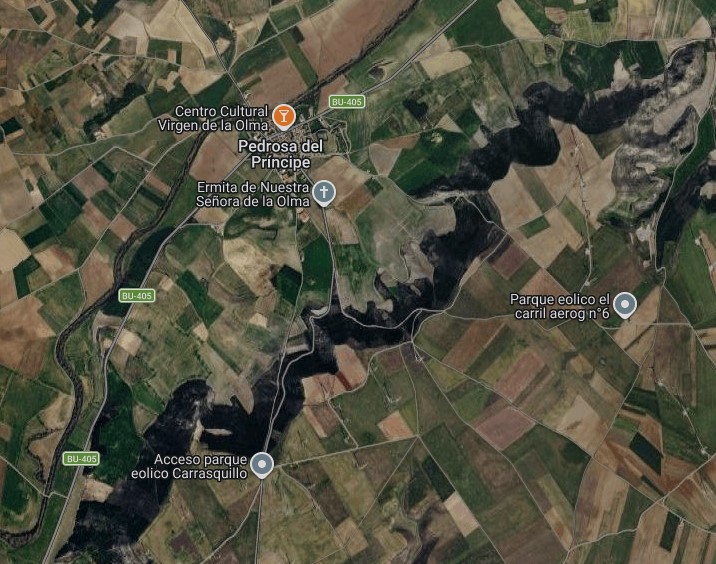
Local circumstances
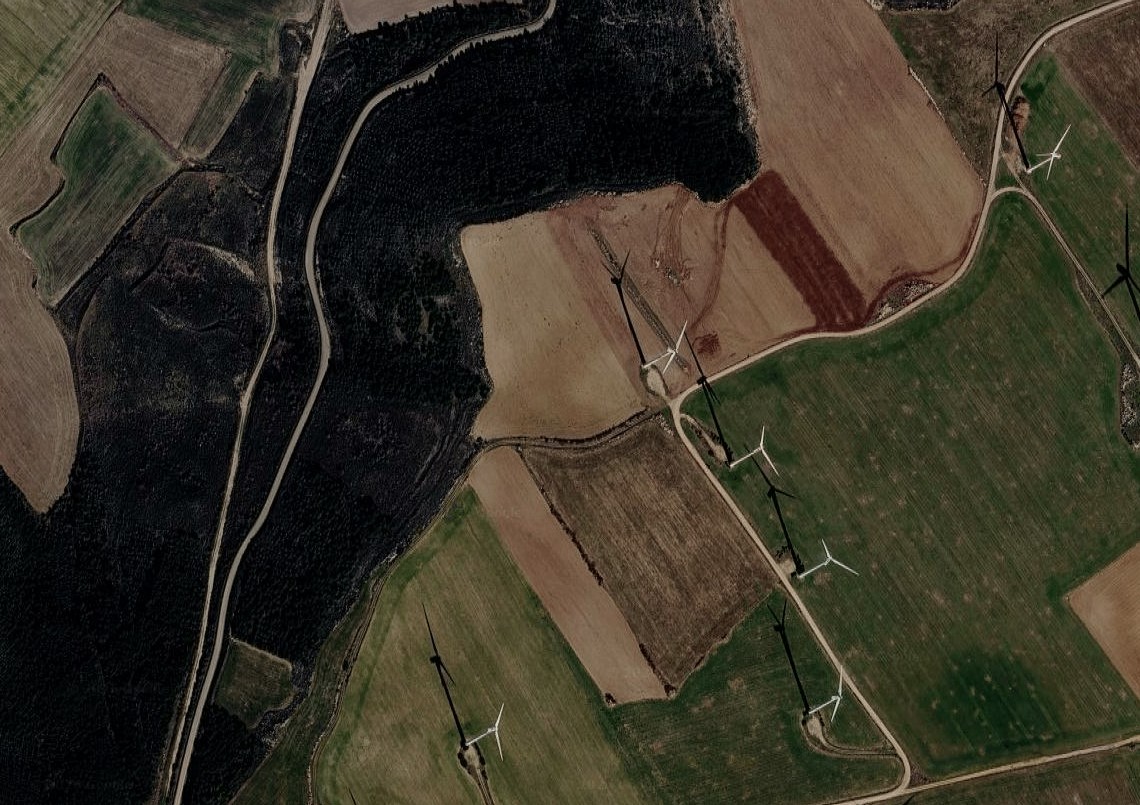
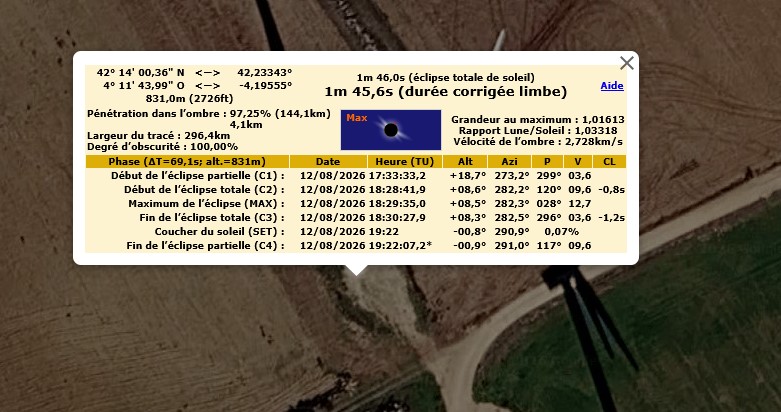
Location (on site GPS measurement) : North +42° 13' 59", West 4° 11 43"
Duration of totality : 1mn 46s
Conditions of observation
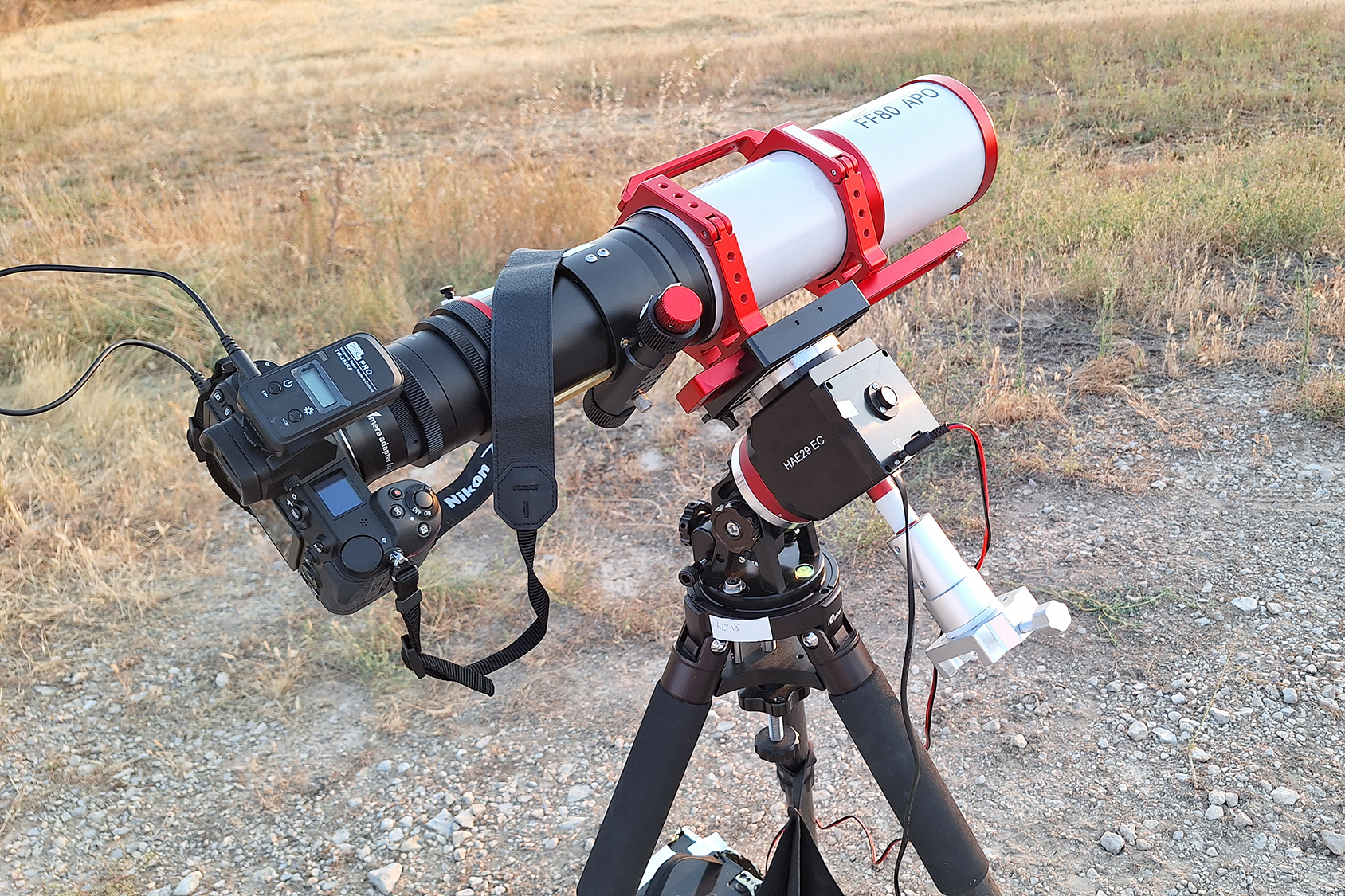
Equipement :
ZWO FF 80/600 refractor with 75 mm aperture stop (to avoid glare). Regular check of focus up to about 5 min before totality.
Nikon Z7II, 14-bit RAW mode (non destructive compression), electronic shutter mode. Pixel size = 4.35 micron. Image scale = 1.5 arsec/pixel.
Exposure time for partial phase : 1/8000 s to 1/1000 s with Astrosolar ND 3.8.
Exposure times for C2 : 1/4000 s to 1/60 s (7 EV bracketing at 1 EV interval) 7 frames taken in burts mode at 1 s interval.
Exposure times for totality : 1/250 s to 1 s (9 EV bracketing at 1 EV interval, 9 frames taken in burst mode. Remote control = 3 s push trigger + 1 s interval between two successive triggers.
Mount : iOptron HAE29EC. Latitude set with an inclinometer. Azimut set using the Sun shadow when the Sun crossed the meridian.
Sky conditions :
- no cloud, blue sky but with low transparency and heavy obscuration and diffusion due to the Sun low elevation (8°). The solar corona appeared brownish.
- no wind.
The ESF (Edge Spread Function) can be measured directly as the radial profile of intensity accross the lunar limb.The PSF is the derivative of the ESF.
It was calculated on the G channel. The derivative profile was then fitted with a gaussian curve with Fityk software. The result is an FWHM of 2.6 pixels (or 3.9 arsec), measured on a single shot image taken 15 min before the eclipse, and 2.5 pixels (or 3.75 arsec) on a single shot image taken during totality.
The FWHM of the 6.8 mag star sout-west of the Sun with measured on the registered stack HDR image: FWHM = 3.0 pixel = 4.5 arcsec.
Limiting magnitude :
About 7.8, measured on the 35 s cumulated exposure HDR stack.
1) Pre-processing
- flat/offset correction,
- hot pixels correction (home-made Julia script).
2) Registration of the image on solar corona
- step 1 : registration of lunar disk on the 1 s exposures,
- step 2 : registration of all images on the basis of the Sun and Moon ephemerides.
3) HDR processing
- home made Julia script,
- calculation done in floating 64-bit, output fit file saved in 32-bit integer,
- image weight function = sinus function (except for 1 s, 1/125s and 1/250 s exposures),
- sensor response function is assumed to be linear (see measurement here : ../2024-Mexique/Mexique2024.html ).
4) Display of HDR image
Different algorithms have been compared (see below)
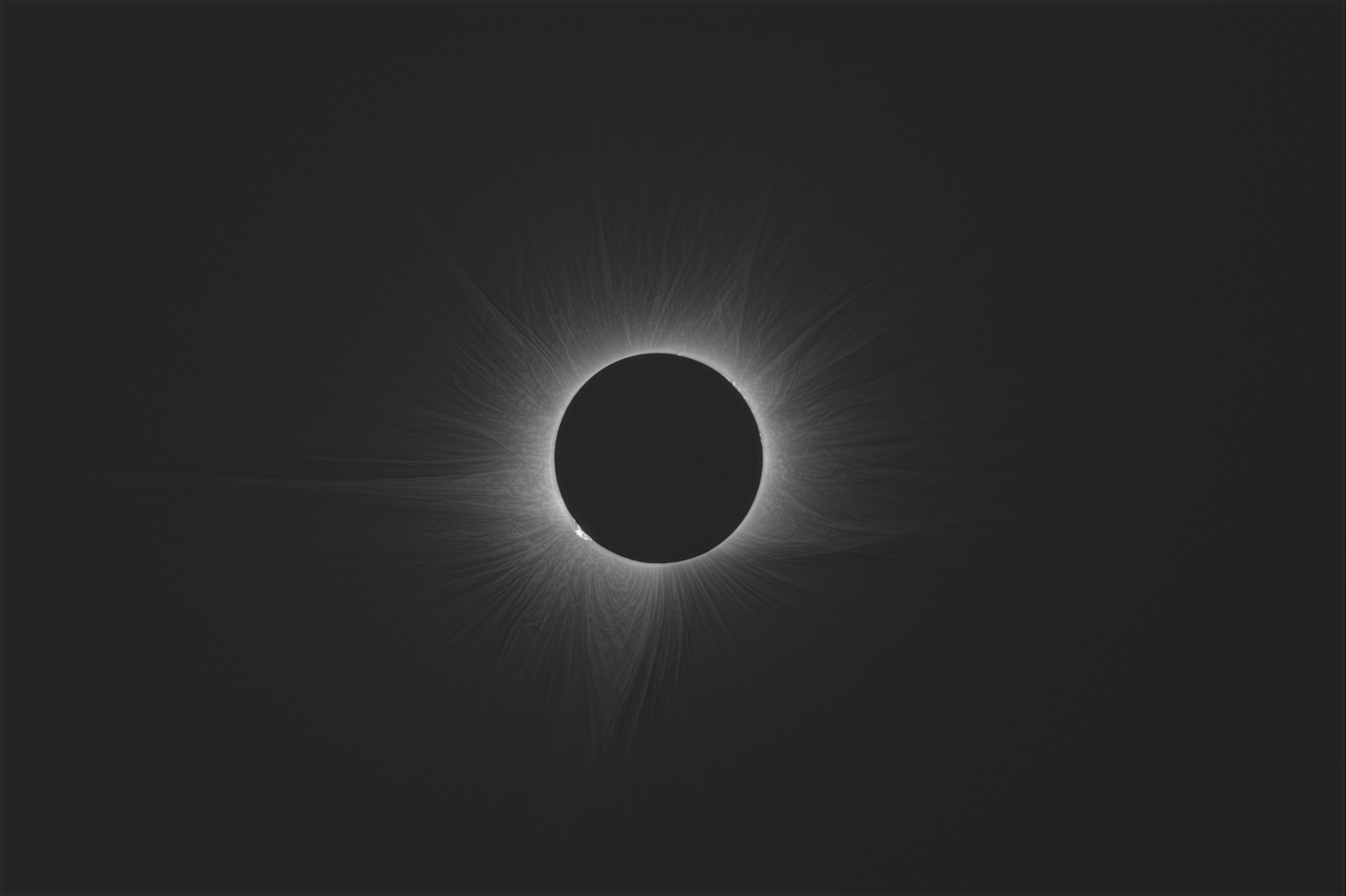
Mid-exposure = mid-totality 18:29:35 UT
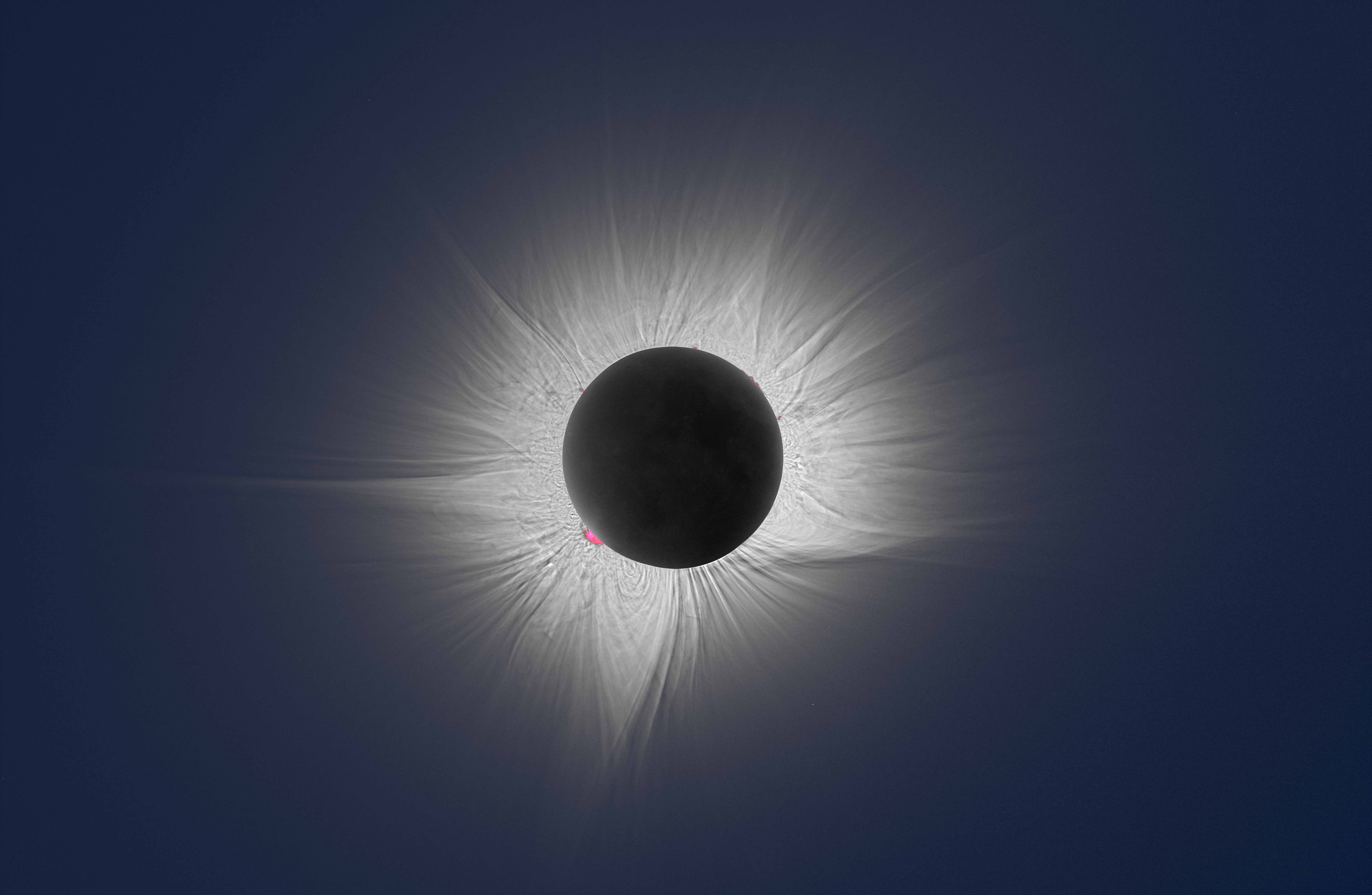
Stack of 162 frames : 18 x 9 exposures from 1/250 s to 1s (at 1 EV interval), from C2 + 11s to C3 - 17 s, cumulated exposure = 35 s
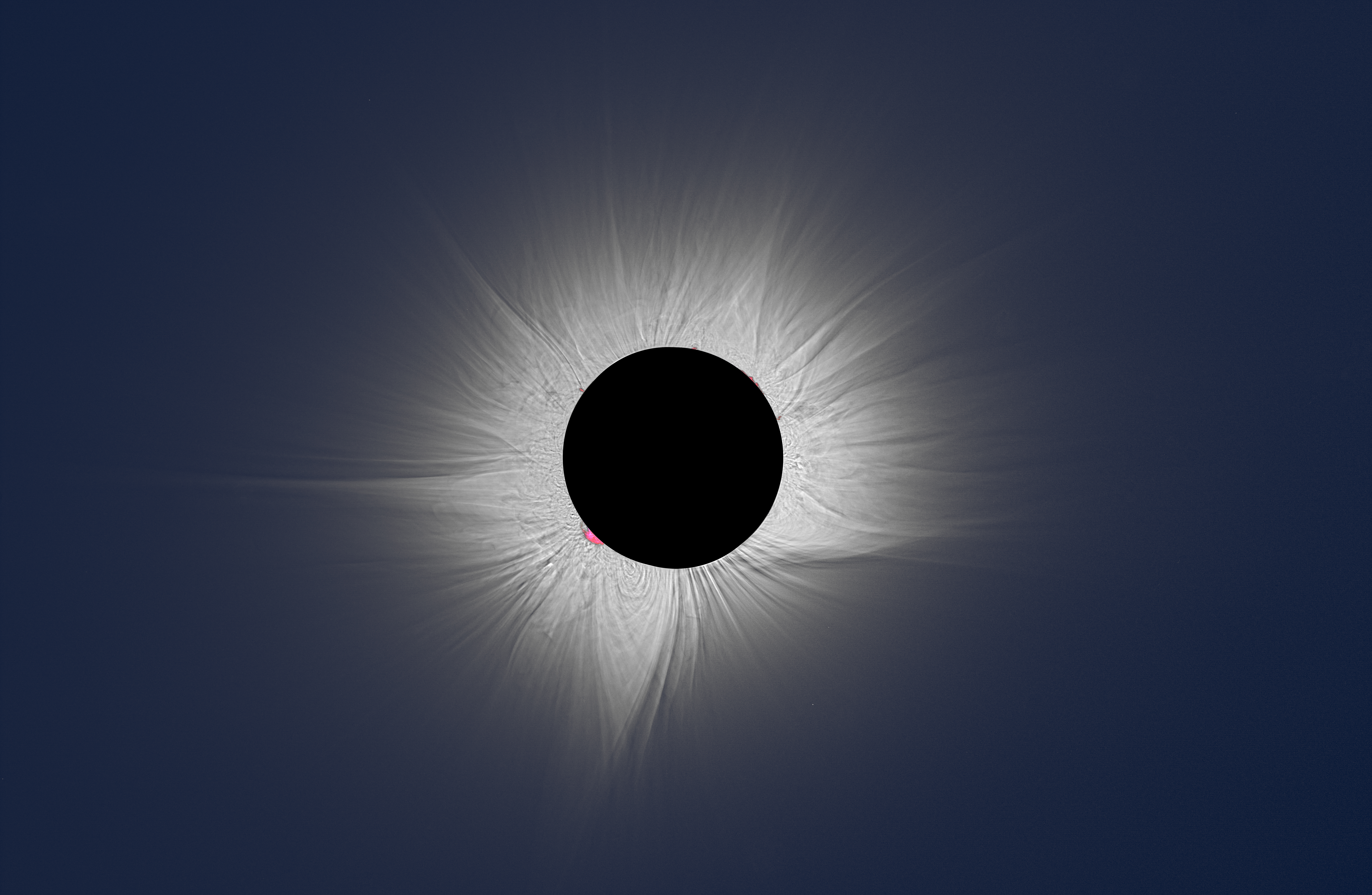
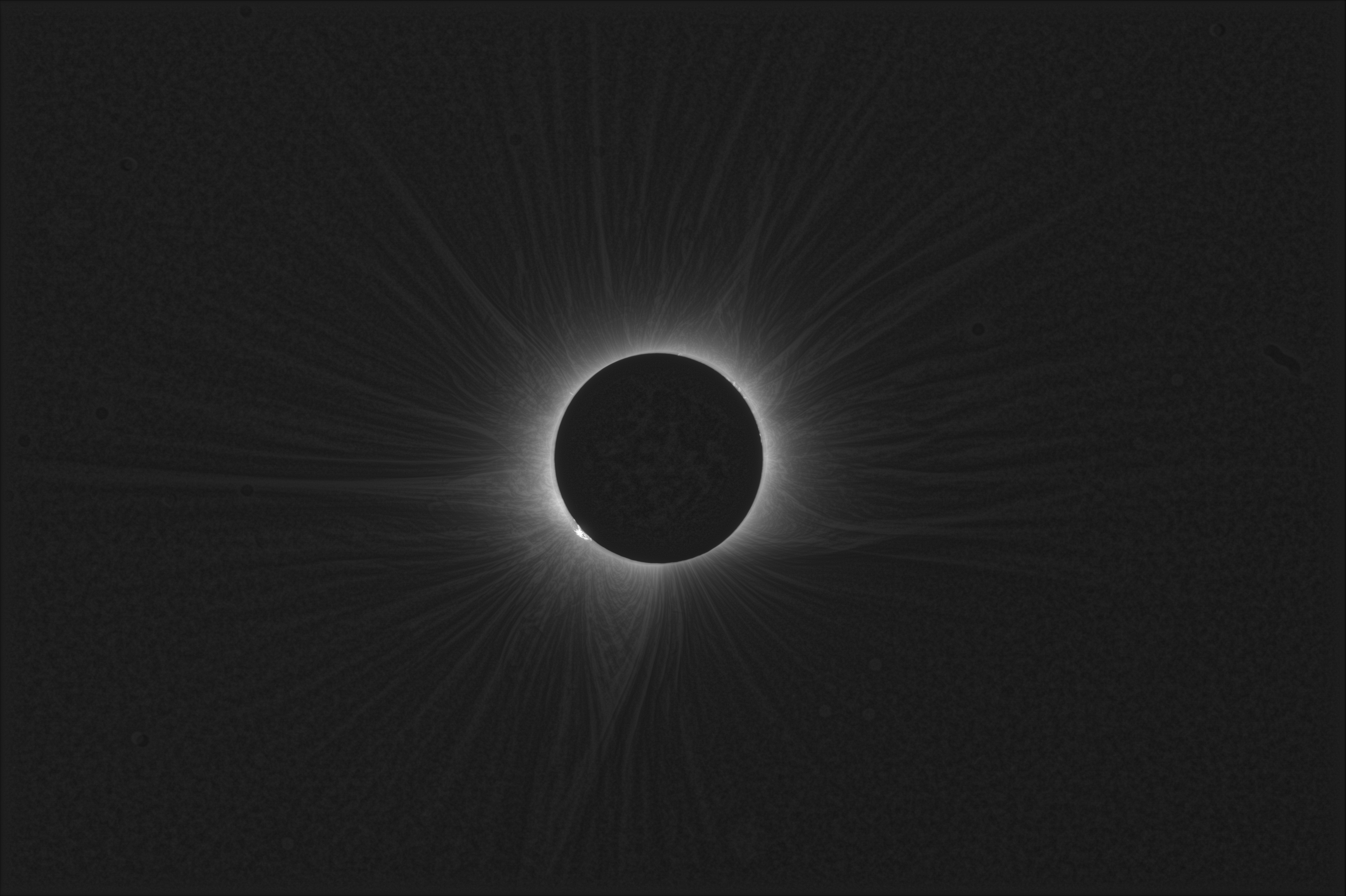
Processing : multi-scale gaussian mask (intensity based) + multi-scale unsharp mask (radius based)
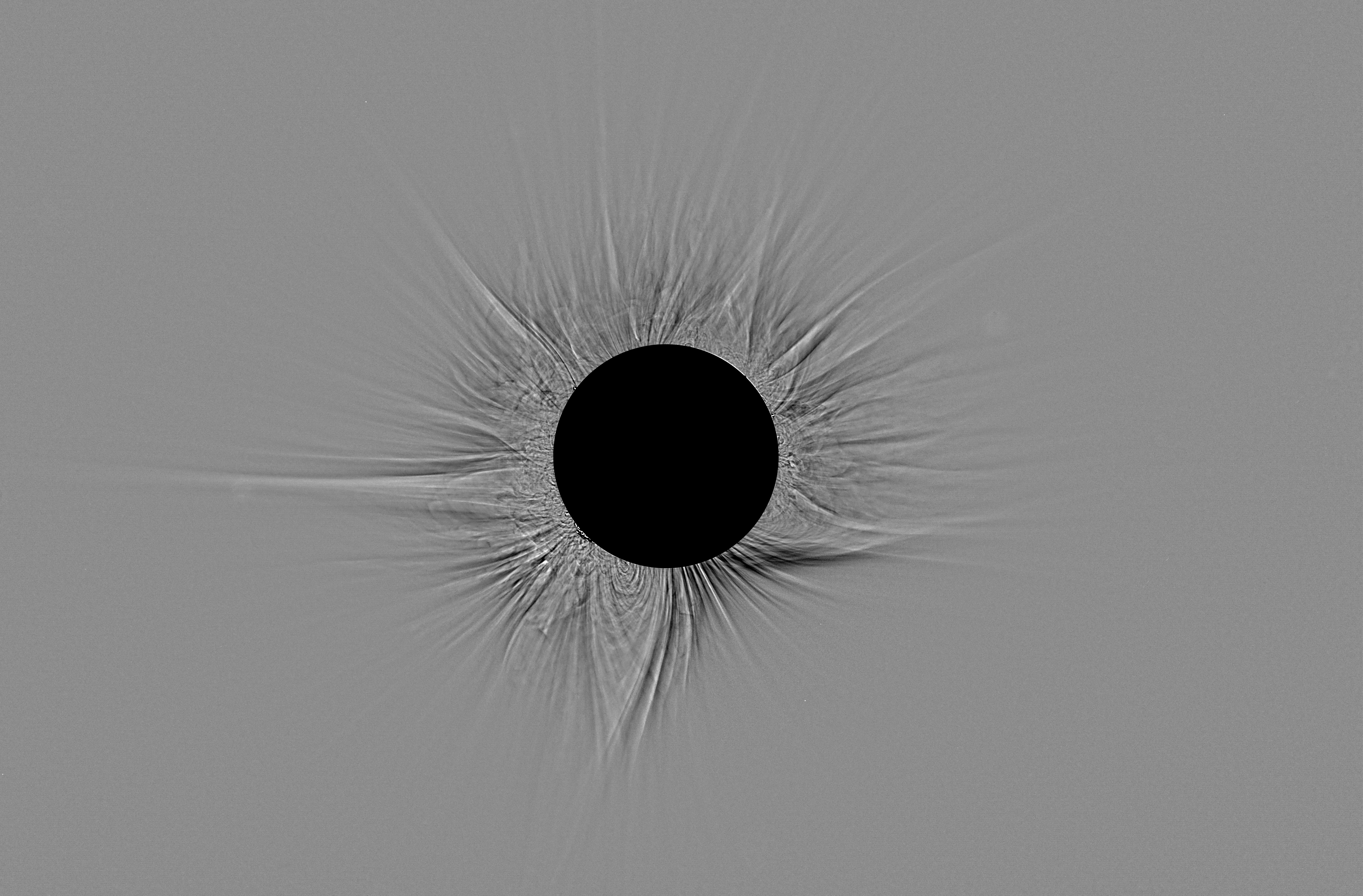
BW version - low contrast
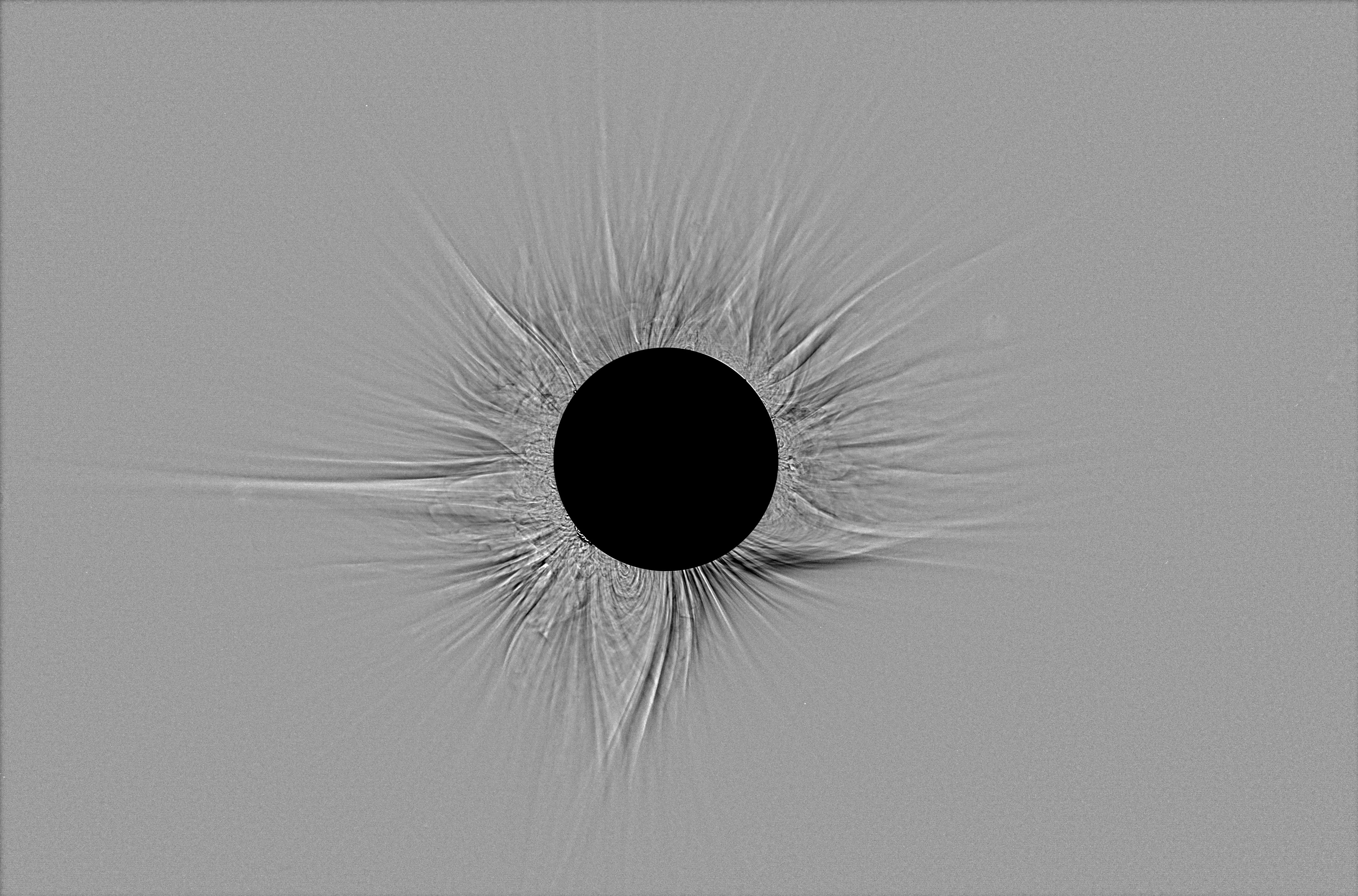
BW version - larger contrast
Stars are visible to only about mag 8 due to the 8° elevation of the Sun (reduction of transmission due to atmospheric is about absorption 16×)
Overview of the processing (visualization of the corona details)
The weighting factor depends on the intensity of the pixel. The brighter the pixel, the higher the weigth of the mask with the smallest sigma (because brighter details are closer to the solar limb and smaller in size).

Notes:
- a large value sigma increases the visibility of long streamers and large scale structures away from the solar center (and decreases apparent noise in the resulting image),
- a small value of sigma increase the contrats of small size details in the inner corona,
- four values of sigma are used (typically from 7 to 30 pixels)
- the offset increases/lowers the effect of the division.
NB : partial convolution is use to avoid ring effect near the lunar limb (as described in Jonathan Hill video).
https://www.cloudynights.com/forums/topic/1005428-photo-collaboration-for-aug-12-tse/
Link to an older techical presentation about processing the eclipse images (in French)
Julia script for multi-scale unsharp mask (radial based)
Julia script for colorization of the BW image
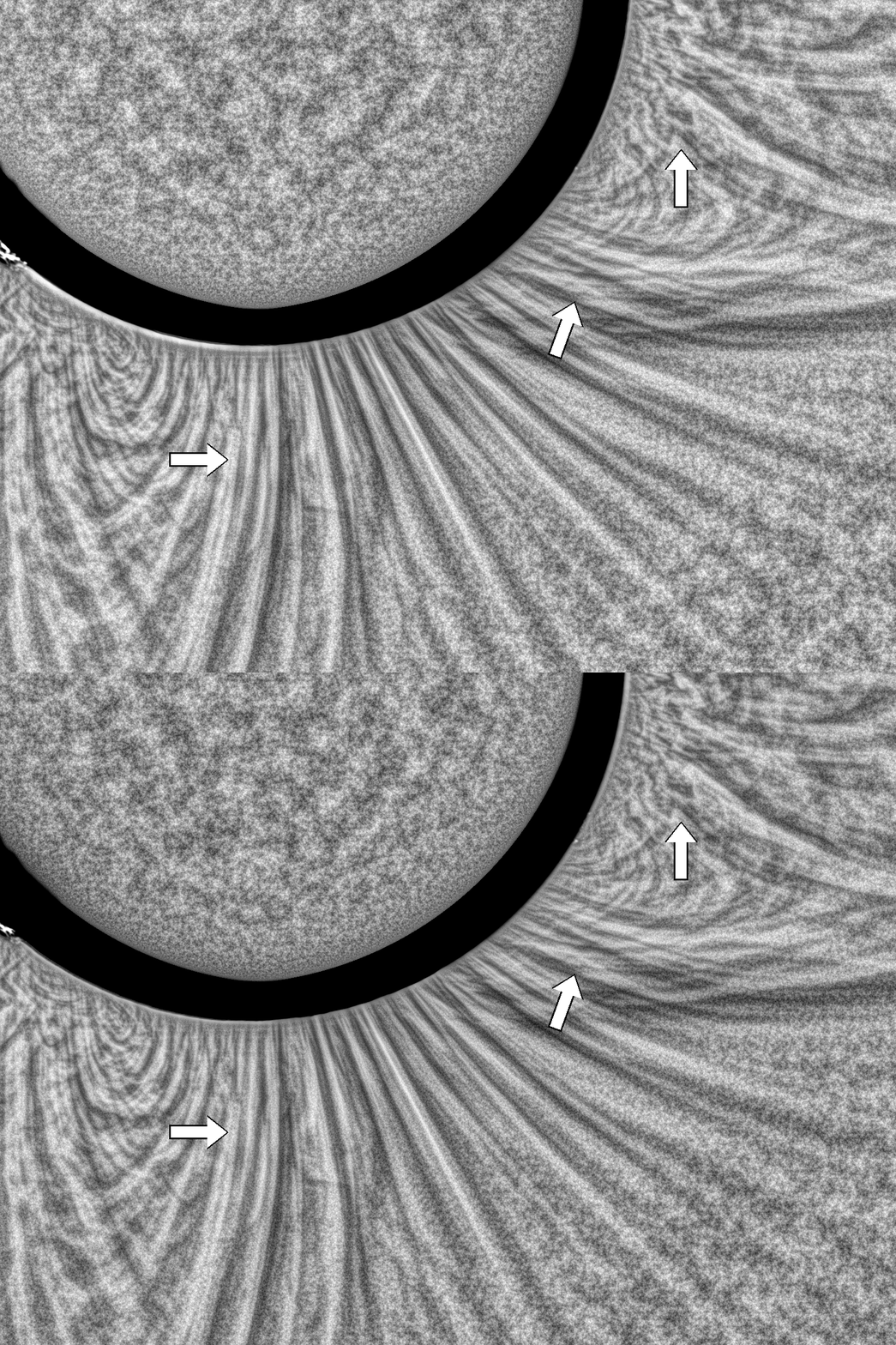
Motions in the south limb
Radial expansion along 6 o'clock PA and, possibly along 4 o'clock PA.
36s delays between the mid-exposure of each image (18:29:11 and 18:29:47).
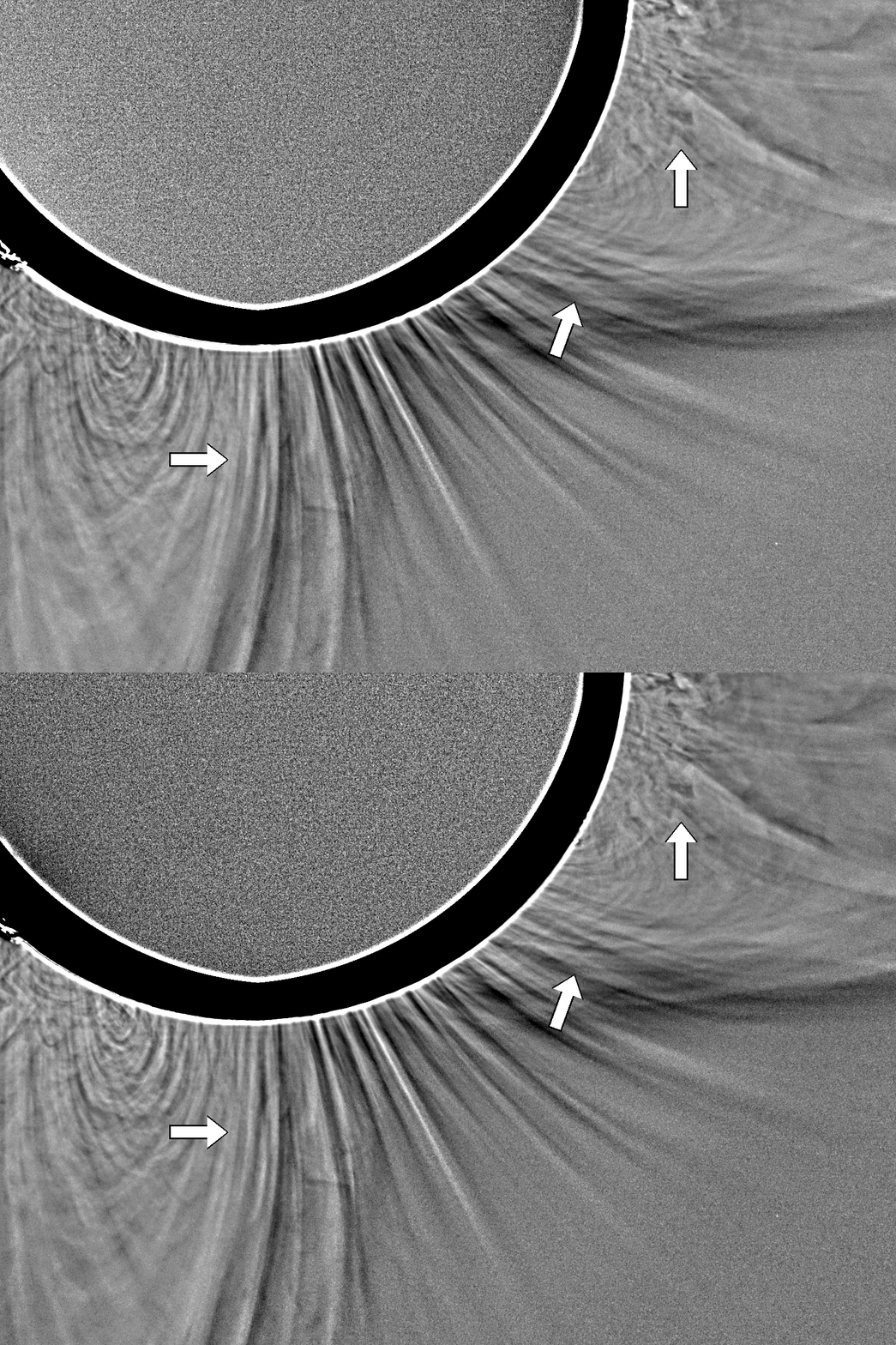
Same two images with WOW algorithm:
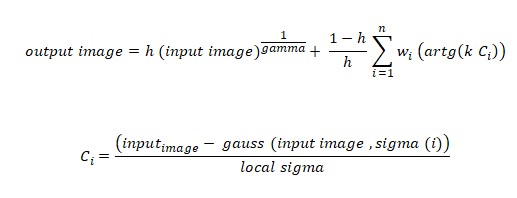
Multi Gaussian Normalization (MGN) algorithm
M. Druckmuller. Multi-Scale Gaussian Normalization for Solar Image Processing (2014)
Python code from Sunpy/Sunkit lib : https://docs.sunpy.org/projects/sunkit-image/en/latest/generated/gallery/index.html
Julia script
Parameters:
scales = [7, 7 ,7 , 10, 20, 30, 40], k = 0.3, gamma = 4.2, h = 0.92
Wavelet-Optimized Whitening (WOW) algorithm
F. Auchère. Image enhancement with wavelet-optimized whitening. Astronomy & Astrophysics (2022)
Python code from Sunpy/Sunkit lib and F. Auchère's Github.
Julia script
WOW parameters:
scale number = 5, h = 0.995, gamma = 3.2, noise reduction, whitening
Additional noise reduction was applied with Noise Xterminator (parameters : 40-10)
Julia script for WOW
Normalizing Radial Grade Filter (NRGF) algorithm
Original Python code from Sunpy/Sunkit lib.
The code was modified in order to avoid numerical artefacts when the "rings" used for calculation of the radial reach the border of the image. In this part of the mask, the profile of the mask is extrapolated by an Hermite function (two anchors points are set to keep continuity of intensity and slope and avoid numerical artefacts).
Furthermore, the radial intensity mask is filtered with a gaussian (2.5 pixels) to remove high frequency numerical noise.
Julia script with standard NGRF (input image is divided by radial intensity mask and normalized by radial rms mask)
Julia code with simplified algo : input image is only divided by radial intensity mask
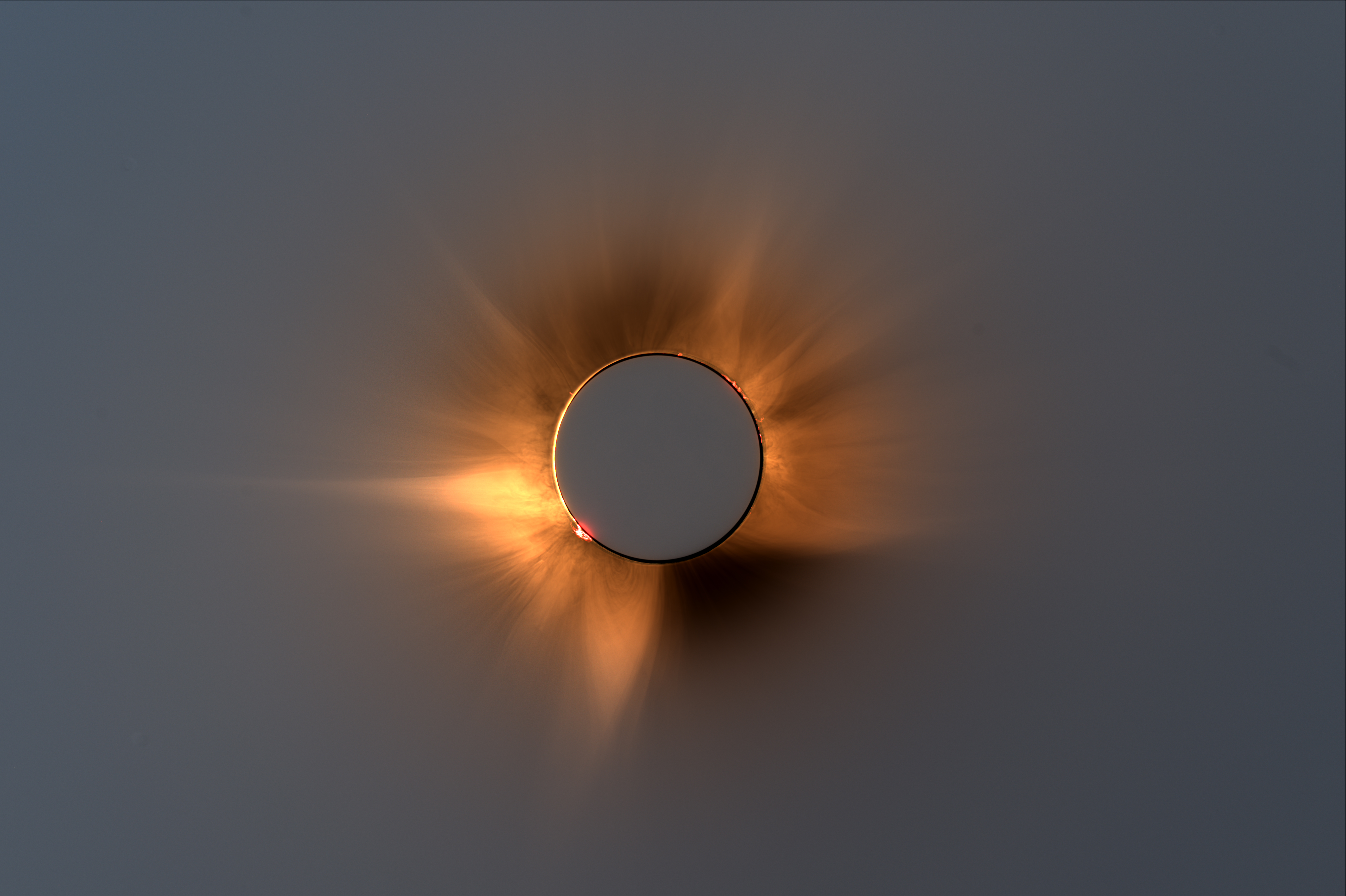
Use of radial intensity mask only.
(FNRGF) algorithm
No complete code was found on the Internet.
The Julia script was written with Claude based on Sunkit/Sunpy code and on the description of the algorithm presented in H. Druckmullerova PhD Thesis.
Julia code
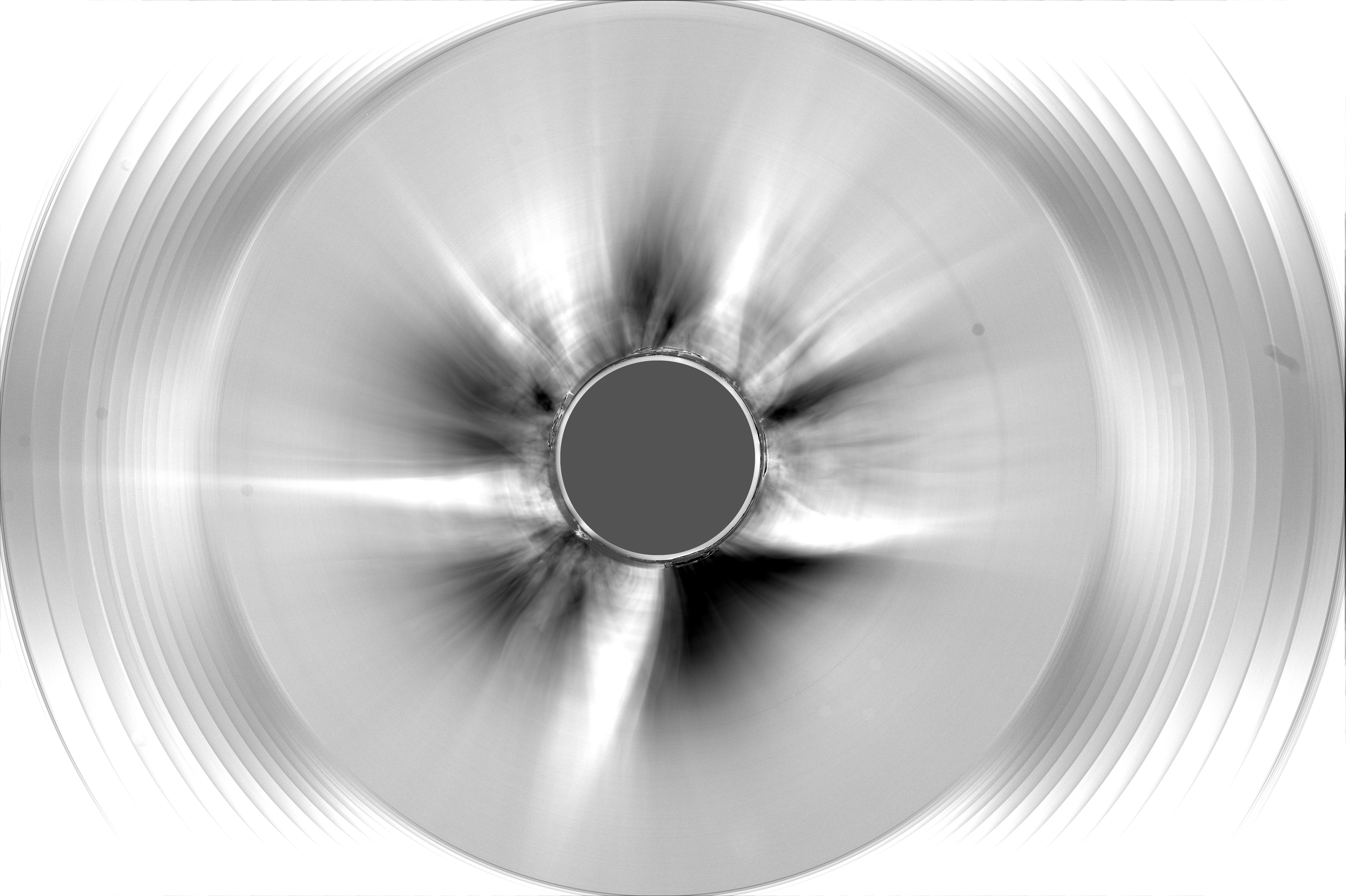
The image suffers from very strong circular numerical artefact due, in particular, to the lack of smoothing from one radius for the next. The issue was mentionned in H. Druckmullerova PhD Thesis.
A potential evolution could be to smooth radially the Fourrier coefficient of the rms of the "rings".
C2 and C3 Contacts
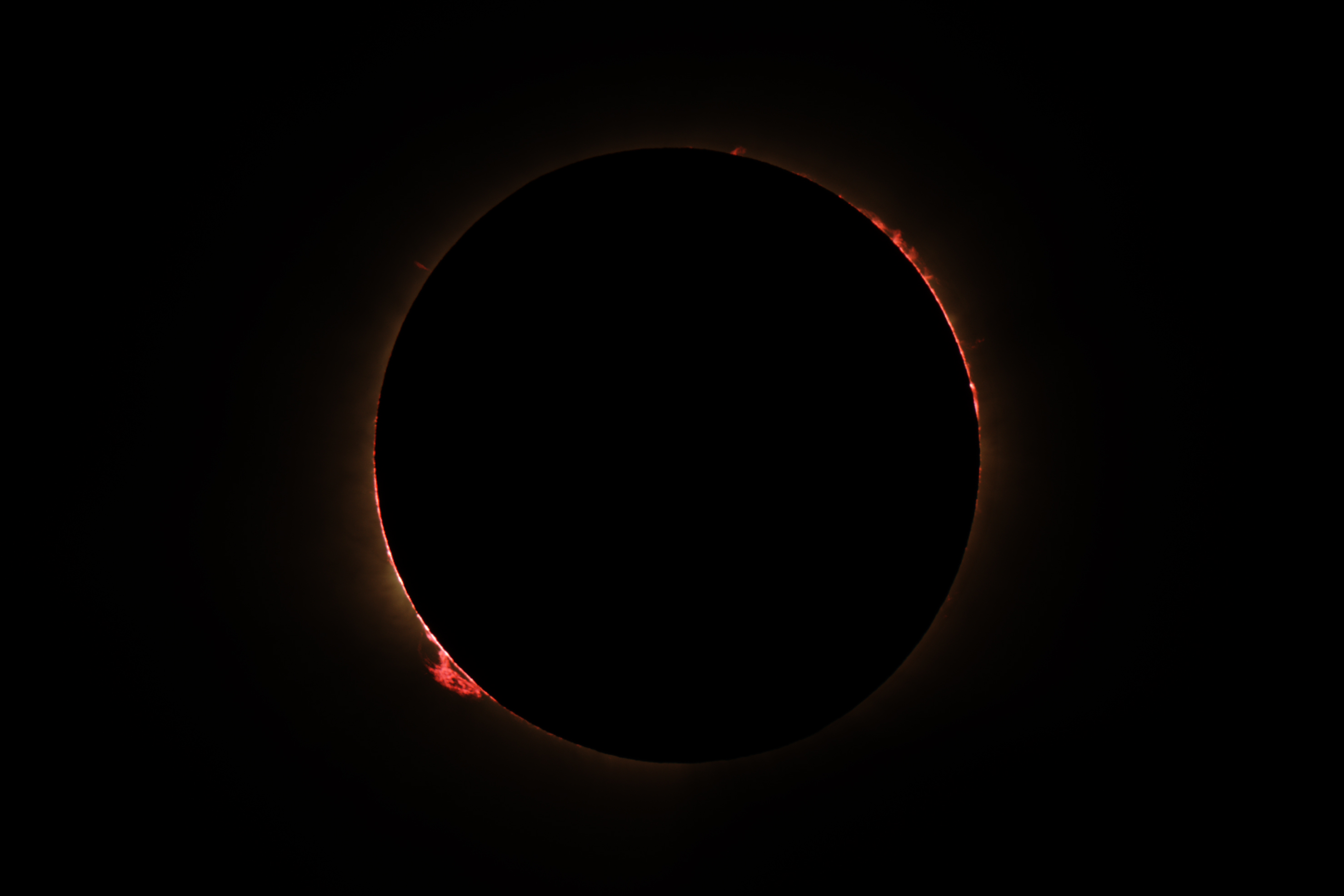
Composite image made of two 1/125 s images taken at C2 and C3 - natural color
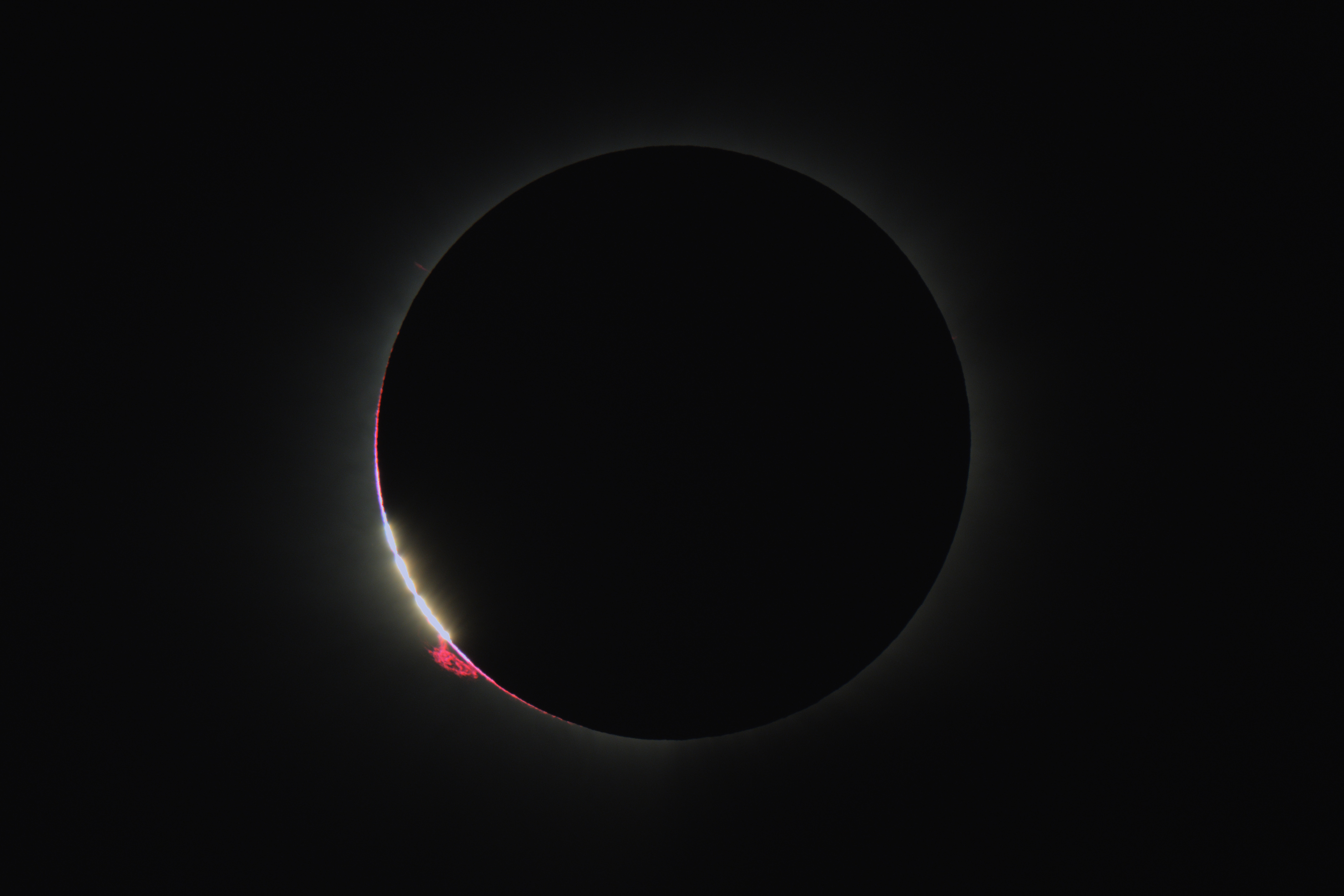
6 s before C2 - 1/250s - color corrected from atmospheric absorption- asinh vizualisation
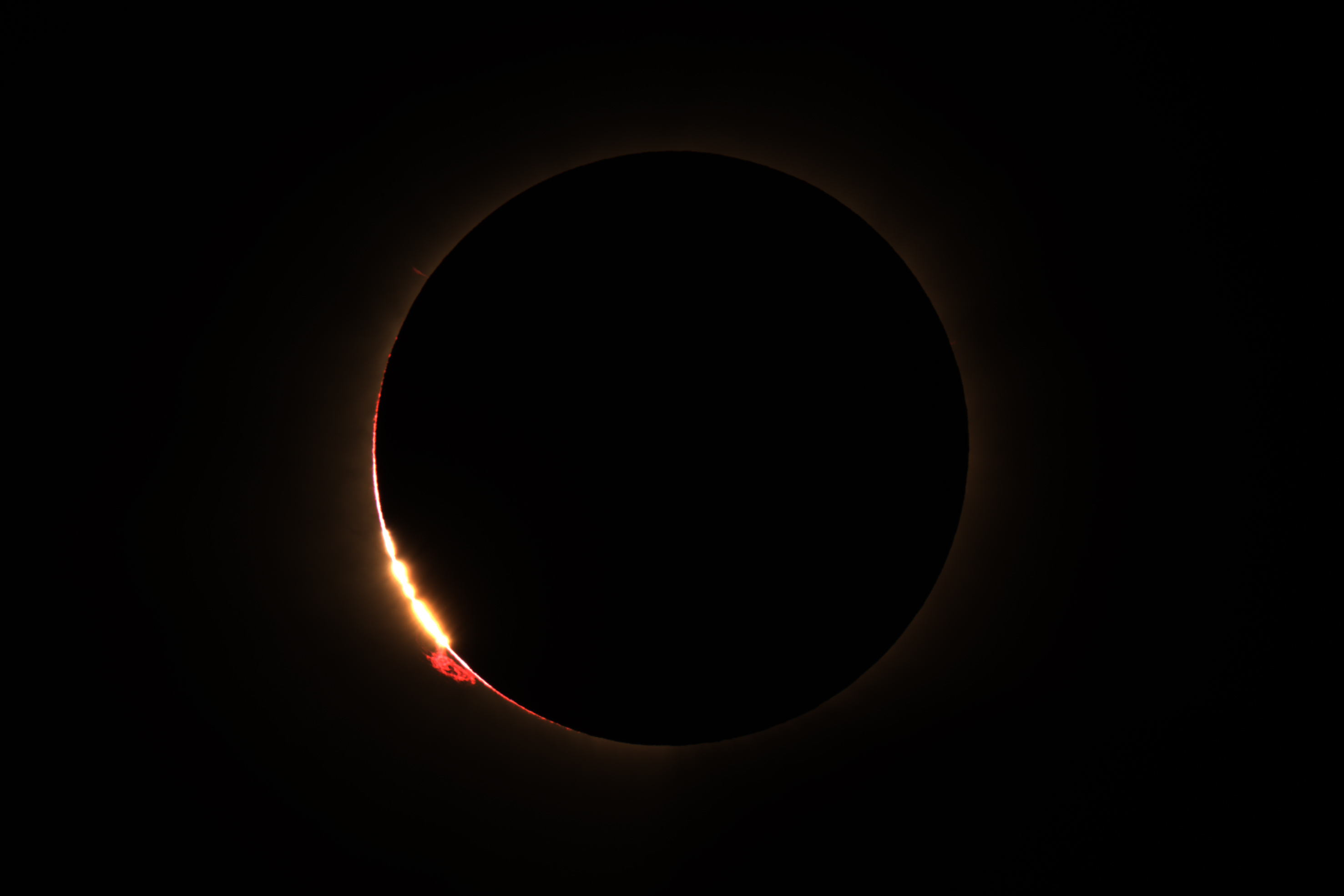
6s before C2 - 1/60 s - natural color
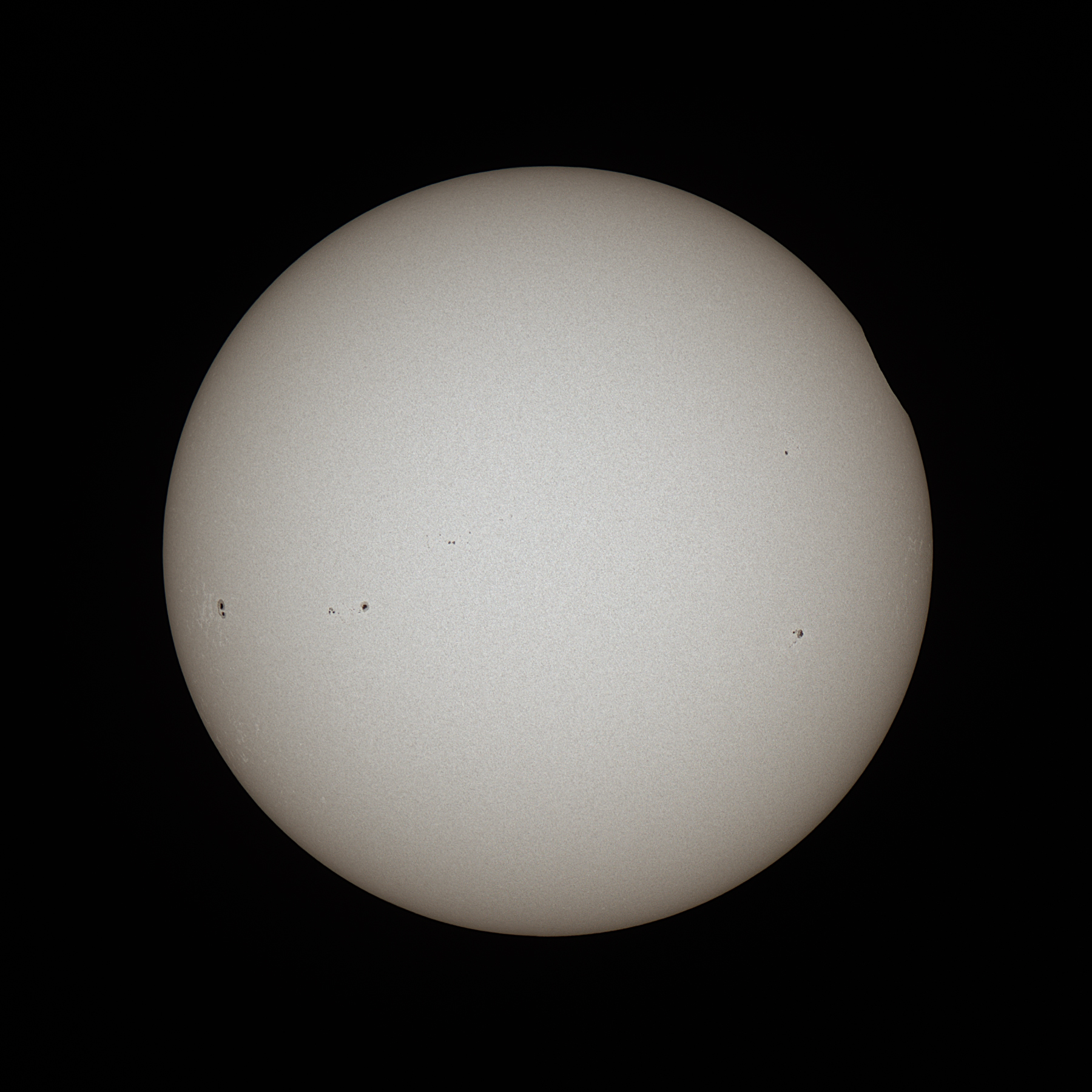 20 frames × 1/5000 s |
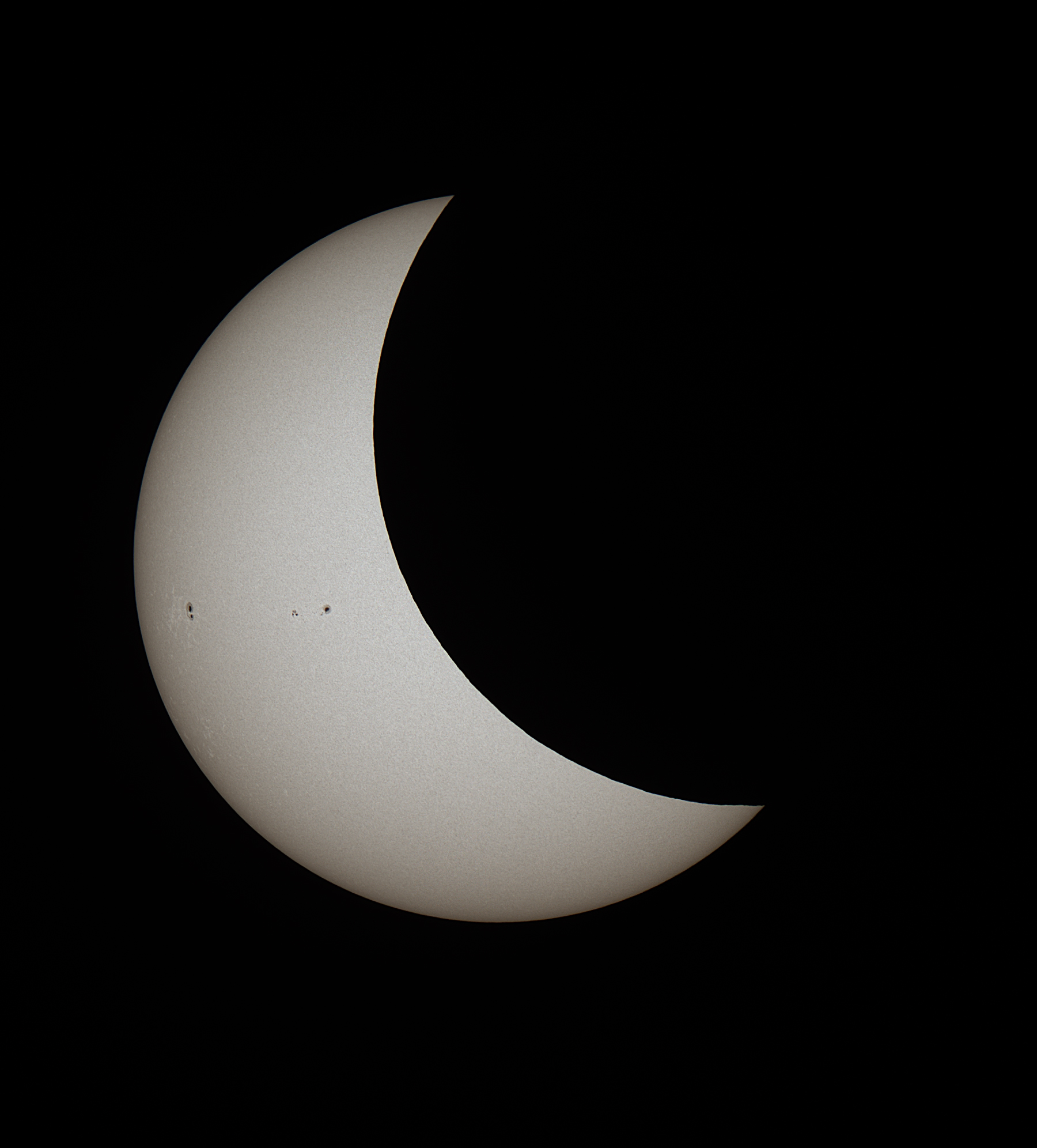 20 frames × 1/2000 s |
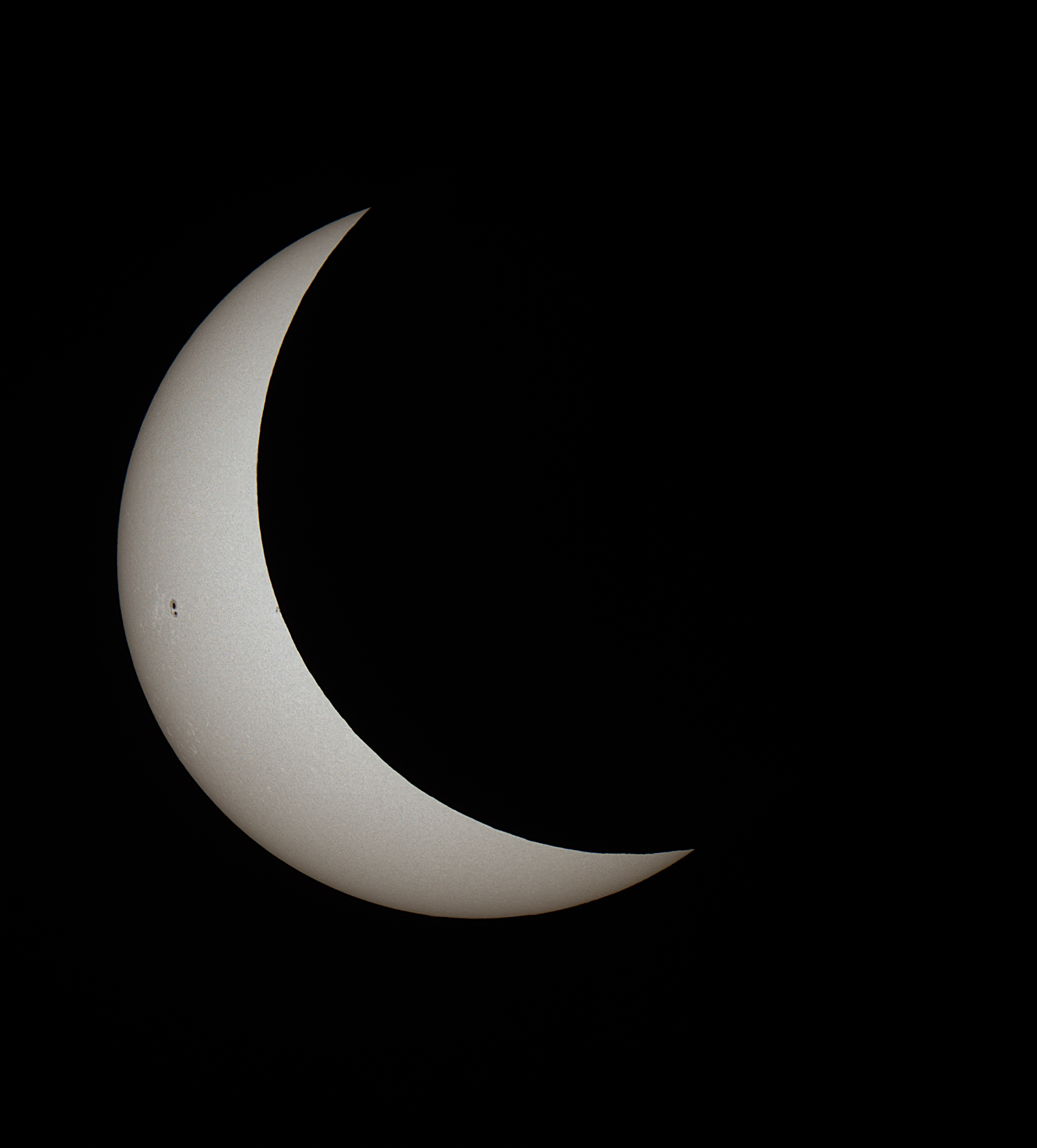 20 frames × 1/2000 s |
All images are copyright Christian Viladrich