| Test method | f-ratio | Surface sampled | FSR | FWHM | Delta CWL | Note | |
| Heliostar 76 mm (#2) |
Spectro - SHG700 (fc=125 mm, fi=200mm, 2400 l/mm, 10 micron × 4.5 mm slit) IMX585 Etalon left inside the Heliostar 76 |
collimated |
full aperture |
10.5 A | < 0.30 A, when tuned on Ha < 0.20 A, when tuned on Ha + 0.6 A |
compression shifts the CWL to the blue and broaden the FWHM |
|
| Spectro - Solex (fc=200 mm, fi=200mm, 2400 l/mm, 7 micron × 6.0 mm slit) IMX585 Etalon left inside the Heliostar 76 |
collimated | full aperture | 10.5 A | < 0.30 A, when tuned on Ha < 0.20 A, when tuned on Ha + 0.6 A |
compression shifts the CWL to the blue and broaden the FWHM | ||
| Hydrogen lamp + diffuser | full aperture | < 0.30 A |
Compression mechanism:
- The air-spaced etalon is tuned by compression. It is unclear whether compression is applied only at the center of the etalon, or at both the center and rim.
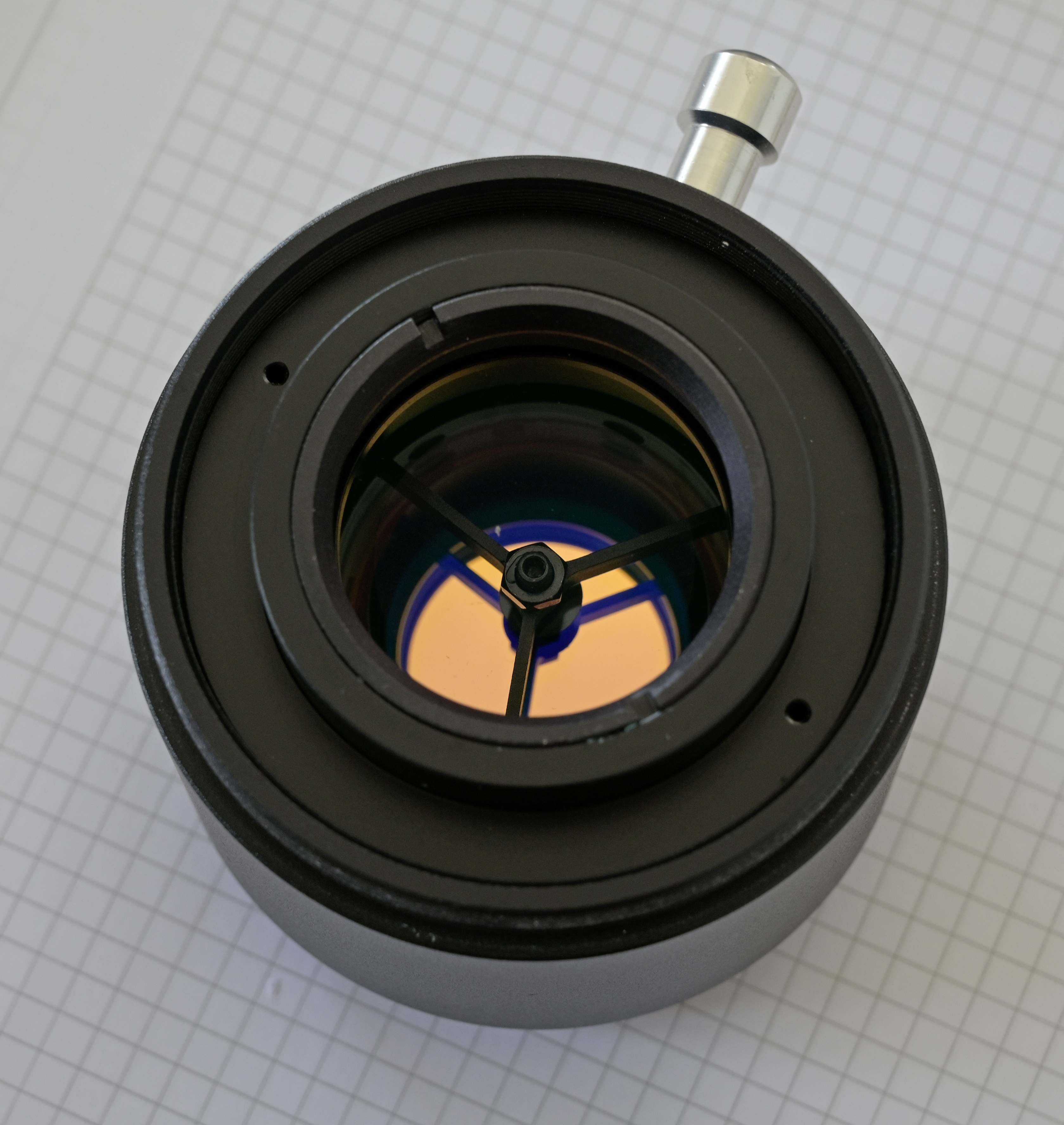
- In any case, the central pin is hold by a three-leg spider supported by the threaded ring (approximate pitch = 1 mm).
- The tuning of the CWL is very smooth, accurate and without any backlash.
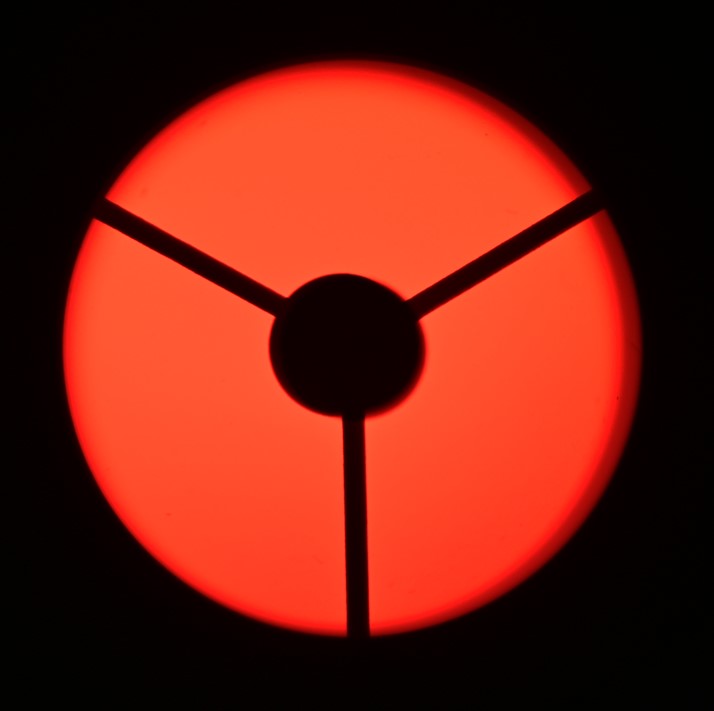
Three-leg spider supporting the central compression pin seen from the focuser.
- The air-spaced etalon is tuned by compression. It is unclear whether compression is applied only at the center of the etalon, or at both the center and rim.
- In any case, the central pin is hold by a three-leg spider supported by the threaded ring (approximate pitch = 1 mm).
- The tuning of the CWL is very smooth, accurate and without any backlash.
Three-leg spider supporting the central compression pin seen from the focuser.
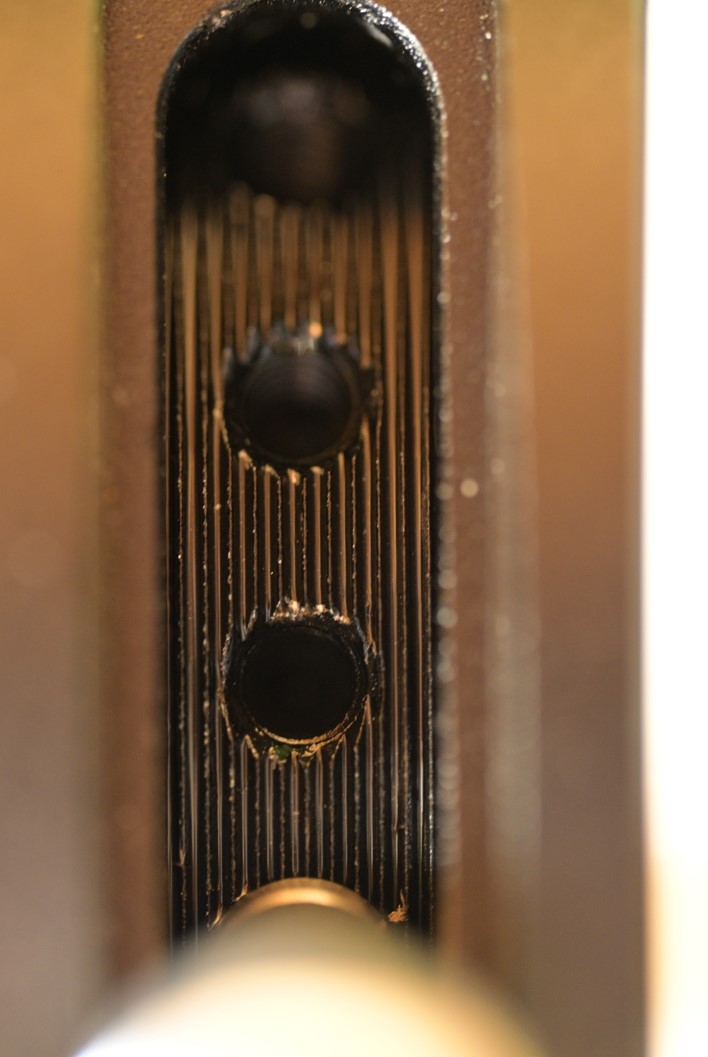
Threaded ring supporting the three-leg spider.
- Maximum rotation of the spider
cell is about 1/8 of a turn. If necessary, it is possible to plug the
tuning rod in another hole. For this particular unit, 1/8 of a
turn means a
tuning range of 0.75 A (from -0.15 A from Ha to +0.60 A), if
the tuning rod is left in the same hole.
- Center wavelength shifts to the blue when the rod is rotated CCW (as seen from the focuser end of the telescope). Then the etalon is compressed (the cavity gap is reduced).
- On this particular unit, and with this setting of the rod, the etalon is no longer compressed when tuned at Ha +0.6 A (this was checked using the hydrogen lamp).
Optical design
- the air-spaced etalon is in a collimated beam (with is a divergent lens in front of the etalon and a convergent lens after the etalon).
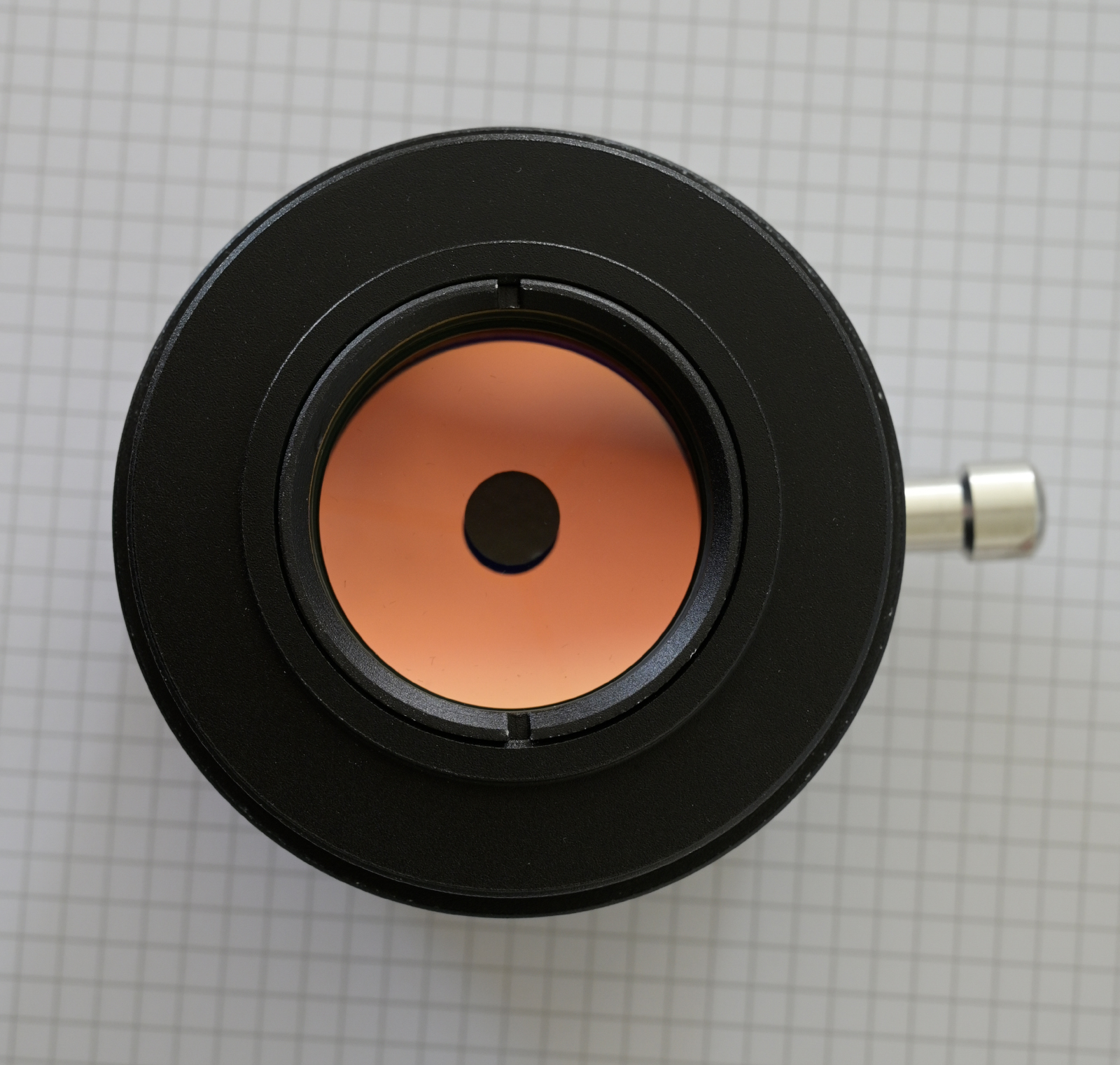
- etalon free aperture is 40 mm, central obstruction is 10 mm (i.e. 25%), which means that the impact on the contrast of image is quite limited.
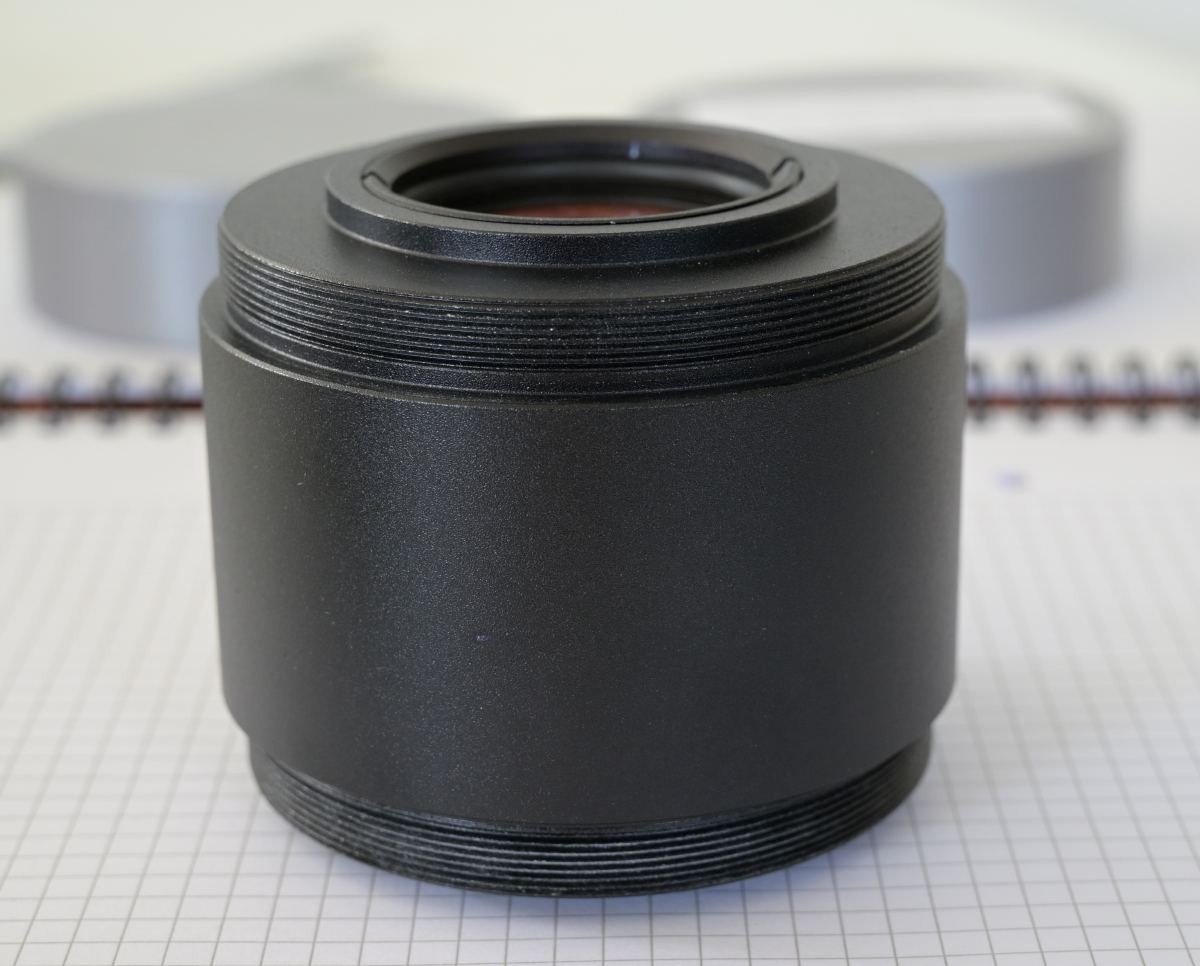
- the black body containing the etalon, associated optics and compression mechanism is 45.5 mm long (72.6 mm including protusions) and 80 mm in diameter. Male thread at both ends is M80 ×1 mm.
- Center wavelength shifts to the blue when the rod is rotated CCW (as seen from the focuser end of the telescope). Then the etalon is compressed (the cavity gap is reduced).
- On this particular unit, and with this setting of the rod, the etalon is no longer compressed when tuned at Ha +0.6 A (this was checked using the hydrogen lamp).
Optical design
- the air-spaced etalon is in a collimated beam (with is a divergent lens in front of the etalon and a convergent lens after the etalon).
- etalon free aperture is 40 mm, central obstruction is 10 mm (i.e. 25%), which means that the impact on the contrast of image is quite limited.
- the black body containing the etalon, associated optics and compression mechanism is 45.5 mm long (72.6 mm including protusions) and 80 mm in diameter. Male thread at both ends is M80 ×1 mm.
Spectro measurement in a collimated beam at the focus of the Heliostar 76, with the etalon tuned on Ha: measurement #1
Optical setup:Sun => Heliostar with etalon tuned on Ha (without BF) => slit of the spectro preciselly positioned at the focus of the Heliostar => Solex spectro with 7 microns × 6.0 mm slit, fc = f i =200 mm, 2400 l/mm grating, Player One IMX585, 0.0471 A/pixel dispersion, measured spectral resolution = 0.18 A
Surface of the etalon sampled:
Because the etalon is in a collimated beam, and because the slit of the spectroscope is positionned at the focus, all the aperture of the etalon is sampled. In other words, the FWHM and the FSR measured are integrated over the full aperture of the etalon. Indeed, each point of the slit receives a light beam covering the full aperture of the etalon.
The only diffence between the different points along the slit is the field angle, which makes a negligeable CWL shift over the height of the slit (and no change in FWHM).
Because the etalon is in a collimated beam, and because the slit of the spectroscope is positionned at the focus, all the aperture of the etalon is sampled. In other words, the FWHM and the FSR measured are integrated over the full aperture of the etalon. Indeed, each point of the slit receives a light beam covering the full aperture of the etalon.
The only diffence between the different points along the slit is the field angle, which makes a negligeable CWL shift over the height of the slit (and no change in FWHM).
Central part of the solar spectrum transmitted by the etalon when tuned on Ha:

Profile of the transmitted spectrum:
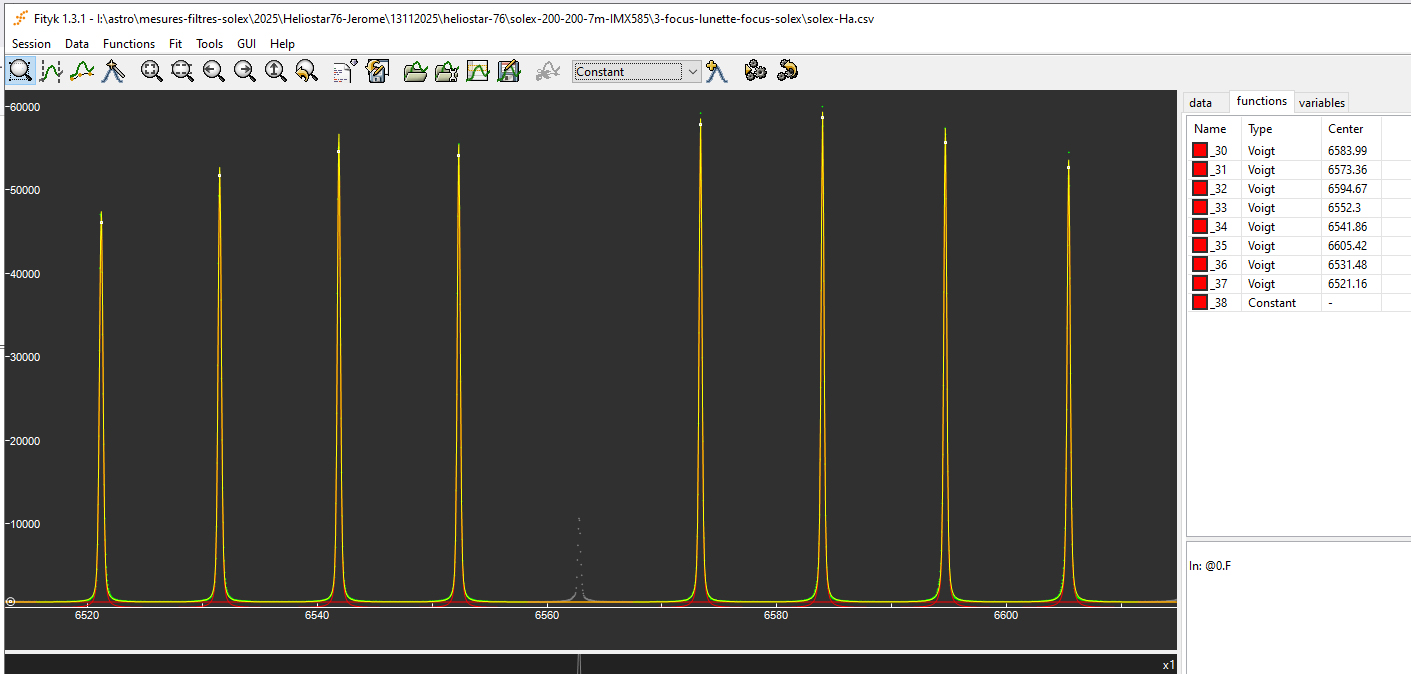
The FSR and FWHM are measured throught curve-fitting using a Voigt function. The FWHM is simlar for the four peaks of transmission next to Ha.
The measured values are : FWHM = 0.30 A and FSR = 10.5 A
If we take into account the measured spectral resolution of the spectroscope (0.16 A), the actual FWHM of the etalon is close to 0.25 A. So, we can consider FWHM = 0.3 A as a conservative value.
Technical notes:
While the transmission profile is a text book Lorentzian, the profile of transmission was curve-fitted with a Voigt function in order to avoid an "overshoot" of the peaks of transmission.
Thanks to the dispersion of the spectroscope (0.0471 A/px), the transmission profile is properly sampled resulting in an accurate FWHM estimation.
Strictly speaking, the measurement of the FWHM should be made on the transmission profile = transmitted spectrum / solar spectrum (and not on the profile of the tranmitted spectrum like here). In fact, when this is done, results are quite similar. This is because the Ha line is surrounded only by rather faint lines. So, there is hardly any difference between measuring the FWHM of the transmisison (= transmitted spectrum/ solar spectrum) and the FWHM of the peaks of the transmitted spectrum.
While the transmission profile is a text book Lorentzian, the profile of transmission was curve-fitted with a Voigt function in order to avoid an "overshoot" of the peaks of transmission.
Thanks to the dispersion of the spectroscope (0.0471 A/px), the transmission profile is properly sampled resulting in an accurate FWHM estimation.
Strictly speaking, the measurement of the FWHM should be made on the transmission profile = transmitted spectrum / solar spectrum (and not on the profile of the tranmitted spectrum like here). In fact, when this is done, results are quite similar. This is because the Ha line is surrounded only by rather faint lines. So, there is hardly any difference between measuring the FWHM of the transmisison (= transmitted spectrum/ solar spectrum) and the FWHM of the peaks of the transmitted spectrum.
Spectro measurement in a collimated beam at the focus of the Heliostar 76, with the etalon tuned on Ha: measurement #2
To cross-check the results, measurements were also made with the SGH700 spectroscope, which has a slightly lower spectral resolution. The optical setup is the same as above, except for the spectroscope used.
Optical setup:Sun => Heliostar with etalon tuned on Ha (without BF) => slit of the spectro preciselly positioned at the focus of the Heliostar => SGH700 spectro with 10 microns × 4.5 mm slit, fc = 125 mm - f i =200 mm, 2400 l/mm grating, Player One IMX585, 0.0471 A/pixel dispersion.
Central part of the solar spectrum transmitted by the etalon when tuned on Ha:

The measured values are identical to the ones measured with the higher spectral resolution spectroscope : FWHM = 0.30 A and FSR = 10.5 A
Measurement in diffuse light using a hydrogen discharge lamp
In this test, the Fabry-Perot etalon is used as an interferometer. All the surface of the etalon is sampled. The FWHM, FSR and air-gap are derived from the measurements of the fringe system.
Ideally, the etalon would be removed from the Heliostar 76 OTA to be tested. However, this was not possible. So the optical setup is:
Optical setup: hydrogren lamp => diffuser => Heliostar (without BF) with its etalon tuned on Ha, its associated collimating optics and 76 mm objective => 135 mm f/1.8 Sigma lens (focused to the infinite) with Nikon Z7 II.
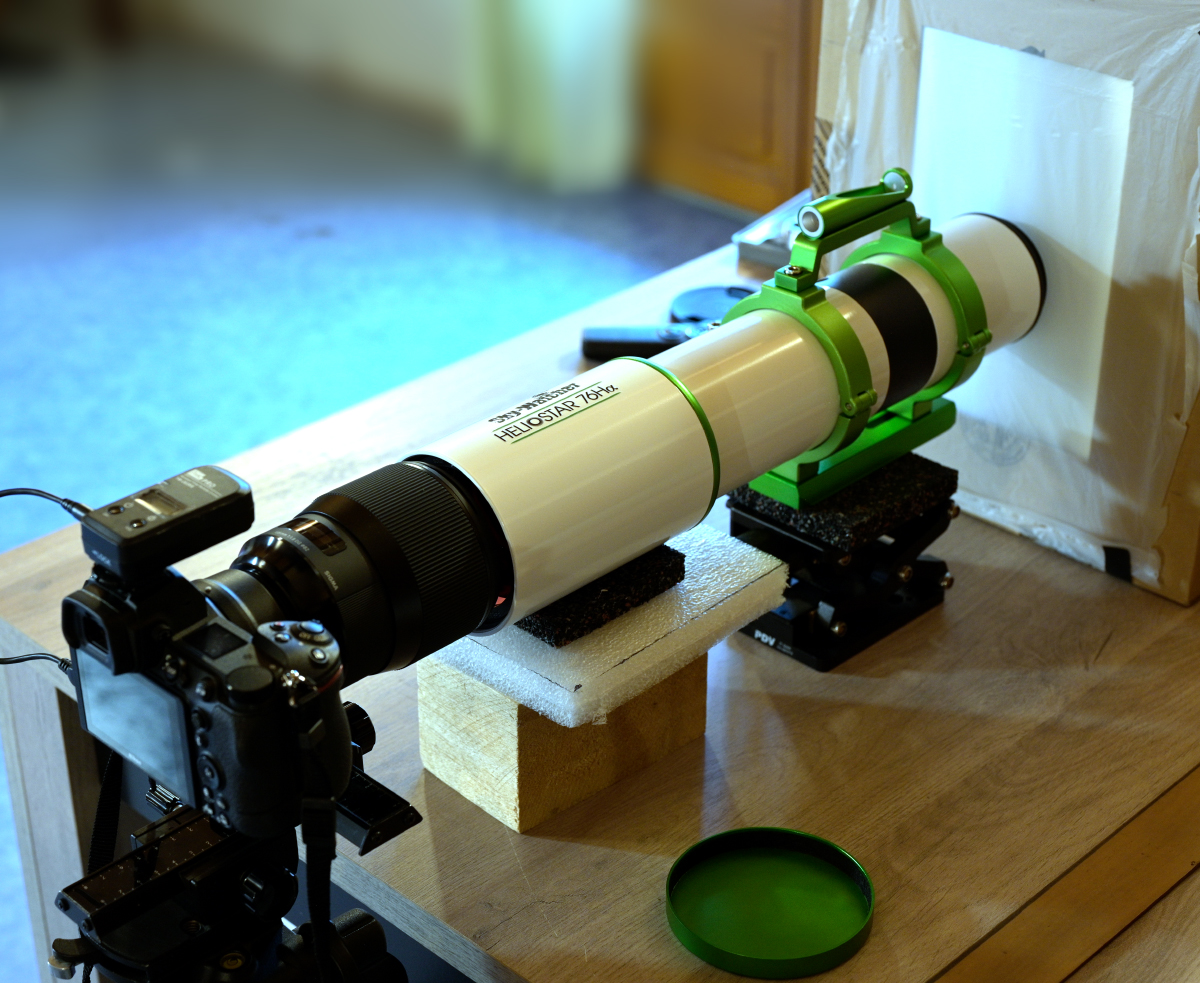
The hydrogen light source is behind the diffuser on the right. The objective of the Heliostar faces the Sigma 135 mm f/1.8 lens of the Nikon Z7 II on the left.
The etalon FWHM is measured at two tuning positions = Ha -0.1 A and Ha + 0.7 A:
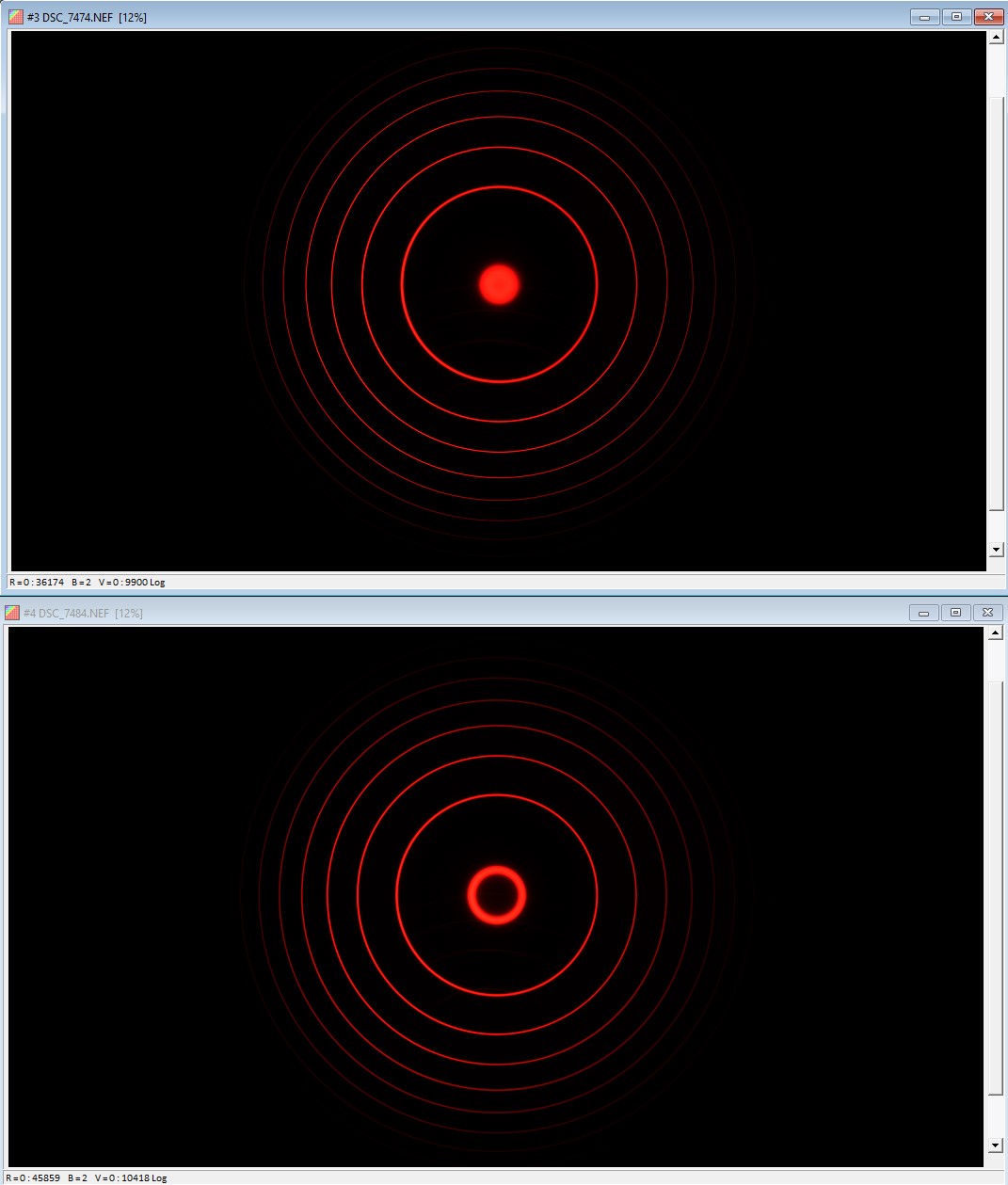
Interference fringes obtained at -0.1 A (top) and and +0.7 A (bottom).
Sigma 135 mm f/1.8 - Nikon Z7 II - RAW mode - 14-bit acquisition - 0.62 s exposure time - 100 ISO
The FWHM measured for the two positions are identical : 0.37 A. Given the measured width of the Ha line produced by the hydrogen lamp (FWHM = 0.263 A), the deconvoluted FWHM of the etalon is estimated at 0.27 A.
Based on the measurement of the fringe system and on the FSR value measured with the spectroscope, the air-gap is 0.20 mm.
In the end, we can consider a conservative value of FWHM < 0.30 A, fully consistent with the spectrometer measurements.
To cross-check the results, measurements were also made with the SGH700 spectroscope, which has a slightly lower spectral resolution. The optical setup is the same as above, except for the spectroscope used.
Optical setup:Sun => Heliostar with etalon tuned on Ha (without BF) => slit of the spectro preciselly positioned at the focus of the Heliostar => SGH700 spectro with 10 microns × 4.5 mm slit, fc = 125 mm - f i =200 mm, 2400 l/mm grating, Player One IMX585, 0.0471 A/pixel dispersion.
Central part of the solar spectrum transmitted by the etalon when tuned on Ha:
The measured values are identical to the ones measured with the higher spectral resolution spectroscope : FWHM = 0.30 A and FSR = 10.5 A
Measurement in diffuse light using a hydrogen discharge lamp
In this test, the Fabry-Perot etalon is used as an interferometer. All the surface of the etalon is sampled. The FWHM, FSR and air-gap are derived from the measurements of the fringe system.
Ideally, the etalon would be removed from the Heliostar 76 OTA to be tested. However, this was not possible. So the optical setup is:
Optical setup: hydrogren lamp => diffuser => Heliostar (without BF) with its etalon tuned on Ha, its associated collimating optics and 76 mm objective => 135 mm f/1.8 Sigma lens (focused to the infinite) with Nikon Z7 II.
The hydrogen light source is behind the diffuser on the right. The objective of the Heliostar faces the Sigma 135 mm f/1.8 lens of the Nikon Z7 II on the left.
The etalon FWHM is measured at two tuning positions = Ha -0.1 A and Ha + 0.7 A:
Interference fringes obtained at -0.1 A (top) and and +0.7 A (bottom).
Sigma 135 mm f/1.8 - Nikon Z7 II - RAW mode - 14-bit acquisition - 0.62 s exposure time - 100 ISO
The FWHM measured for the two positions are identical : 0.37 A. Given the measured width of the Ha line produced by the hydrogen lamp (FWHM = 0.263 A), the deconvoluted FWHM of the etalon is estimated at 0.27 A.
Based on the measurement of the fringe system and on the FSR value measured with the spectroscope, the air-gap is 0.20 mm.
In the end, we can consider a conservative value of FWHM < 0.30 A, fully consistent with the spectrometer measurements.
Technical notes:
Keeping the etalon with both its collimating optics and the objective of the telescope is not the "standard" way to perform this test. Since the diffuse light comes from the focuser side of the OTA:
- The focuser diameter acts like an aperture stop and decreases the intensity of the diffuse light coming away from the optical axis. This produces an effect similar to vignetting, reducing the amount of light in the outer interference rings.
- Only the first two or three inner rings can be measured accurately because of the vigneting.
- The combination of the divergent collimating lens and of the main objective of the Heliostar decreases the field angle, compared to the "usual" implementation of the test. The interference rings are still focused at the infinity, but their angular radius is reduced by a factor f/F, where f = absolute value of the divergent collimating lens, and F = focal length of the objective of the Heliostar (F= 630 mm). In other words, the diameter of the interference rings is the same as it would be with the "standard " protocol (i.e. using the etalon alone) using a camera lengs of 135 mm × f/ F, instead of 135 mm.
Keeping the etalon with both its collimating optics and the objective of the telescope is not the "standard" way to perform this test. Since the diffuse light comes from the focuser side of the OTA:
- The focuser diameter acts like an aperture stop and decreases the intensity of the diffuse light coming away from the optical axis. This produces an effect similar to vignetting, reducing the amount of light in the outer interference rings.
- Only the first two or three inner rings can be measured accurately because of the vigneting.
- The combination of the divergent collimating lens and of the main objective of the Heliostar decreases the field angle, compared to the "usual" implementation of the test. The interference rings are still focused at the infinity, but their angular radius is reduced by a factor f/F, where f = absolute value of the divergent collimating lens, and F = focal length of the objective of the Heliostar (F= 630 mm). In other words, the diameter of the interference rings is the same as it would be with the "standard " protocol (i.e. using the etalon alone) using a camera lengs of 135 mm × f/ F, instead of 135 mm.
Qualitative estimation of the uniformity of the etalon and visualization of the impact of mechanical compression on the FWHM
Optical setup: hydrogen lamp => 3.0 mm aperture stop placed at the focus of the Heliostar 76 (meaning the light beam incident on the etalon is collimated, with a f-ratio = f/110 given the ratio of focal lengths between the Heliostar objective and the collimator) => 135 mm f/1.8 Sigma lens => Nikon Z7 II
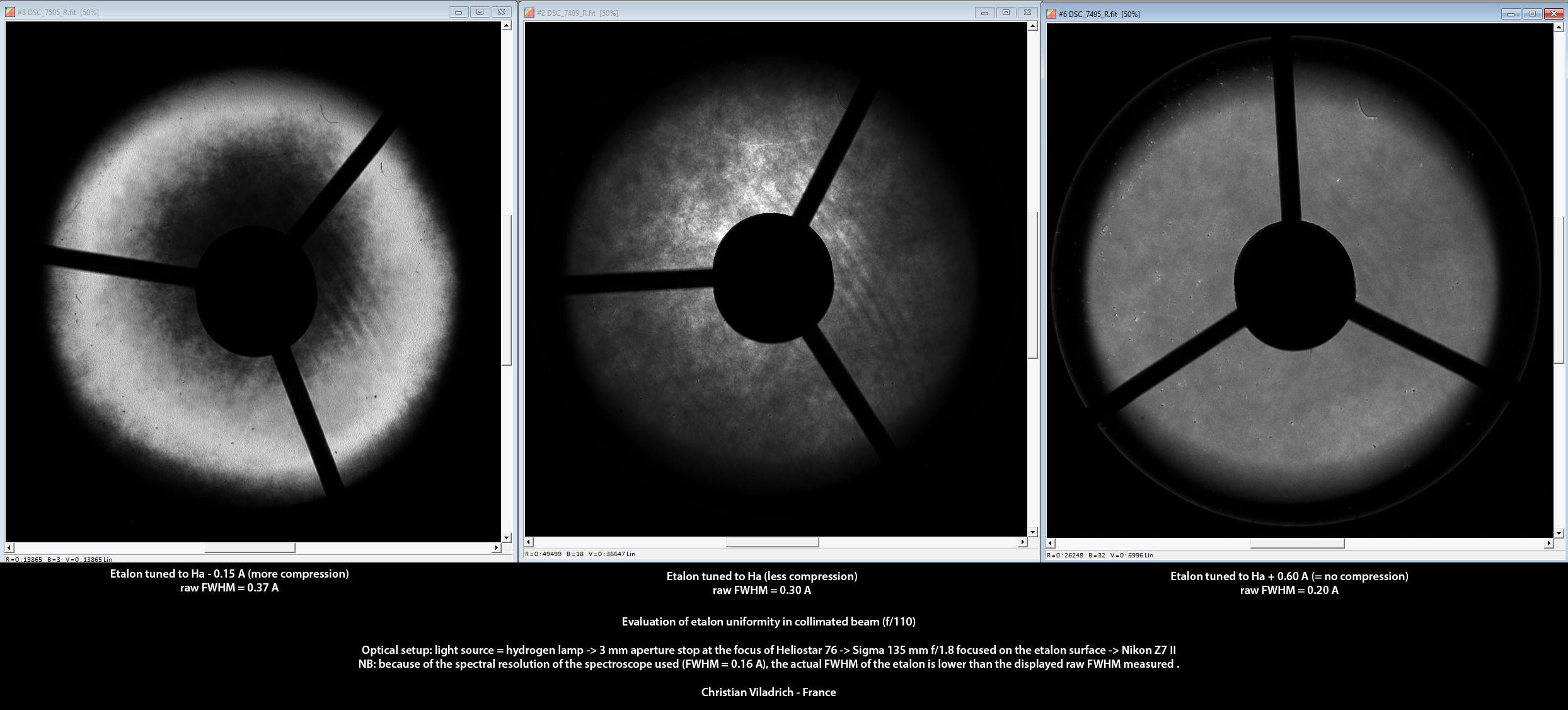
Principle:
- The test evaluates qualitatively the uniformity of transmission of the etalon over its full aperture. Non uniformities can come from coating non uniformities, surface roughness, non uniformity of the cavity gap, etc.. These transmission non uniformities turn into non uniformities of CWL and FWHM over the aperture of the etalon.
- The etalon is illuminated by a collimated beam coming from an hydrogen discharge lamp. The uniformity of the etalon is examined using a 135 mm f/1.8 lens focused on the etalon surface.
- If the etalon were completely uniform, the brightness would be constant over the full aperture of the etalon.
Though qualitative, the test is very sensitive.
- The test evaluates qualitatively the uniformity of transmission of the etalon over its full aperture. Non uniformities can come from coating non uniformities, surface roughness, non uniformity of the cavity gap, etc.. These transmission non uniformities turn into non uniformities of CWL and FWHM over the aperture of the etalon.
- The etalon is illuminated by a collimated beam coming from an hydrogen discharge lamp. The uniformity of the etalon is examined using a 135 mm f/1.8 lens focused on the etalon surface.
- If the etalon were completely uniform, the brightness would be constant over the full aperture of the etalon.
Though qualitative, the test is very sensitive.
Optical setup: hydrogen lamp => 3.0 mm aperture stop placed at the focus of the Heliostar 76 (meaning the light beam incident on the etalon is collimated, with a f-ratio = f/110 given the ratio of focal lengths between the Heliostar objective and the collimator) => 135 mm f/1.8 Sigma lens => Nikon Z7 II
Comments:
- compression of the etalon increases from the right image (Ha +0.6 A, no compression) to the left image (Ha -0.15 A). We can see the spider legs rotating accordingly.
- because of the Sigma 135 mm f/1.8 effective aperture, only about 80% of the aperture of the etalon can be observed (the outer part is vigneted).
- when there is no compression (position Ha + 0.60 A), the etalon uniformity is excellent, resulting in a FWHM better than 0.20 A (when spectral resolution of the spectroscope is accounted for)
- when compression is increased, the distance between the two plates of the etalon (=gap) reduces, but is no longer uniform over the surface of the etalon. Transmission is no longer uniform, and the FWHM integrated over the etalon aperture increases accordingly
- compression of the etalon increases from the right image (Ha +0.6 A, no compression) to the left image (Ha -0.15 A). We can see the spider legs rotating accordingly.
- because of the Sigma 135 mm f/1.8 effective aperture, only about 80% of the aperture of the etalon can be observed (the outer part is vigneted).
- when there is no compression (position Ha + 0.60 A), the etalon uniformity is excellent, resulting in a FWHM better than 0.20 A (when spectral resolution of the spectroscope is accounted for)
- when compression is increased, the distance between the two plates of the etalon (=gap) reduces, but is no longer uniform over the surface of the etalon. Transmission is no longer uniform, and the FWHM integrated over the etalon aperture increases accordingly
-