| Test method | f-ratio | Surface sampled | FSR | FWHM | Delta CWL | Note | |
| Heliostar 100 mm (#3) |
Hydrogen lamp | full aperture |
17.1 A |
Etalon tuned close to Ha: FWHM = 0.5 A Etalon not compressed: FWHM = 0.36 A. |
+ 0.97 A |
gap = 0.126 mm |
|
| Spectro (slit à f/8 prime focus) |
100 % × 50% | 16.9 A 16.7 A |
Etalon tuned on Ha: FWHM = 0.43 A Etalon not compressed: FWHM = 0.36 A. |
+ 0.91 A |
|||
| Spectro (slit à f/16 focus) |
full aperture | 16.7 A 16.7 A |
Etalon tuned on Ha: FWHM = 0.41 A Etalon not compressed: FWHM = 0.41 A. |
+ 0.95 A |
Measurement in diffuse light using a hydrogen discharge lamp
In this test, the Fabry-Perot etalon is used as an interferometer. The whole the surface of the etalon is sampled. The FWHM, FSR and air-gap are derived from the measurements of the fringe system.
The etalon is removed from the Heliostar 100. The divergent is removed. The convergent lens is kept since is has no impact on the test. The optical setup is:
Optical setup:hydrogren lamp => diffuser => W25 filter (to remove continuum from hydrogen lamp => convergent lens next to the etalon (no impact on the fringe system) => etalon (without divergent collimating lens, the side facing the Sun face the telephotolens) => 135 mm f/1.8 Sigma lens (focused to the infinite) with Nikon Z7 II.
1 - Etalon tuned close to Ha (on the blue side)
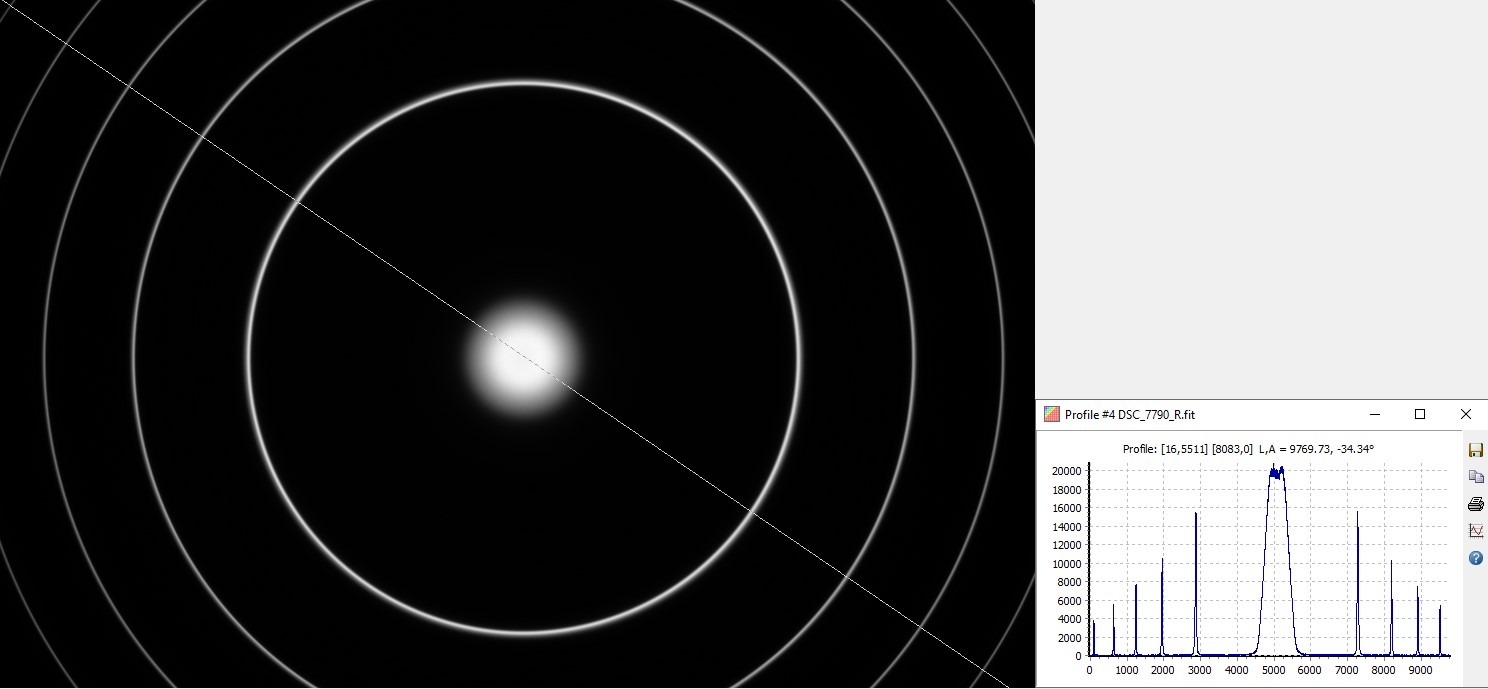
Interference fringes obtained with the etalon tuned on Ha.
Sigma 135 mm f/1.8 - Nikon Z7 II - RAW mode - 14-bit acquisition - 1.6 s exposure time - 100 ISO
Raw FWHM = 0.56 A,
deconvoluated FWHM = 0.49 A.
NB : the CWL is a bit on the blue side of Ha
Etalon not compressed (CWL = Ha + 0.97 A)
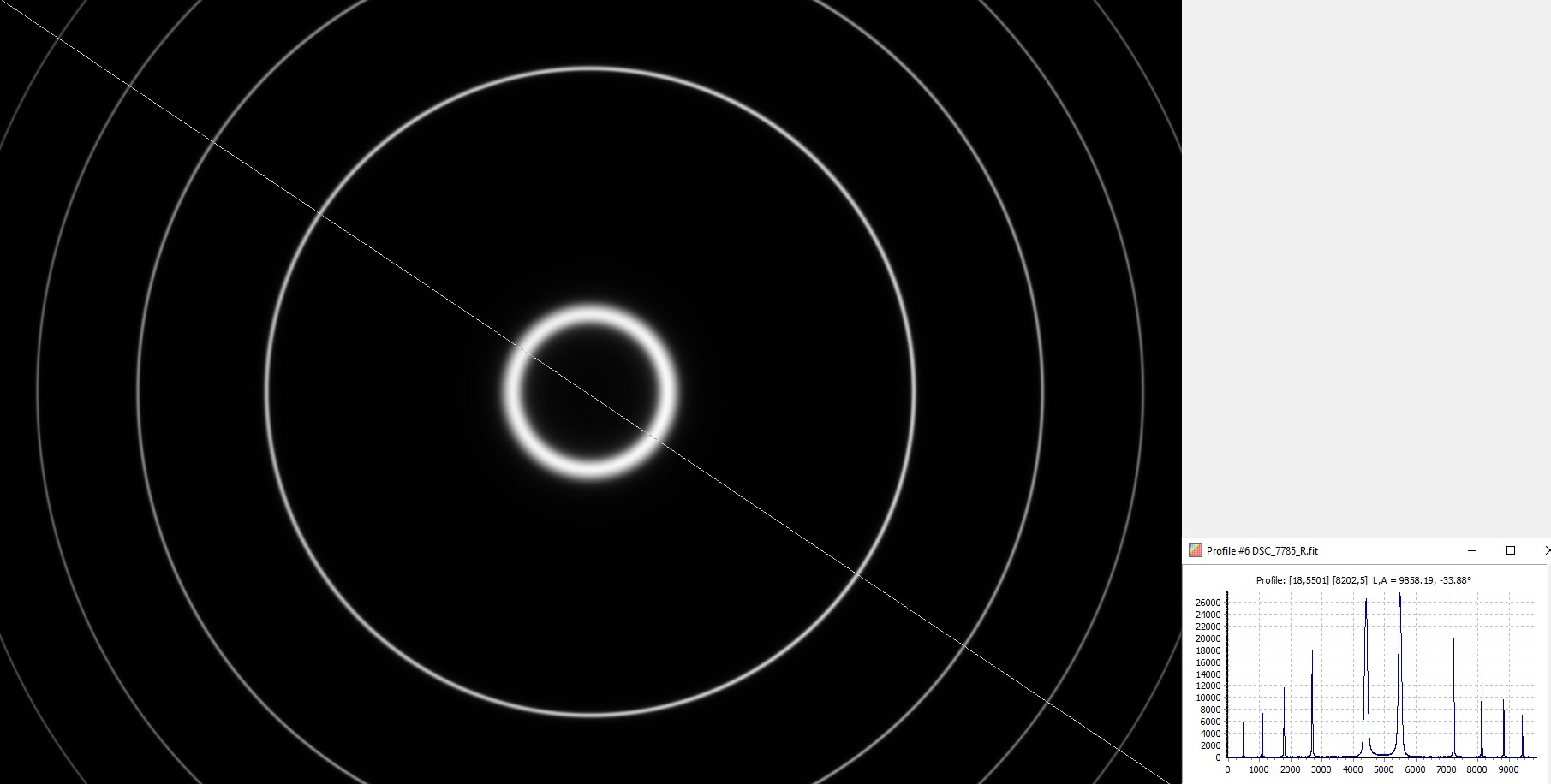
Raw FWHM = 0.45 A,
deconvoluated FWHM = 0.36 A.
Summary of measurements made:

As compression increases, the FWHM increased.
Measurement with the spectrosocope using the Sun as a light source
Optical setup #1 : Sun => Heliostar 100 complete with in internal etalon and associated collimating lenses => SHG 700 => IMX 585
Configuration of the SHG 700 : 10 microns slit, f_c= 125 mm, 2400 lpm, f_im = 200 mm,. Dispersion = 0.0471 A/pixel
Given the f/8 ratio of the Heliostar, the 125 mm focal length of the collimator and 25 mm × 25 mm grating size, only a 100% × 50% of the aperture of the etalon is measured.
Etalon transmission (wavelength) = Transmitted solar spectrum (wavelength) / Solar spectrum (wavelength).
The etalon transmission profile is curved fitted with Voigt functions using Fityk.
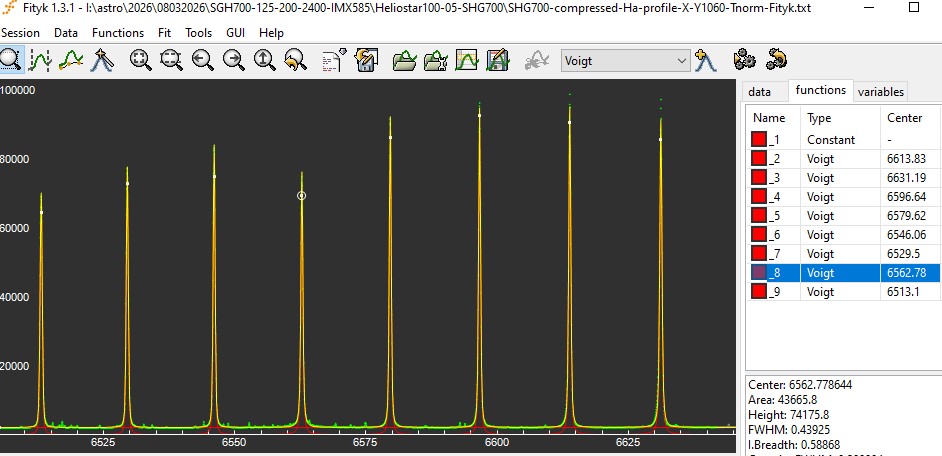
With no compression: FWHM = 0.36 A, FSR = 16.7 A, delta CWL = + 0.91 A
With the etalon tuned on Ha: FWHM = 0.43 A, FSR = 16.9 A.
Optical setup #2 : Sun => Heliostar 100 complete with in internal etalon and associated collimating lenses => 2× Astrophysics Barlow lens => SHG 700 => IMX 585
Configuration of the SHG 700 : 10 microns slit, f_c= 125 mm, 2400 lpm, f_im = 200 mm,. Dispersion = 0.0471 A/pixel
Thanks to the use of the 2× Barlow lens, the f-ratio falling on the slit is f/16, which means that there is no more vigneting of the light beam by the grating. Accordingly, the full-aperture of the etalon is measured.
With no compression: FWHM = 0.41 A, FSR = 16.7 A, delta CWL = + 0.95 A
With the etalon tuned on Ha: FWHM = 0.41 A, FSR = 16.7 A.
Heliostat blocking filter and etalon FSR
These two spectra were taken with the same Heliostar 100 Blocking Filter and two different etalons having the following FSR:
- top FSR = 17 A, the two transmission peaks on each side of Ha are blocked by the BF,
- bottom FSR = 11 A, the transmission peak of the etalon on the blue side of the Ha peak is transmitted by the BF. Its peak intensity is equal to 25% the peak intensity on Ha. Accordingly, the final image at the focus of the Heliostar is a mix between 75% chromosphere + 25% photosphere
Note : the BF is placed at the f/8 of the Heliostar (this might explained the blue shift of the transmission curve of the BF).
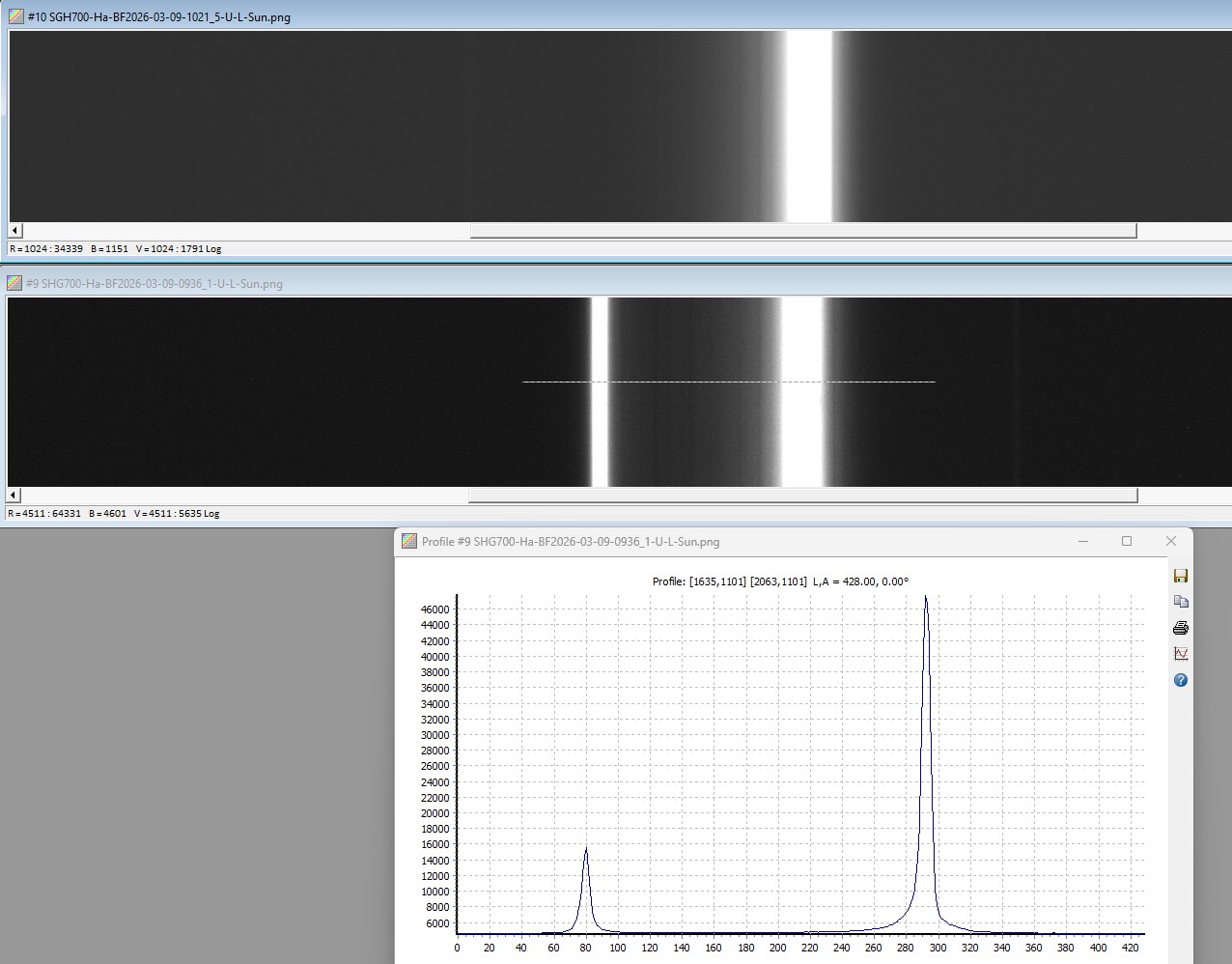
Comparison of Heliostar blocking filter (FWHM = 7 A) and Alluxa (FWHM = 10 A) with the 17 A FSR etalon
Spectra transmitted by the Heliostar and Alluxa filters:
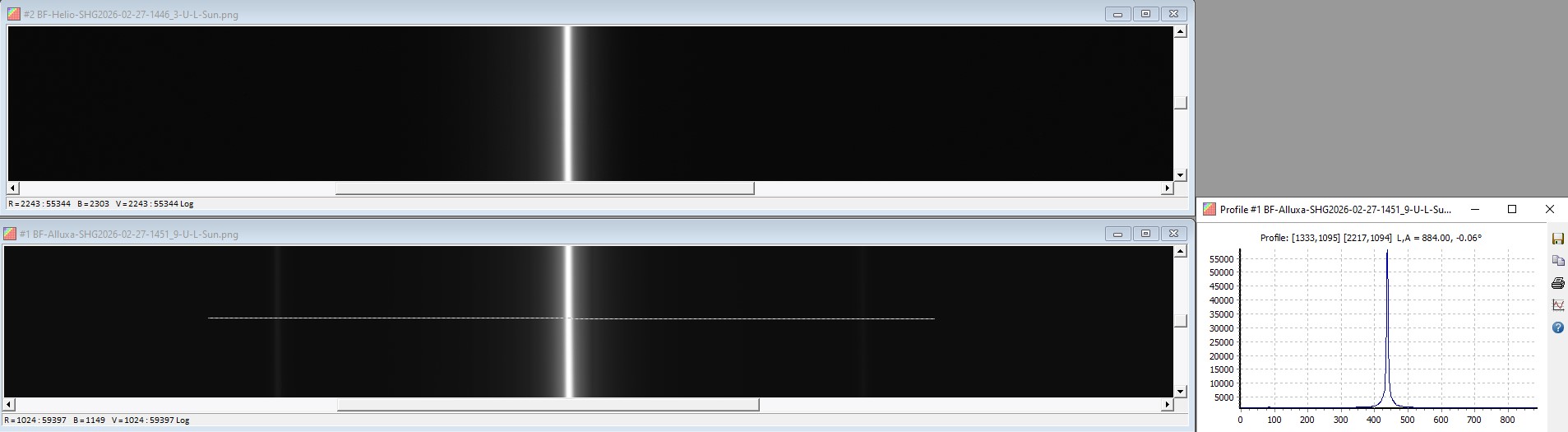
With the Alluxa 10 A filter, the peak intensity of the blue peak of transmission is 2.5% of the peak intensity on Ha. This is completely negligeable.