| Test method | f-ratio | Surface sampled | FSR | FWHM | Delta CWL | Note | |
| Blocking Filter |
Diode source + collimator + Solex 80 mm / 125 mm / 1200 lpmm / IMX585 | collimated |
7.3 A BW at 10% = 9.7 A |
3-cavity filter 80% ±5% peak transmission. The reflectivity of the mirror diagonal is about 10% |
The Heliostar 100 "BF diagonal" consists in three parts:
(1) the 1"1/4 tube inserting into the focuser: this part contains what seems to be an IR-cut filter. The transmission curve is similar to KG3.
(2) the mirror of the diagonal: the mirror reflects only a part of the incident light,
(3) two filters glued together on the eyepiece side of the diagonal. The first one (to the Sun side) in a red filter. The other one (facing the eyepiece) is probably the BF filter. It has a shiny face. The free aperture of the Blocking Filter is approximately 19 mm.
The combined transmission of part (1) and (2) is approximately 10%.
The transmission of part (3) is 80%. ±5%
(1) the 1"1/4 tube inserting into the focuser: this part contains what seems to be an IR-cut filter. The transmission curve is similar to KG3.
(2) the mirror of the diagonal: the mirror reflects only a part of the incident light,
(3) two filters glued together on the eyepiece side of the diagonal. The first one (to the Sun side) in a red filter. The other one (facing the eyepiece) is probably the BF filter. It has a shiny face. The free aperture of the Blocking Filter is approximately 19 mm.
The combined transmission of part (1) and (2) is approximately 10%.
The transmission of part (3) is 80%. ±5%
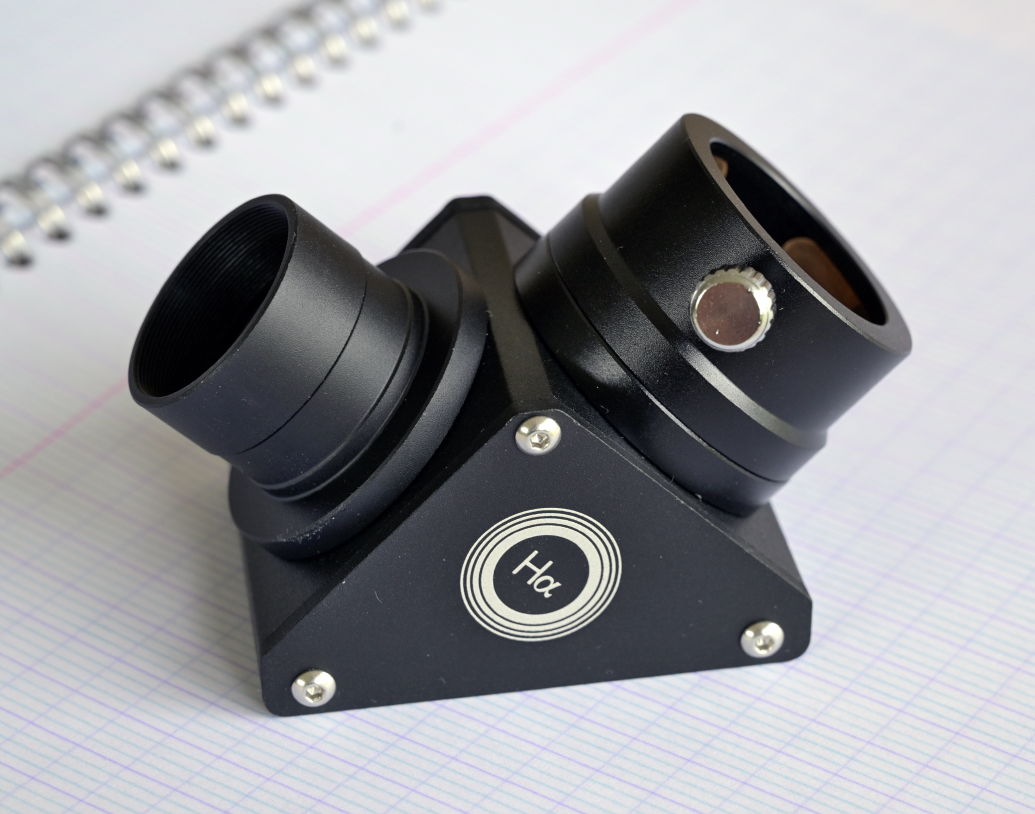
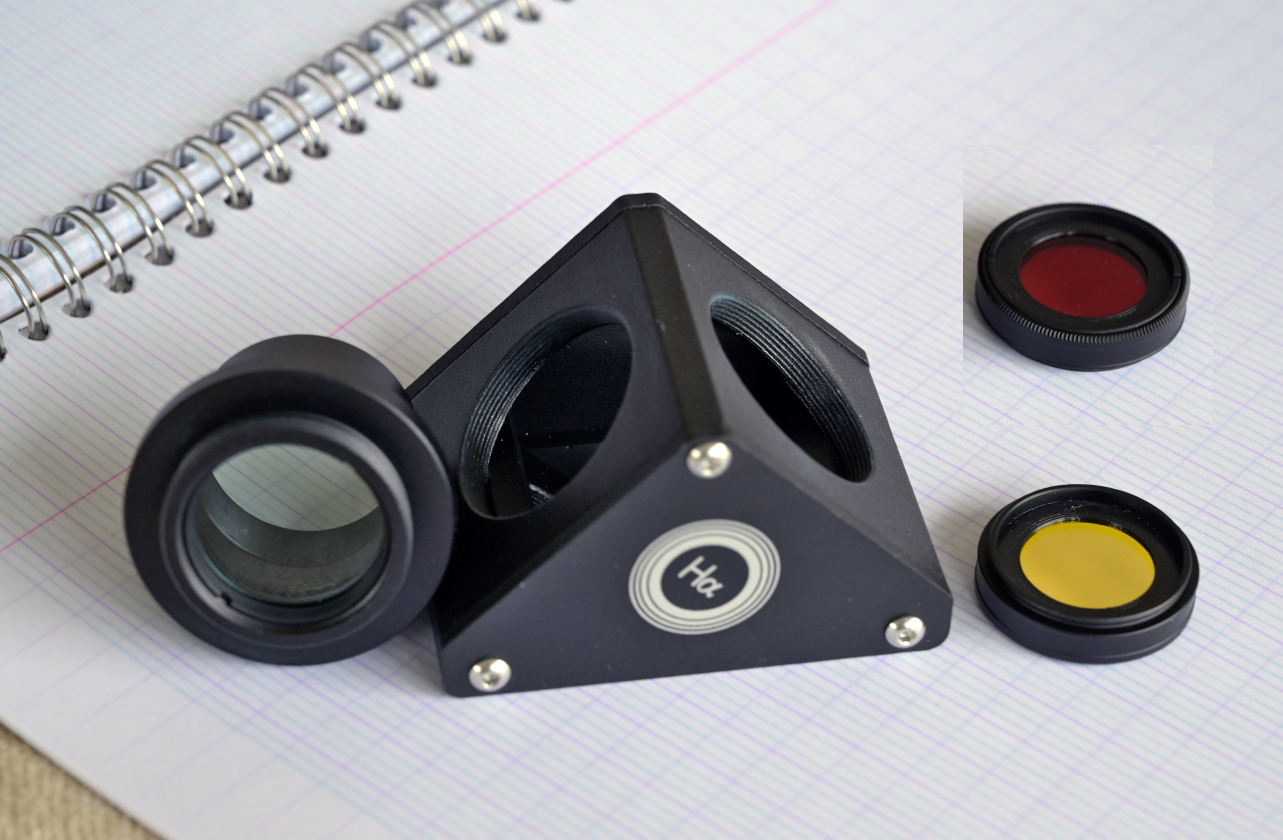
The thread on both sides of the diagonal body is 33 m x 0.75 mm.
Transmission profile of the IR-cut (part 1 of the BF)
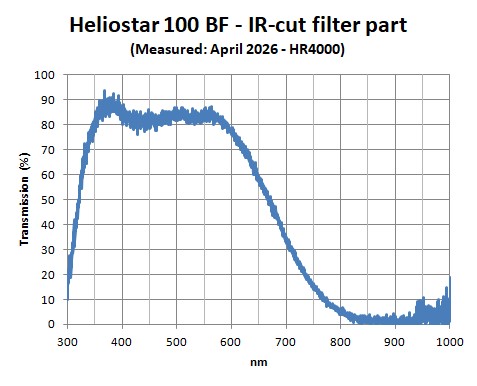
The curve is similar to the transmission profile of KG3.
Measurement of the FWHM using the Sun as a light source
Optical setup: Sun => BF => Solex f_c = 80 mm, _fim= 125 mm, 1200 lpmm, IMX585
dispersion = 0.192 A/pixel
The following images show the solar spectrum (without any filter) and the spectrum transmitted by the blocking filter.
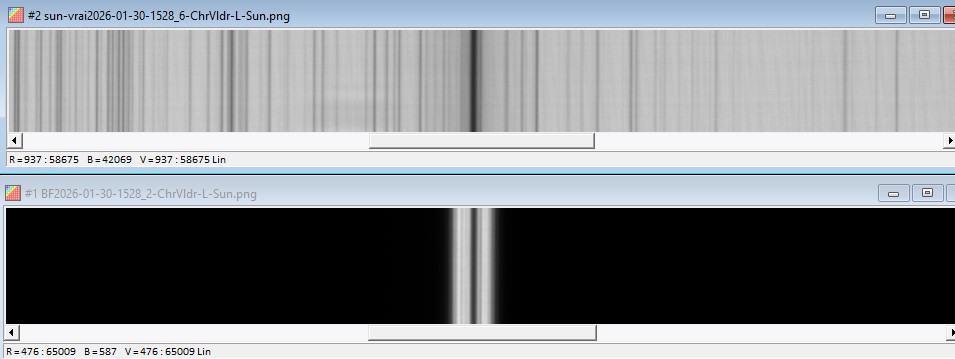
We can see that the Center Wavelength of the BF is very close to Ha (at normal incidence).
Transmission is the ratio between incident light and light transmitted by the filter:
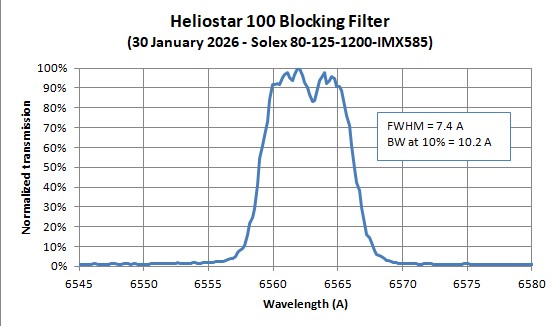
The dip at the center of transmission is not a real one. This artifact is the result of the presence of the dark Ha line combined with interpolation effects.
Measurement of the FWHM using a diode as a light source
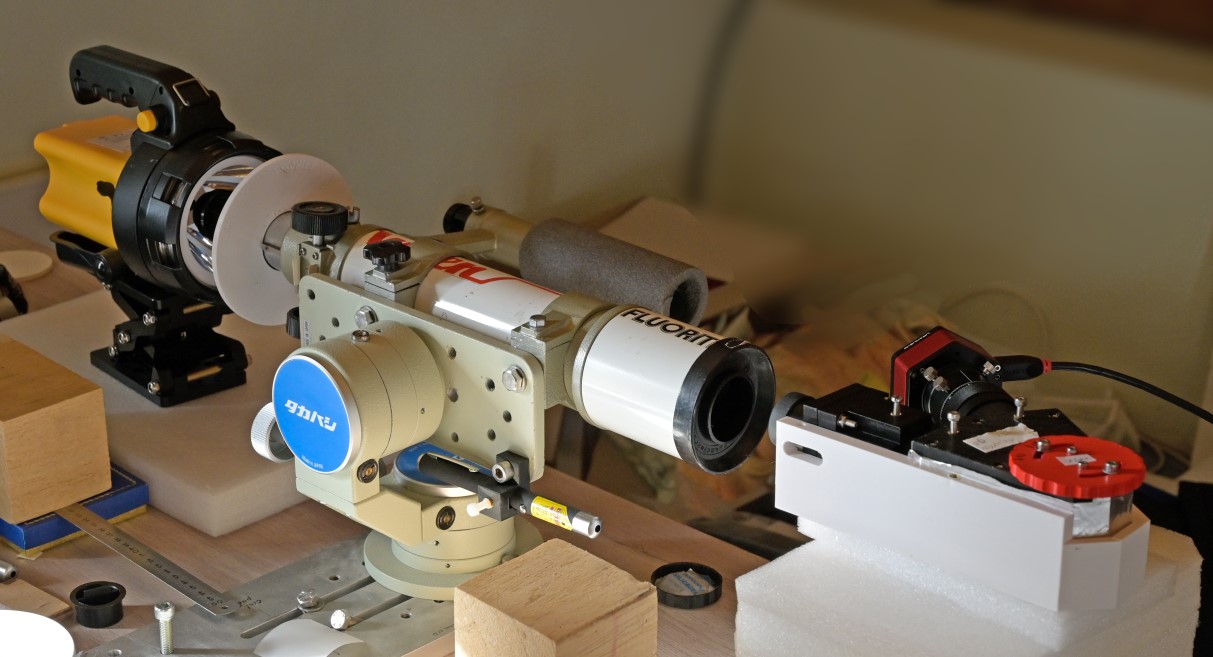
Optical setup: diode => 5 mm aperture hole => 55 mm f/8 collimator => Blocking Filter => Solex f_c = 80 mm, f_im= 125 mm, 1200 lpmm, IMX585
dispersion = 0.192 A/pixel
The use of a diode as a light source avoids the artefact due to the Ha line when using the Sun as a light source.
Diode source on the left, illuminating a 5 mm aperture hole at the focus of the 55 f/8 collimating lens. Solex spectro on the right.
The measurement of the profile is more accurate than when using the Sun as a light source:
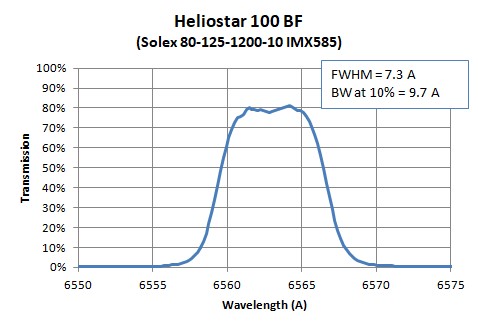
Transmission is measured to about ±5%.
The filter is 3-cavity (BW at 10% peak transmission < 1.5 × FWHM)
Optical setup: diode => 5 mm aperture hole => 55 mm f/8 collimator => Blocking Filter => Solex f_c = 80 mm, f_im= 125 mm, 1200 lpmm, IMX585
dispersion = 0.192 A/pixel
The use of a diode as a light source avoids the artefact due to the Ha line when using the Sun as a light source.
Diode source on the left, illuminating a 5 mm aperture hole at the focus of the 55 f/8 collimating lens. Solex spectro on the right.
The measurement of the profile is more accurate than when using the Sun as a light source:
Transmission is measured to about ±5%.
The filter is 3-cavity (BW at 10% peak transmission < 1.5 × FWHM)
Comparison between Heliostar BF 7 A abd Alluxa 10 A
(June 2026)
Alluxa BF : 2× shorter exposure time, darker background, solar ghost = 1% of main image.
Heliostar BF : brighter background, solar ghost = 0.25 % of main image.
(June 2026)
Alluxa BF : 2× shorter exposure time, darker background, solar ghost = 1% of main image.
Heliostar BF : brighter background, solar ghost = 0.25 % of main image.