Optical setup: Ha lamp => diffuser => etalon => Nikon Z6 with 85 mmS f/1.8 lens
Interference fringe pattern
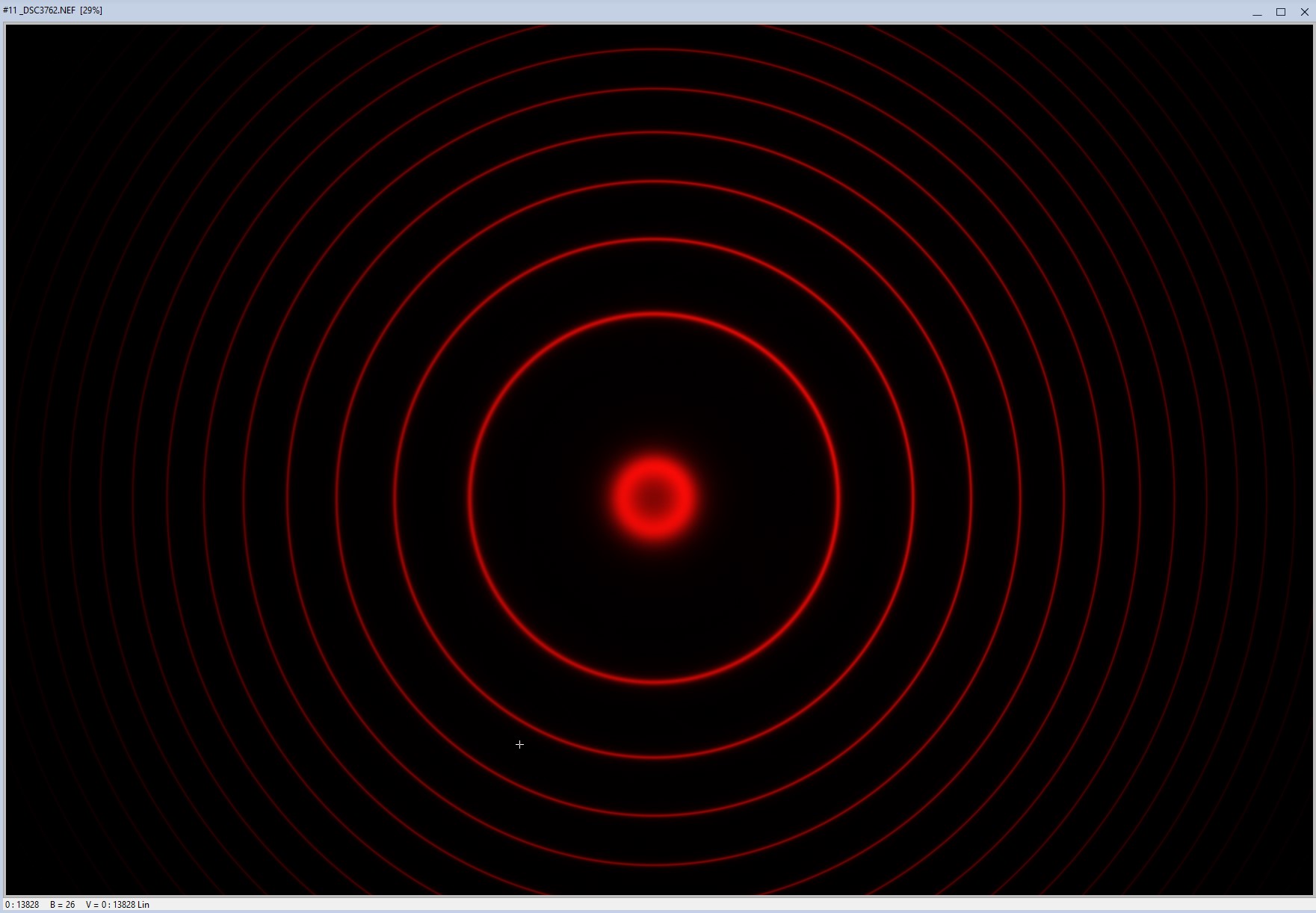
Lunt LS40FHa - Interference fringe pattern - Nikon Z6 - 85 mm S f/1.8 Nikkor lens at f/2.2 (i.e. 37.4 mm aperture) - 12-bit RAW file - 0.5 s - 100 ISO - 22 November 2024
Comments:
- The interference patern is quite uniform with a nice Lorentzian profile for the rings.
- The mesurements from the different rings are very consistent.
- There is a very slight improvement in the FWHM when the aperture is stopped down to 15 mm.
- The mesurements from the different rings are very consistent.
- There is a very slight improvement in the FWHM when the aperture is stopped down to 15 mm.

Spectro measurement in a collimated beam
Optical setup: Sun => etalon => Solex with 7 microns x 6 mm slit, fc = f i =200 mm, 2400 l/mm grating, ASI 290, 0.0471 A/pixel dispersion
Top image : spectrum transmitted by the etalon.
Bottom image : solar spectrum.
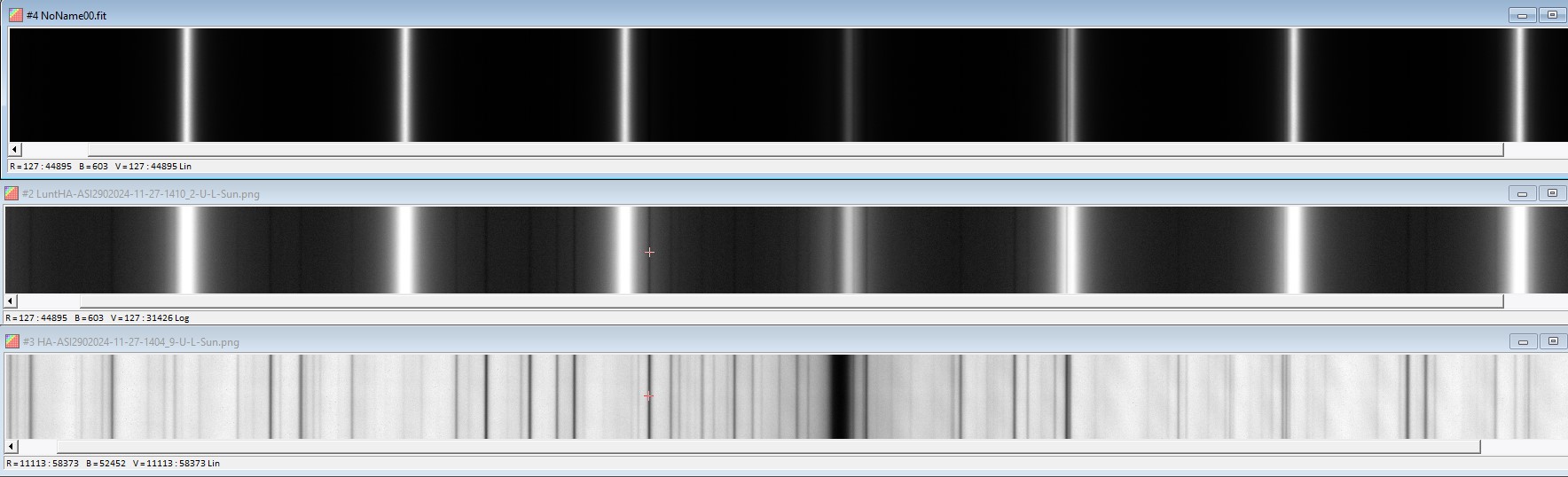
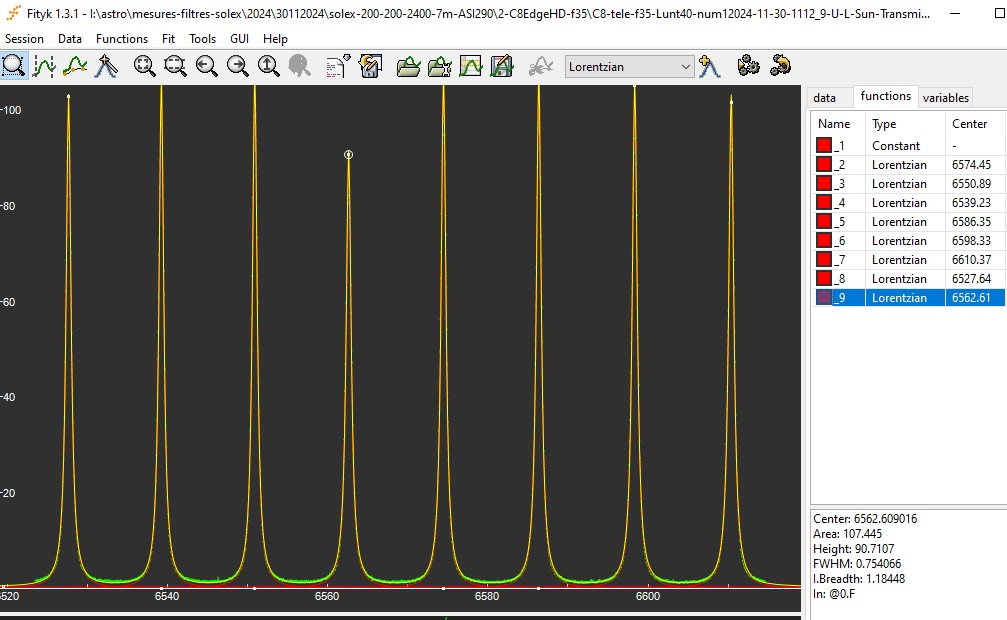
The transmission profile (= transmitted spectrum/solar spectrum) consists in textbook Lorentzian curves (curve fitting with Fityk).
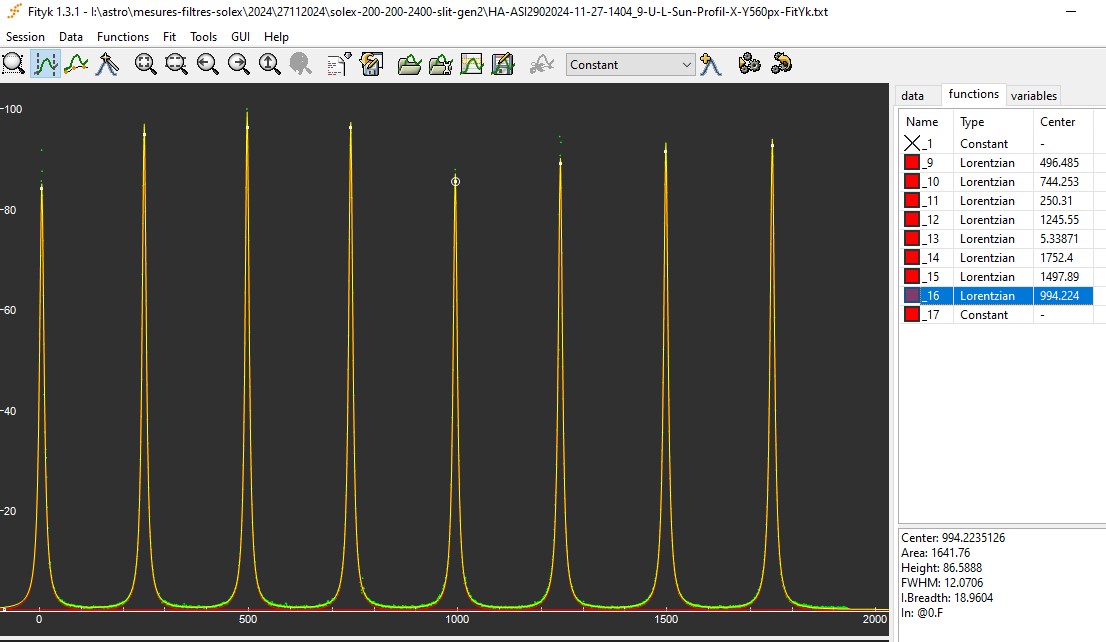
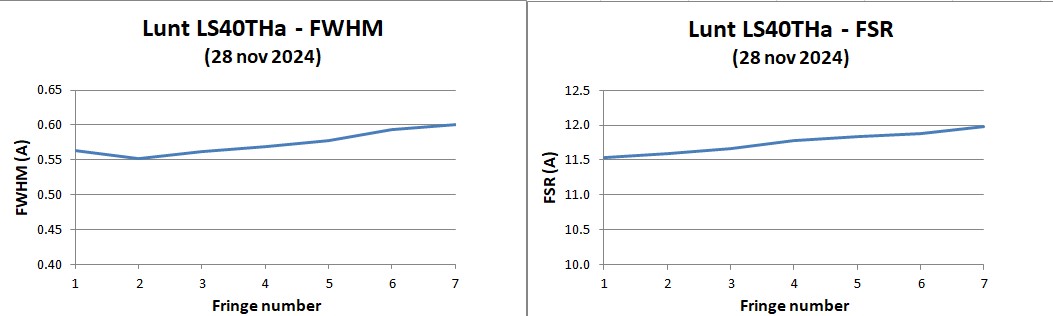
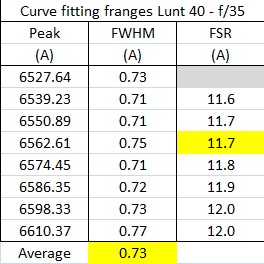
FSR increases with the order of interference (as expected). Fringe #4 is on Ha:
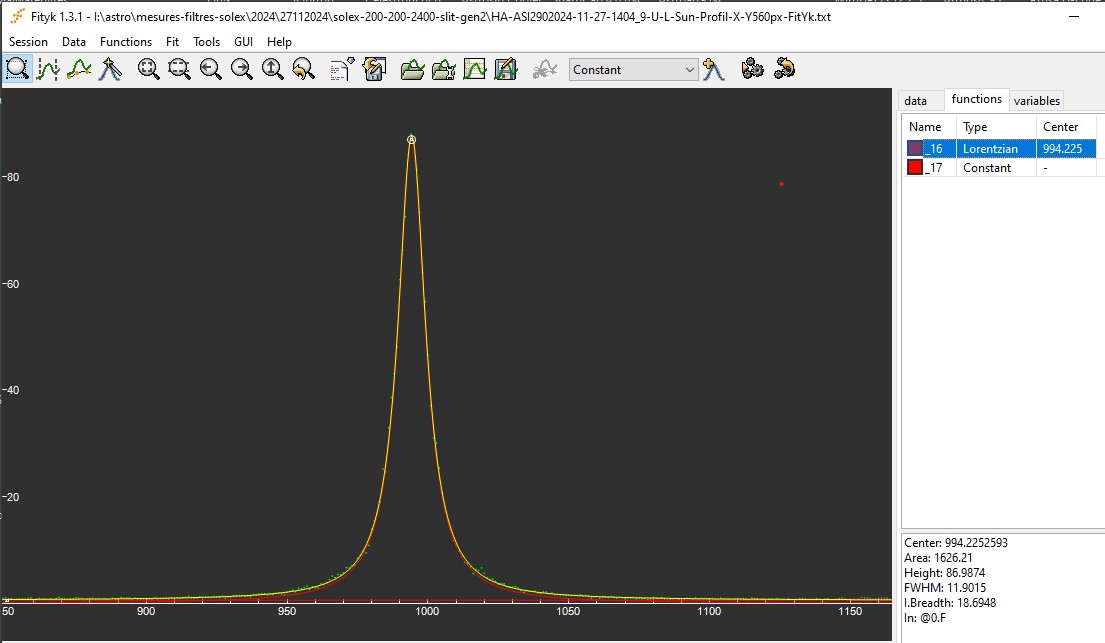
The values for Ha (fringe #4) are :
FWHM = 0.57 A and FSR = 11.8 A.
Spectro measurement in a f/35 telecentric beam
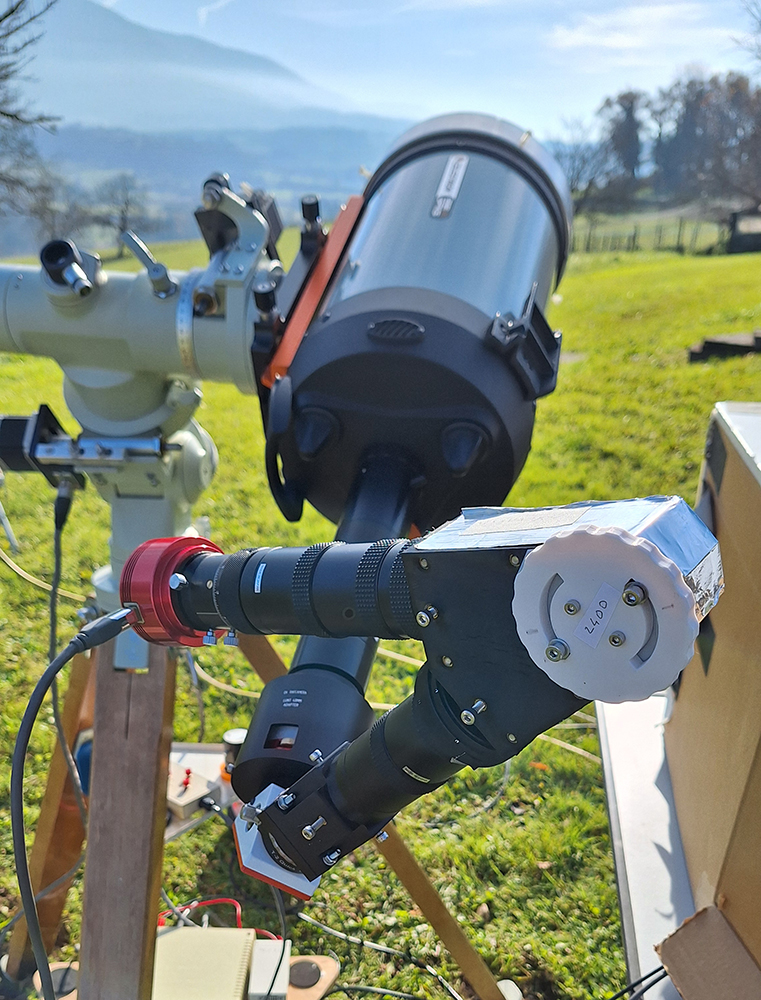
Optical setup: Sun => C8 EdgeHD => f/35 telecentric => etalon => Solex with 7 microns x 6 mm slit, fc = f i =200 mm, 2400 l/mm grating, ASI 290, 0.0471 A/pixel dispersion
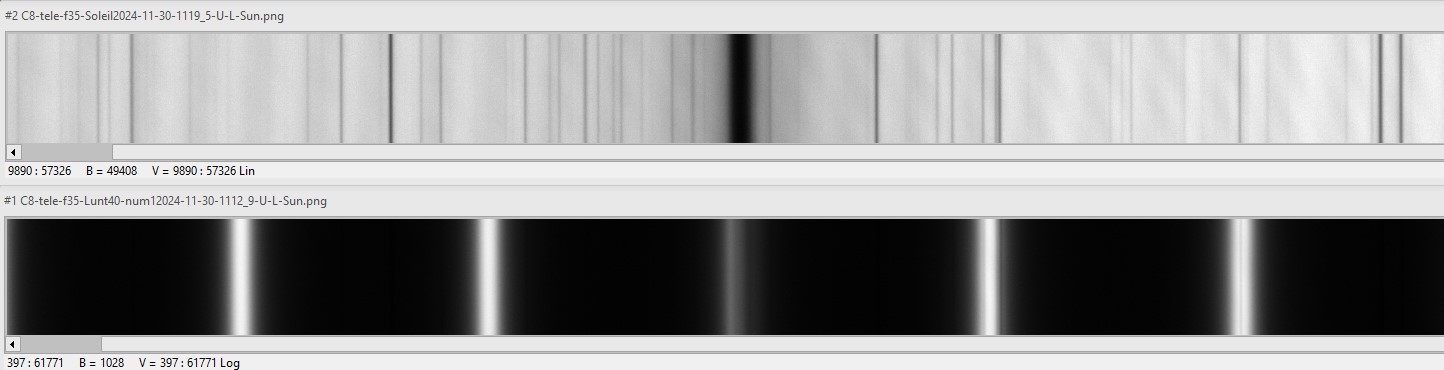
Curve-fitting done on etalon transmission = transmitted spectrum/solar spectrum :
Peak transmission
Optical setup: Sun => C8 EdgeHD => f/35 telecentric => etalon => Solex with 7 microns x 6 mm slit, fc = f i =200 mm, 2400 l/mm grating, IMX585, 0.0471 A/pixel dispersion
10 May 2025 - Sun elevation = 41°
Comparison of the intensity of the lines of the solar spectrum with / without etalon allows to estimate the peak transmissionn to about 59% at f/35 (including the ERF).
It is difficult to estimate the uncertainty of the measurement.The spectra without/with the etalon were taken at 4 min interval. Sky transparency might have changed in between.
By comparison, a second etalon without ERF was measured 20 min later at 68% without the ERF. This is consistent with the 10% absorption of the RG630 with 3 mm thickness.
Test of the etalon in Ha collimated beam
Optical setup: Ha lamp => 3 mm aperture stop => 55 mm f/8 collimating fluo doublet => etalon in collimated light (equivalent to f/146 ratio) => Nikon Z6 with 105 mm f/2.8 S macro lens
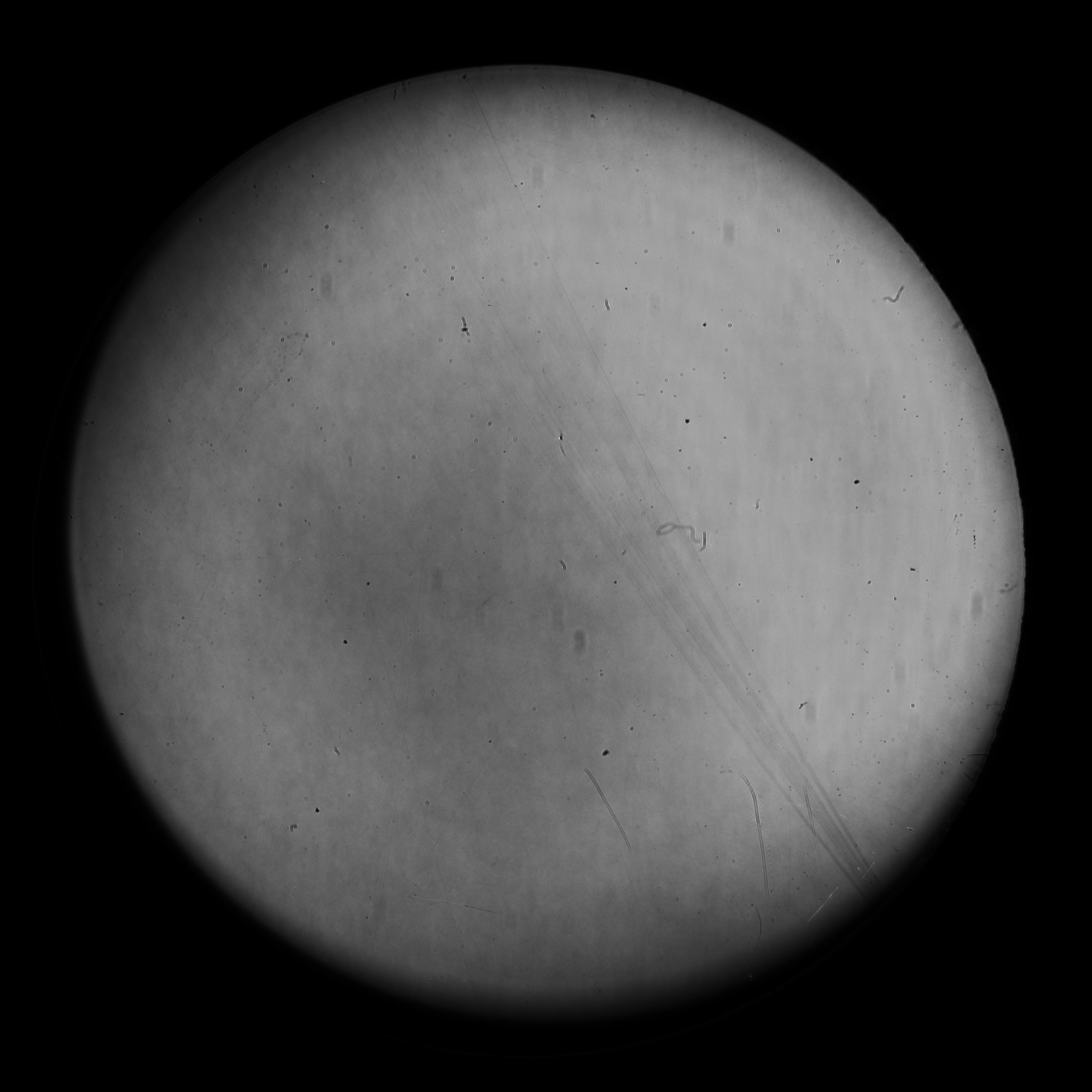
Comments:
This test is quite demanding and shows any on uniformity of the etalon. The etalon under test is clearly very uniform. Traces of the manufacturing process are visible.
Test of the etalon in Ha collimated beam - Impact of machanical compression
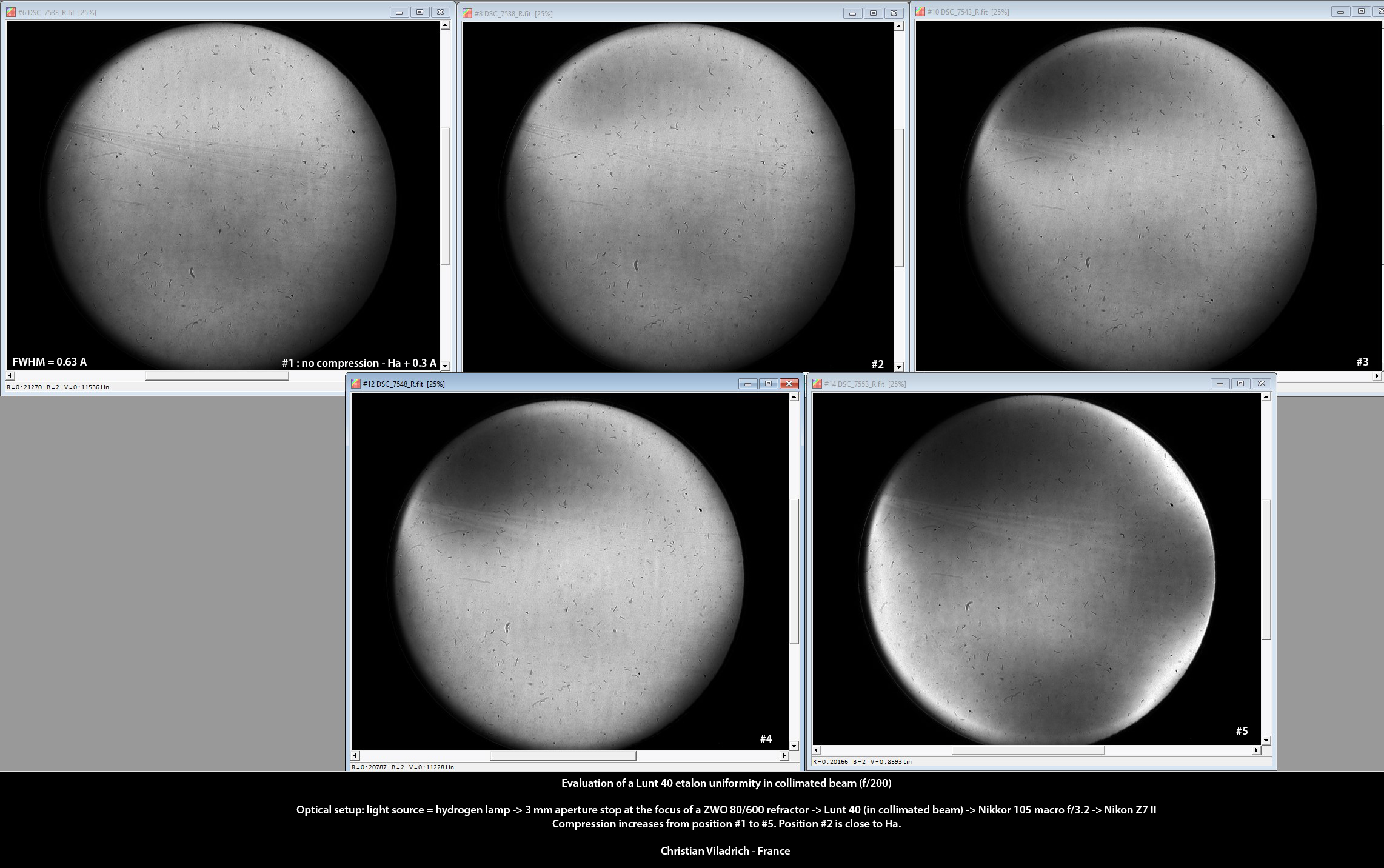
Optical setup: Ha lamp => 3 mm aperture stop => ZWO80/600 => etalon in collimated light (equivalent to f/200 ratio) => Nikon Z7II with 105 mm f/2.8 S macro lens at f/3.2
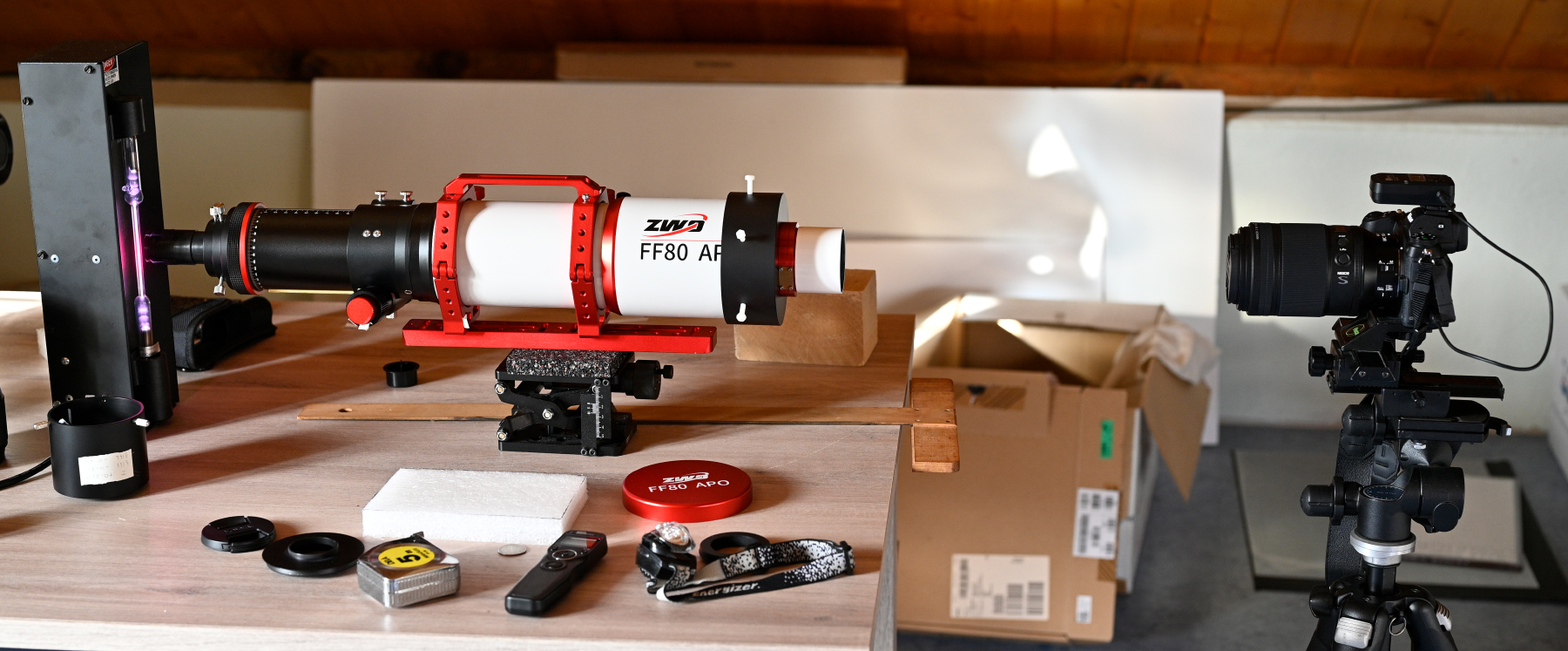
Increasing compression is applied to the rim of the etalon (through a PTFE washer):