Principe: the Fabry-Perot cavity is used as a Fabry-Perot interferometer
Optical setup: Hydrogen lamp => diffuser => etalon => Nikon Z7II with 85 mmS f/1.8 lens
Interference fringe pattern
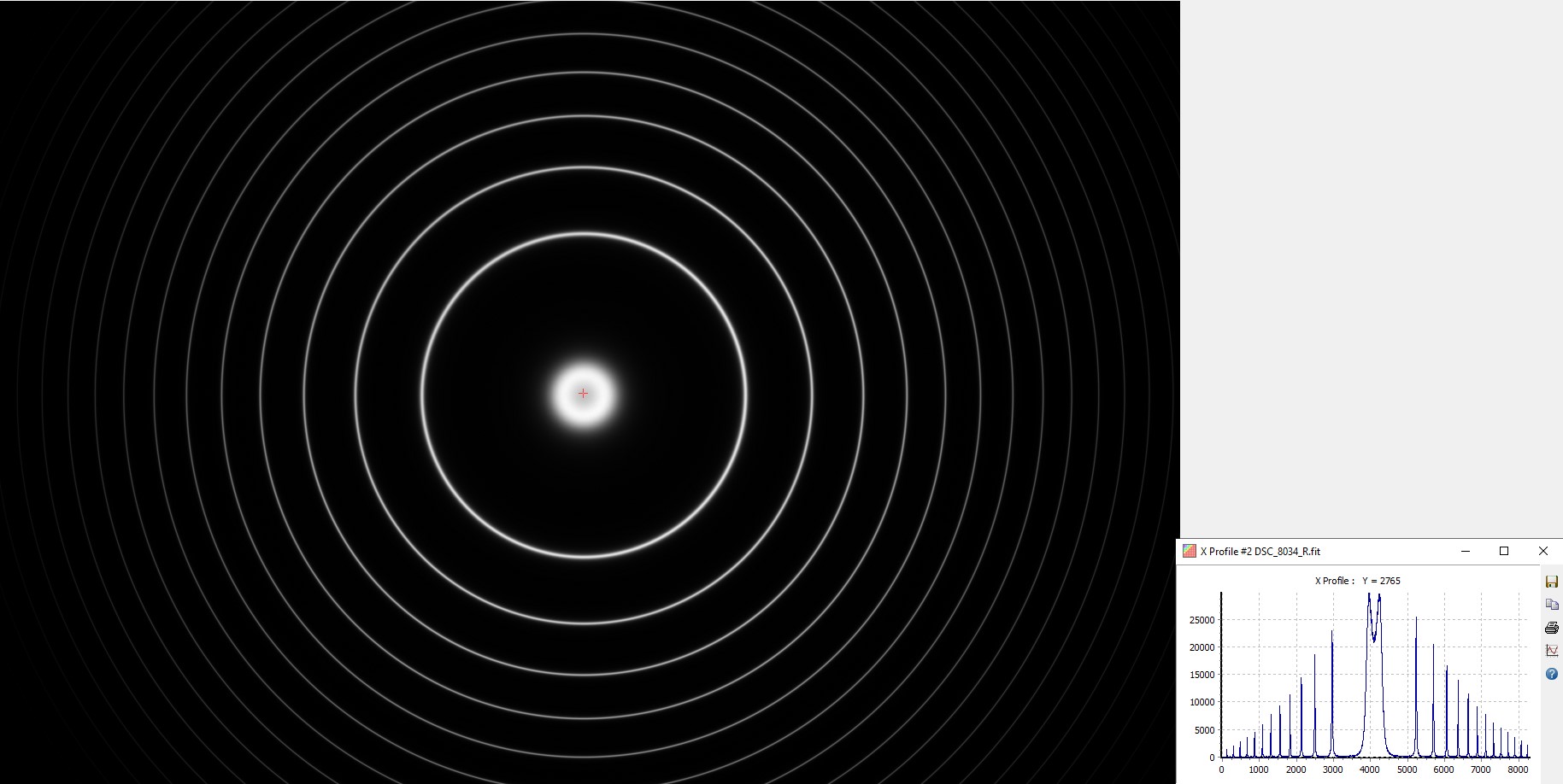
Lunt LS40 genII v1 - Interference fringe pattern - Nikon Z7II - 85 mm S f/1.8 Nikkor lens at f/1.8 - 12-bit RAW file - 1 s - 100 ISO - 17 June 2026
Comments:
- The interference patern is quite uniform with a nice Lorentzian profile for the rings.
- The mesurements from the different rings are very consistent.
Measurements were made at full-aperture (relevant for a use of the etalon in a collimated beam) and over a 21 mm diameter (relevant for a use of the etalon in a telescentric beam with the IMX432). Both measurements are very similar.
- The mesurements from the different rings are very consistent.
Measurements were made at full-aperture (relevant for a use of the etalon in a collimated beam) and over a 21 mm diameter (relevant for a use of the etalon in a telescentric beam with the IMX432). Both measurements are very similar.

Measurement of the etalon by spectroscopy in collimated beam using the Sun as a light source
Optical setup: Sun => Lunt 40 => ZWO 80/600 + 2× AP Barlow lens => SGH700
Configuration of the SHG 700 :
- slit placed placed preciselly at the focus of the ZWO80/600 (in order to have a collimated beam on the etalon,
- thanks to the use of the 2× AP Barlow lens, the f-ratio falling on the SGH700 slit is large enough (f/30) to prevent any vigneting on the grating. In other words, all the surface of the etalon is sampled by the grating (see Christian Buil, 2026, p 135 for technical explanations) ,
- 125 mm collimator, 2400 lpmm grating, 200 mm imaging lens, 10 microns × 4.5 mm slit, IMX585
- top image : solar spectrum,
- bottom image : solar spectrum transmitted by the etalon.
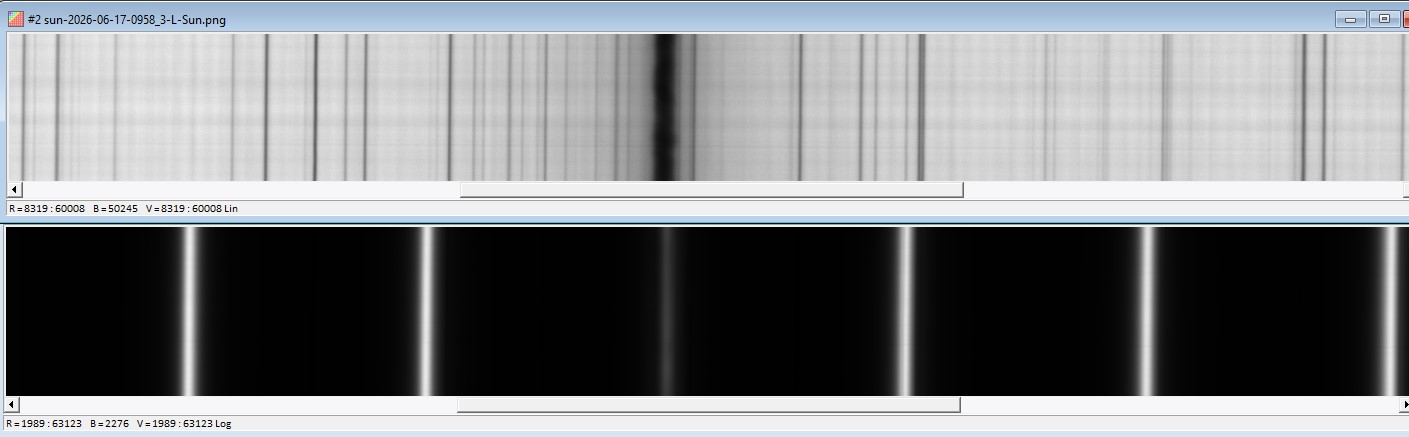
The transmission profile of the etalon (= transmitted spectrum:solar spectrum) is curve-fitted using Voigt functions in order to calculate the FWHM, FSR and delta CWL of the etalon.
FWHM = 0.48 A
FSR = 11.3 A
delta CWL = 0.18 A
NB : the FWHM is deconvoluated from the spread function (= spectral resolution) of the SHG700.