| Test method | f-ratio | Surface sampled | FSR | FWHM | Delta CWL | Note | |
| Coronado 90 mm (#1) |
Hydrogen lamp | 70 mm aperture |
9.9 A |
0.65 A |
+ 0.5 A | gap = 0.22 mm |
|
| Spectro | about 90 mm × 60 mm | 9.7 A | 0.70 A | + 0.4 A | |||
| Coronado 90 mm (#2) | Hydrogen lamp | 70 mm aperture | 10.3 A | 0.70 A | + 0.3 A | gap = 0.21 mm | |
| Spectro | about 90 mm × 60 mm | 10.1 A | 0.70 A | + 0.2 A |
Measurement in diffuse light using a hydrogen discharge lamp
In this test, the Fabry-Perot etalon is used as an interferometer. The surface of the etalon sampled is limited by the aperture of the lens of the camera. The FWHM, FSR and air-gap are derived from the measurements of the fringe system.
The optical setup is:
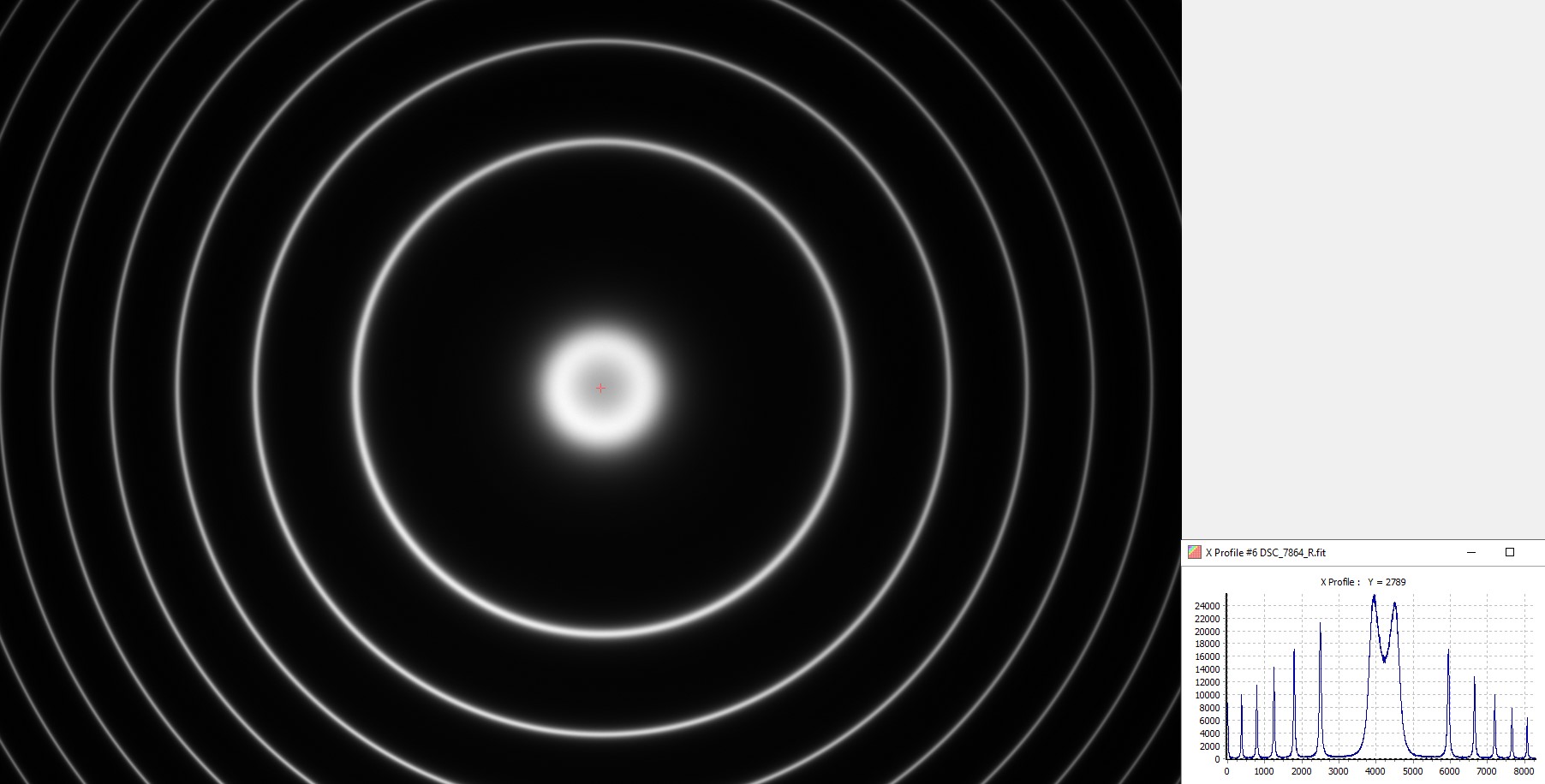
Optical setup:hydrogren lamp => diffuser => W25 filter or ERF (to remove hydrogen lines other than Ha) => etalon => 135 mm f/1.8 Sigma lens (focused to the infinite) with Nikon Z7 II.
Coronado 90 mm #1
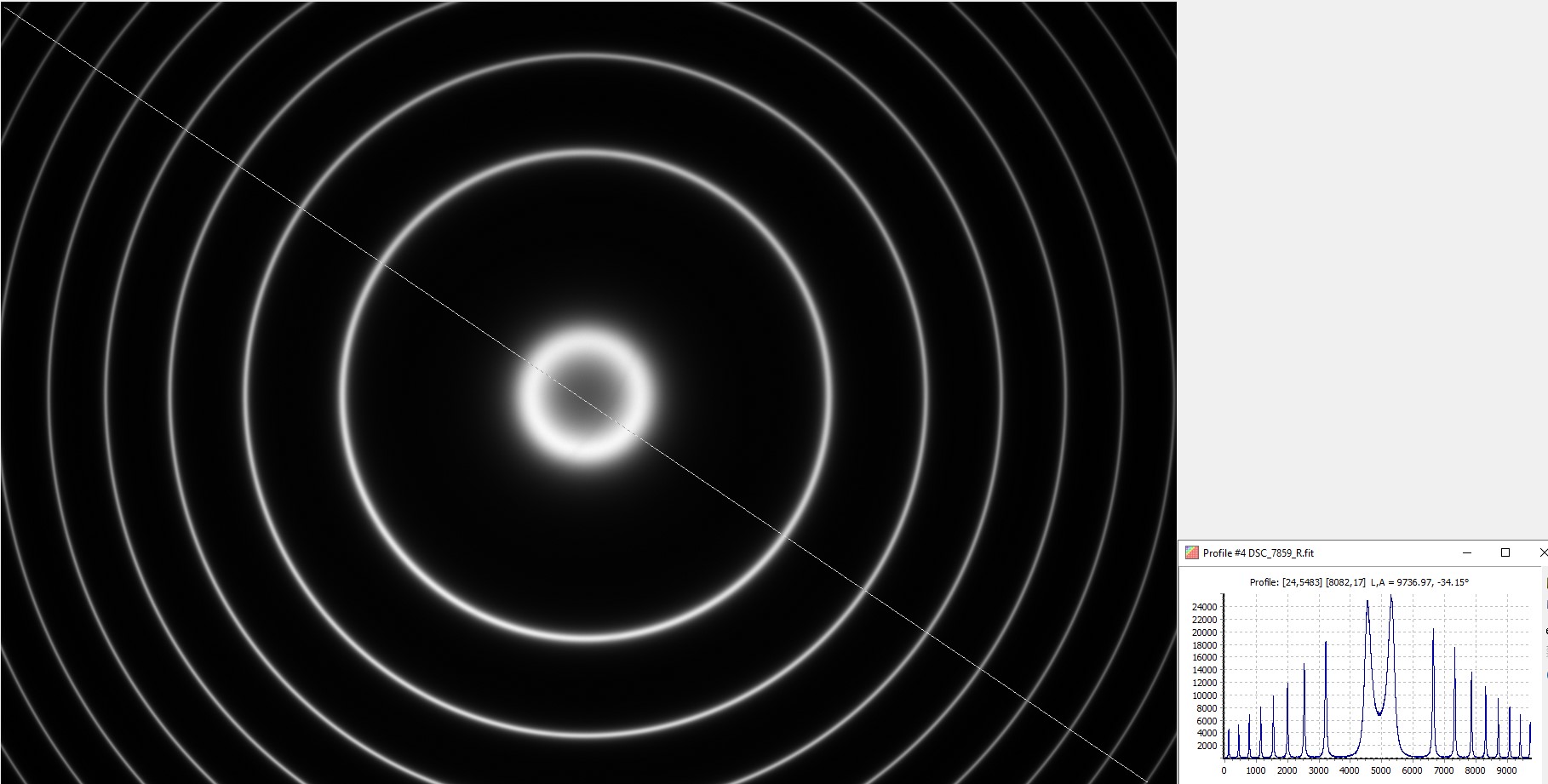
Sigma 135 mm f/1.8 - Nikon Z7 II - RAW mode - 14-bit acquisition - 0.25 s exposure time - 100 ISO

Coronado 90 mm #2

Measurement in collimated beam using a spectroscope
The optical setup is:
Optical setup: Sun => Coronado 90 etalon (no tilt) => Takahashi FSQ 106 ED + 2× Astrophysics Balow lens (effective f-ratio = 10.8) => SGH700
Configuration of the SGH 700 : 10 microns slit, 125 mm collimating lens, 2400 lpm grating, 200 mm imaging lens, IMX585
Important note : given the f-ratio of the refractor (f/10.8), the focal length of the collimating lens, and the grating size (25 mm × 25 mm) , the sampled aperture of the Coronado etalon is about 90 mm × 60 mm. An f-ratio of f/16 would be required to avoid vigneting by the grating and sample the full aperture of teh etalon
Coronado 90 mm #1 (no tilt)
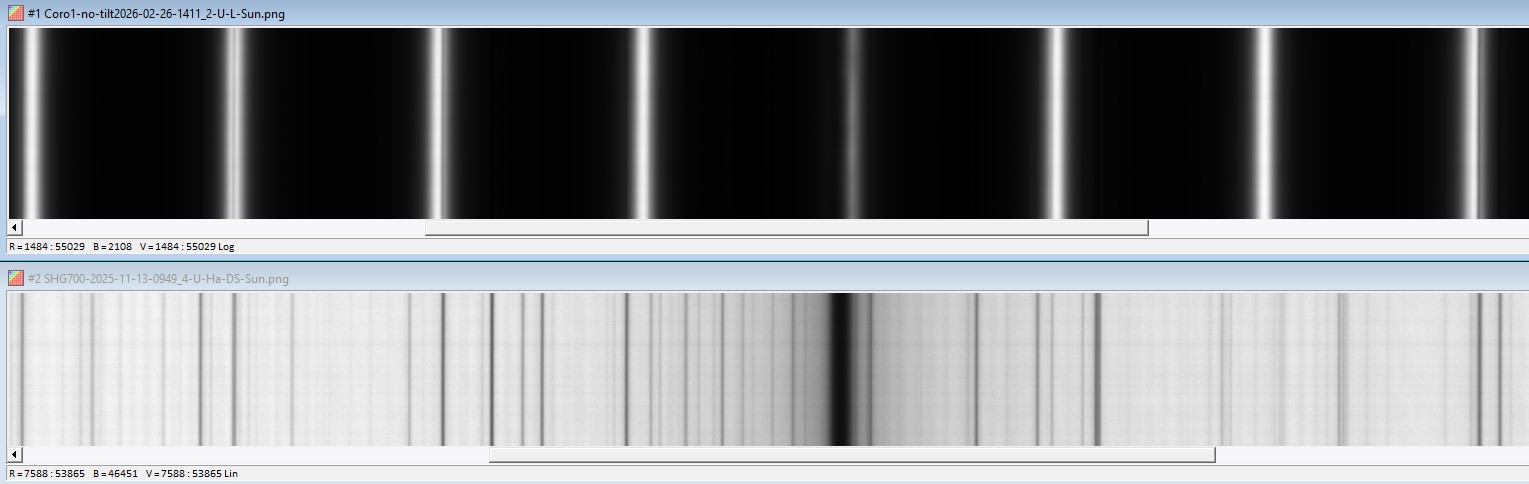
FWHM is estimated based on the transmission profile of the etalon (curve fitting using Voigt function). The average over the four peaks of transmission next to Ha is taken.
FHWM = 0.70 A - FSR = 9.7 A - delta CWL = + 0.4 A
Coronado 90 mm #2 (no tilt)
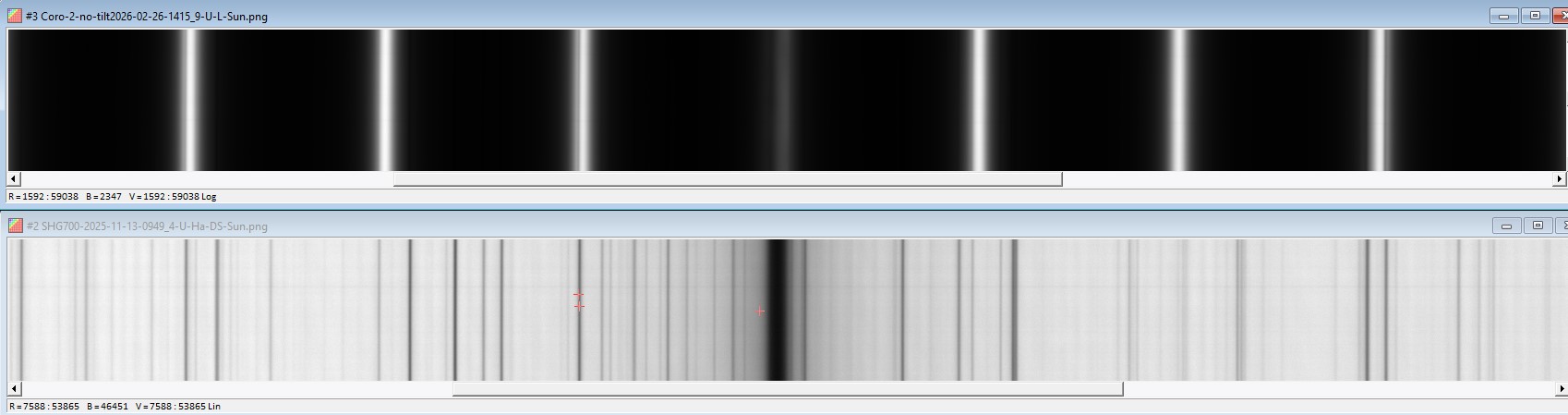
FWHM is estimated based on the transmission profile of the etalon (curve fitting using Voigt function). The average over the four peaks of transmission next to Ha is taken.
FHWM = 0.70 A - FSR = 10.1 A - delta CWL = + 0.16 A