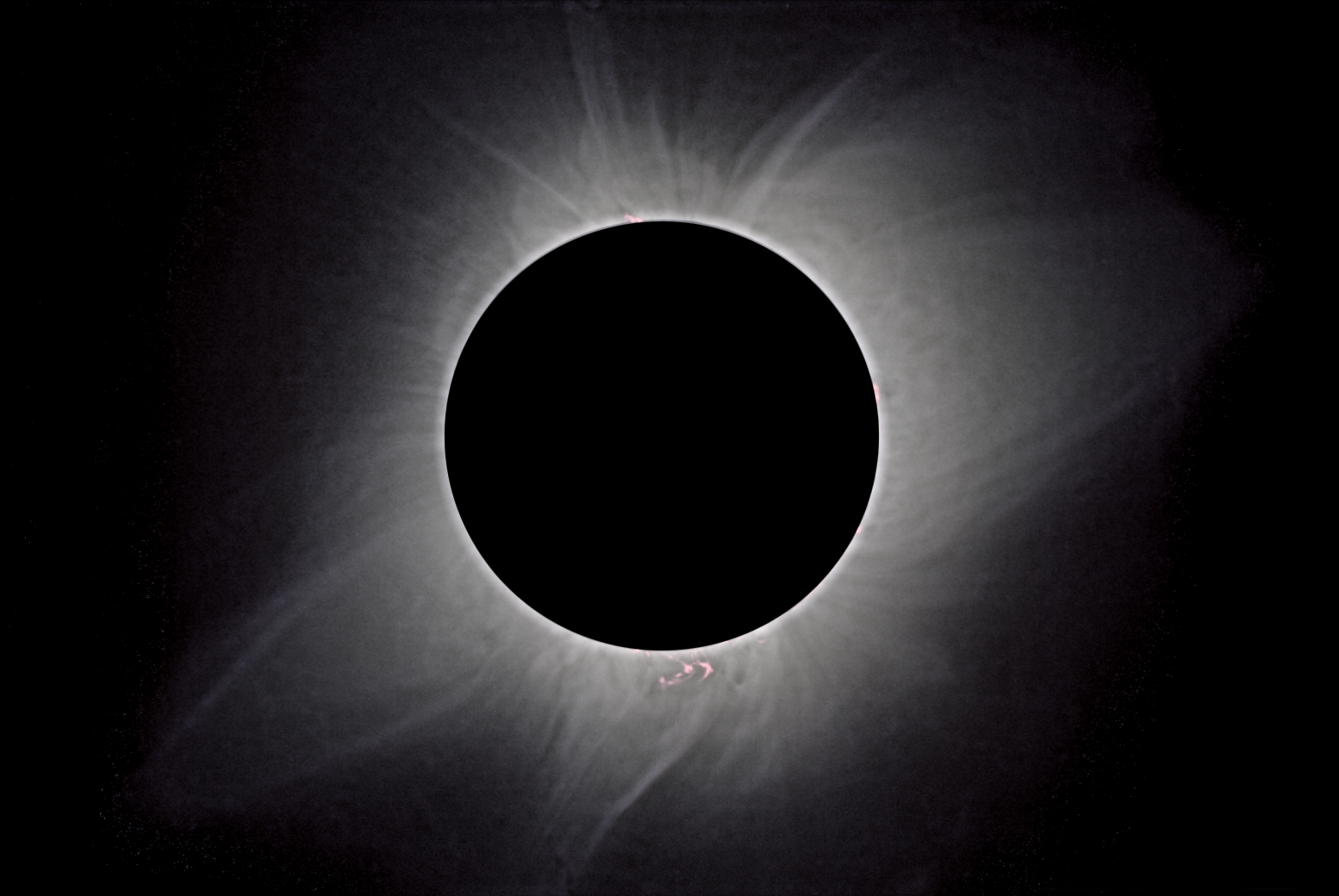
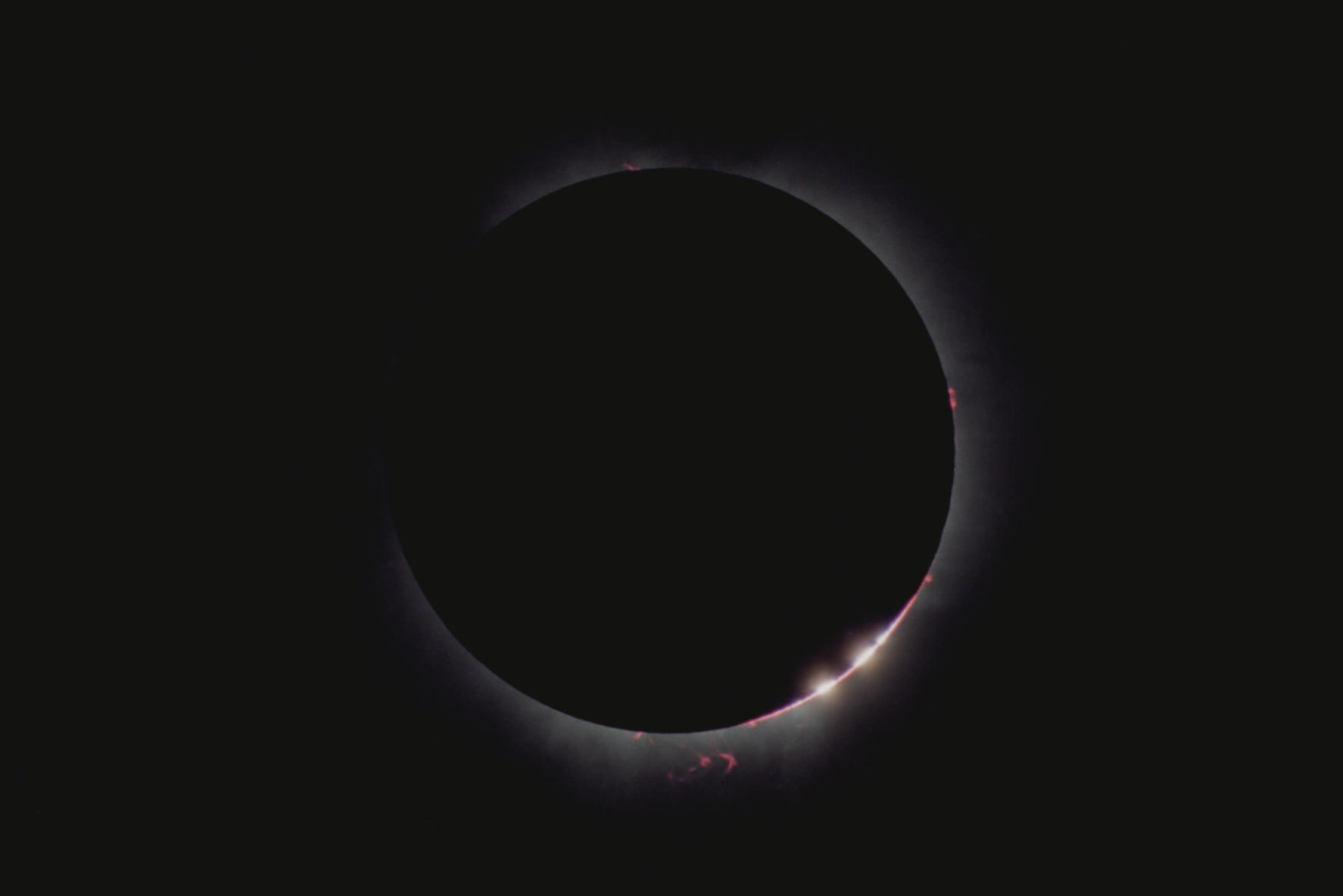
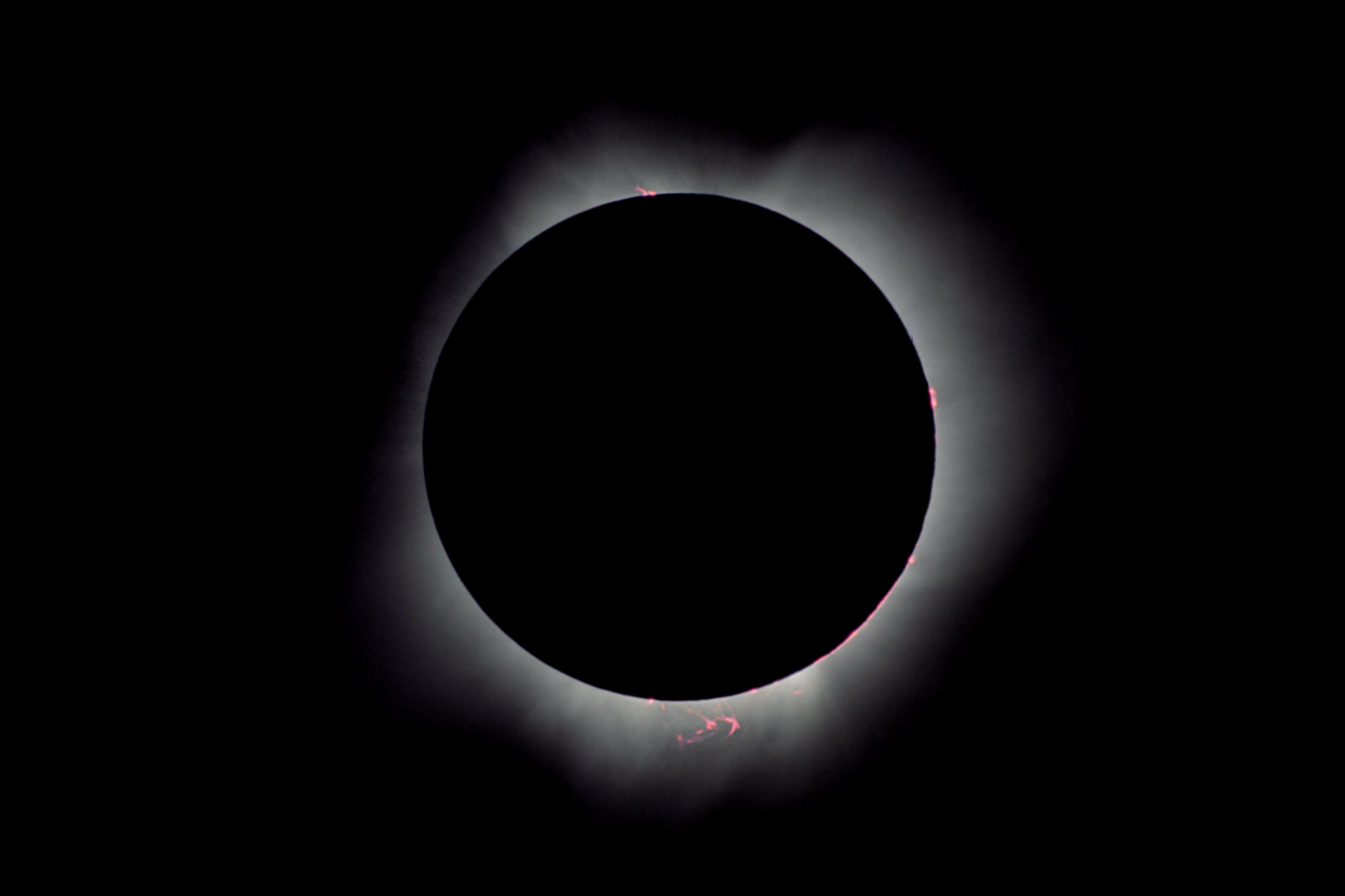
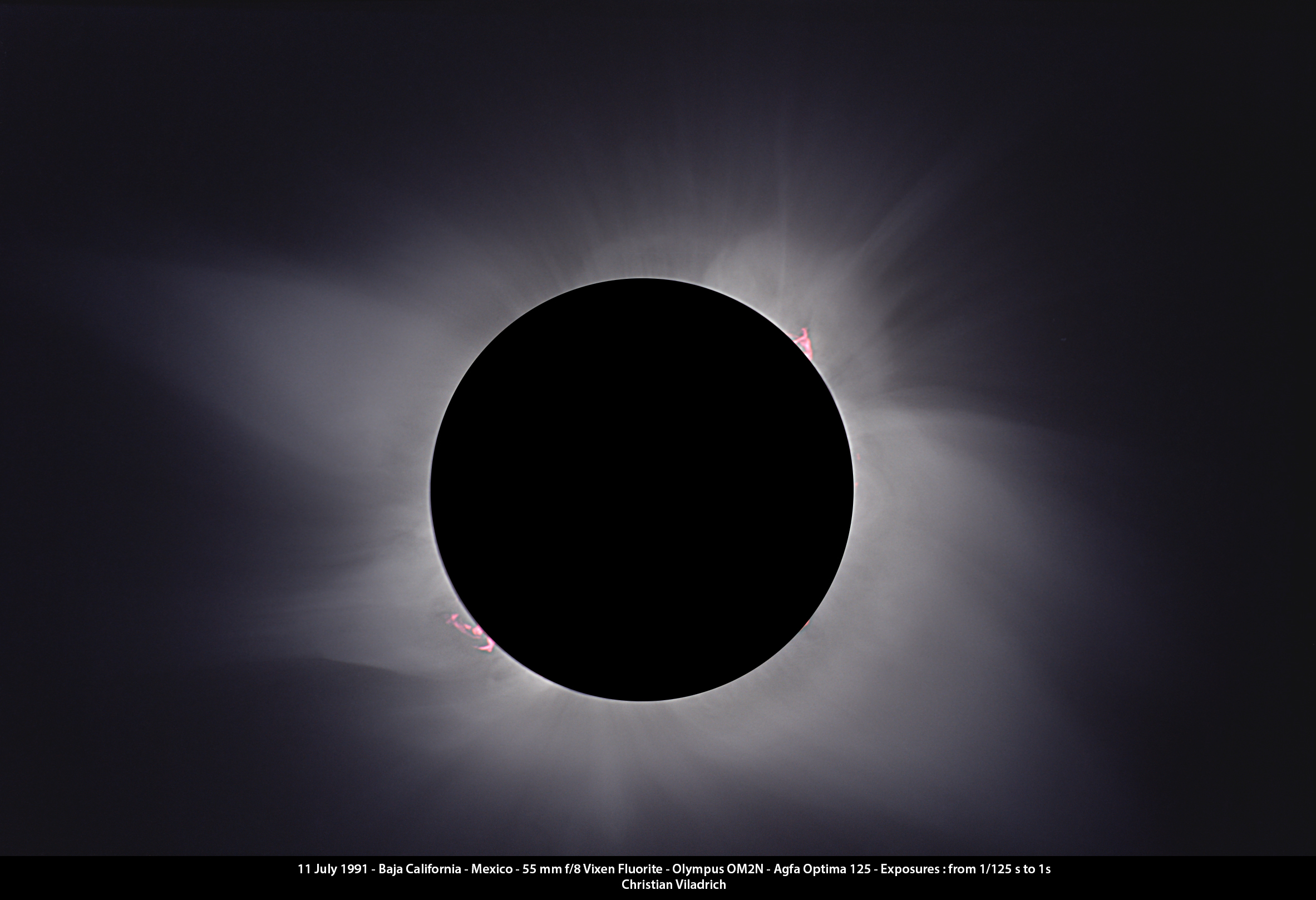
11 July 1991
Baja California - Mexico
"The Big One"
Local circumstances

Location : pacific coast east of San Jose del Cabo
Duration of totality : 6 mn 26s
Conditions of observation
Equipment:
Vixen 55 mm F/8 fluorite with 2× Clavé Barlow lens.
Olympus OM2n camera with astro focusing glass + Varimagni 2.5× + winder 2.
Agfa Optima 125 ISO negative film.
Exposure times for totality : from 1s to 1/125 s (at 1 EV interval).
Scanner Reflecta RPS 10:
- negatives are scanned at 5000 dpi (= 5.08 microns pixel), actual resolution measured on resolution target is 3600 dpi,
- sampling = 0.91 arsec/pixel,
- scratch correction using IR diode (iSRD mode 13-5-2),
- negative scanned as positive (3x16 bits) in order to record the full dynamic range of each negative.
Mount : Takahashi EM1S mount
Seeing conditions : deep blue sky, Sun near zenith
FWHM of 3.5 mag star measured on RAW image = 6.0 pixels (= 5.5 arsec).
1) Pre-processing
- dust/scracth correction using Photoshop clone tool,
- color correction using Photoshop:
- negative transformation (in order to get positive images),
- color correction using the curve tool (linear curves). Criteria : the corona is white (to a good approximation) as well as the faintest part of the sky background. Color correction applied checked on a color target image taken with the same negative.
- underexposed sky back ground is then clipped to remove noise and scratches in this part of the images.
- images are binned 3 × 3 resulting in 2.7 arsec/pixel sampling.
2) Registration of the image on solar corona
- registration of in translation and rotation using two prominences as references, and also mag 3.5 for 1 s to 1/8 s exposures.
3) Composite image
- addition of all exposures from 1 s to 1/125 s,
4) Display of composite image
- log visualisation,
- local increase of contrast for inner and intermediate corona (= change of gamma),
- unsharp masks with different parameters for inner and intermediate corona.
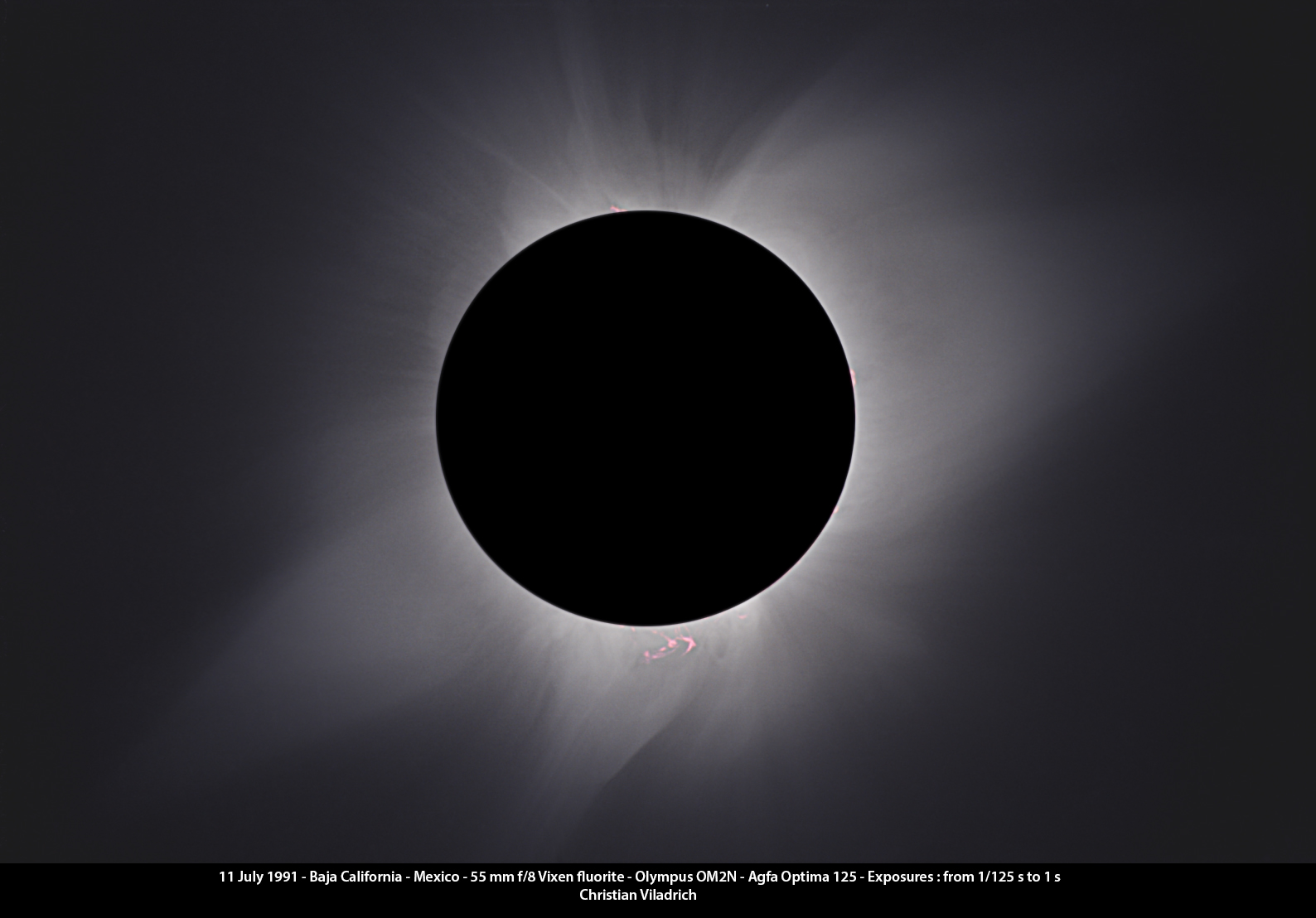
More agressive processing using Local Histogram Equalization in AstroArt 9: